The most elusive black holes (BHs) in the Universe are not large and not small, but medium in size. These are black
The authors of the new study hope to useLISA mission (Laser Interferometer Space Antenna, Russian laser interferometer space antenna). The European Space Agency plans to launch this gravitational wave detector in 2037. The observatory will detect subtle gravitational waves—ripples in space-time first predicted by Einstein.
Similar ground-based observatories such asThe Laser Interferometer Gravitational-Wave Observatory (LIGO) and Virgo have already made huge strides in detecting stellar-mass black hole mergers, but these instruments are not sensitive to the frequencies needed to detect signals from something larger.
LISA will consist of three satellites,orbiting the Sun, which will constantly track the distances between them. When a gravitational wave passes, the satellites will detect a telltale signature.
To find IMBH, astronomers have to hopefor luck. If an IMBH at the galactic center were to capture a stray dense remnant (such as a smaller black hole, neutron star, or white dwarf), the process would produce gravitational waves that LISA would potentially detect.
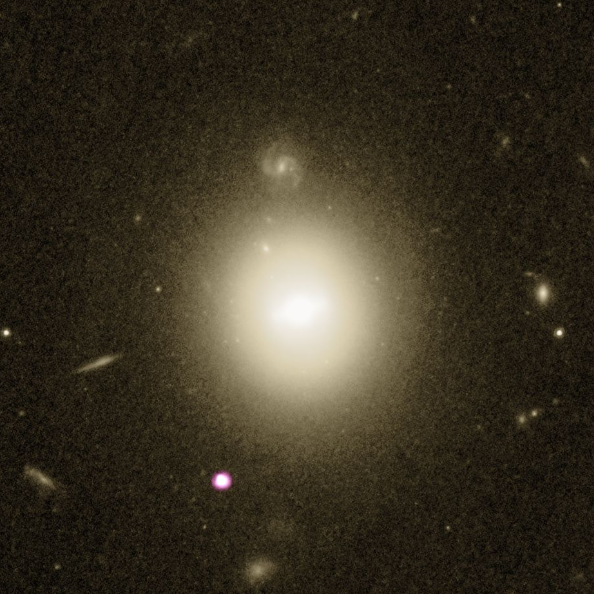 The bright galaxy 6dFGS gJ215022.2-055059 is believed to contain an intermediate-mass black hole. Image credit: NASA/CXC/UNH/D. Lin et al.
The proposed method is far from perfect: LISA will be able to detect PMBMs only if they have a mass range from 1,000 to 100,000 solar masses.
Read more:
"Sea" of quarks inside one proton: what does an elementary particle consist of
Look at the highest resolution map of Mars: 110,000 frames and 5.7 trillion pixels
Scientists have studied an ultra-bright object that violates the law of physics
Cover photo: X-ray clouds at the center of the Milky Way reveal a supermassive black hole and possibly other even more exotic objects
Image courtesy of ESA/XMM-Newton/G. Ponti et al. 2019