Analyzing data from the Spektr-RG (SRG) spacecraft and NASA’s satellite for studying transit
Cataclysmic variablesvariables, CV) are binary star systems that consist of a white dwarf accreting material from a normal stellar companion. Cataclysmic variables are stars whose brightness non-periodically increases many times, after which it decreases to the level of a quiet state. And polars are a subclass of cataclysmic variables that differ from other CVs by the presence of a very strong magnetic field in their white dwarfs.
Recently, a group of astronomers led by SametOka from the Leibniz Institute for Astrophysics Potsdam (AIP) in Germany analyzed observations of the field of the open cluster NGC 2516 using the eROSITA Spektr-RG X-ray telescope and TESS and discovered a new CV.
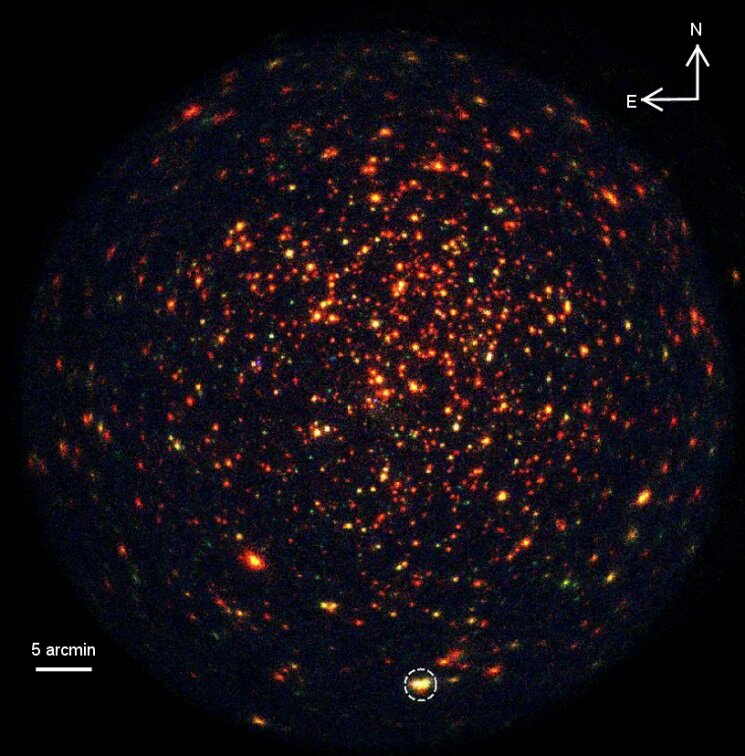 X-ray image of NGC 2516 obtained by eROSITA. The white dotted circle marks the position of SRGE J075818-612027. Photo: Ok et al, 2023
SRGE J075818-612027 was identified as one of the brightest X-ray field objects during the eROSITA Calibration and Performance Verification (CalPV) observing phase.
Further observations of SRGE J075818-612027 revealed its variability with a period of about 106 minutes. It is also a magnetic cataclysmic variable.
According to the study, the X-ray spectrum of SRGEJ075818-612027 is compatible with single-temperature thermal plasma radiation at levels around 10 keV, which is typical for polars. In addition, the object exhibits large differences in magnitudes over long time scales in both optical and x-ray wavelengths. This behavior can be interpreted as high and low states, which also supports its classification.
Read more:
Named a vitamin that protects the brain from dementia
See how the Earth has changed over 100 million years on the most detailed map
It turned out which men are the most fertile: their sperm is 50% better than the rest
Cover photo: NARA & DVIDS Public Domain Archive