Researchers at Southwestern Texas State University have shown that the enzyme Fic workslike a thermostat,
Back in 2018, researchers showed that flies,constantly exposed to bright light, which damages their eyes, suffered permanent damage if they had the Fic gene removed. However, the role of this enzyme in mammals has so far been unclear.
To answer this question, researchersmodified the genome of mice by blocking the gene responsible for the production of the Fic enzyme. At the first stage, the edited animals did not differ in any way from normal mice from the same litter. Scientists did not feed the animals for 14 hours, and then opened unlimited access to food for two hours, thereby creating stress for the pancreas.
It turned out that animals with enzyme deficiencyshowed a much higher response to stress than their siblings. Further research showed that a molecular pathway called the unfolded protein response (UPR), which is activated when stressed cells cannot keep up with the formation of new proteins, was more strongly activated in Fic-deficient animals.
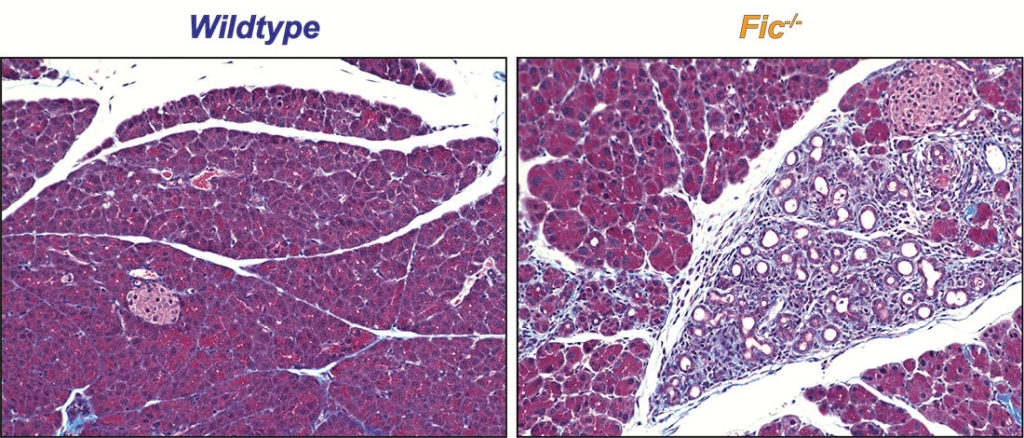 Animals lacking the Fic gene (right) were more likely to develop scarring in the pancreas after recovery. Image: UT Southwestern Medical Center
The researchers reached similar conclusions whenmice were injected with a drug called cerulein, which acts on the pancreas, causing an increased release of digestive enzymes. Animals without the Fic gene tolerated impaired enzyme production much worse.
Researchers note that uncontrolledcellular stress response and UPR play a role in the development of many diseases. If scientists can figure out how the “stress thermostat” works, they can artificially control it to treat cancer and neurodegenerative diseases.
Read more:
An asteroid with a diameter of half a kilometer approaches the Earth
Giant 'scar' on Earth's surface shown from space
It turned out what happens to the human brain after one hour in the forest