In 2013, a research team led by Nobel Prize winner in Physiology or Medicine
This left a mark on the biology of Homo sapiens:The DNA of representatives of various non-African peoples contains from 1 to 4% of the Neanderthal genome. These genes influence the development of protective reactions of the immune system and resistance to diseases.
Still about how the Homo themselves livedNeanderthalensis, very little is known. To solve this mystery, an international team of scientists led by the Max Planck Institute for Evolutionary Anthropology in Leipzig studied the genomes of several representatives of one group of an ancient species for the first time.
Who are the Neanderthals?
Neanderthals - an extinct species or subspecies (scientistsstill not come to a consensus) ancient people. For a long time they inhabited the territory of Eurasia, first separately, and later together with the ancestors of Homo Sapiens.
About 40 thousandyears ago, Neanderthals became extinct. Researchers have no consensus on how this happened. Possibly small populations, competitive ancestral replacement of modern humans, disease, or major climatic changes that these early humans failed to adapt to are to blame. It is likely that all these factors played a role to some extent, but what became the "trigger" is not known.
It is also unknown when the Neanderthals split off.from the ancestors of modern humans. Different researchers date the formation of two species (subspecies) from 315 to 800 thousand years ago. But it is reliably known that even after the separation, crossings between them continued. The oldest bones that could belong to the Neanderthal date back to about 430 thousand years ago, but it has not yet been possible to unequivocally identify their belonging to this species.
Neanderthal bones were first discovered in 1856year in the Neander Valley in what is now Germany. For a long time, researchers portrayed the representatives of this species as rude barbarians. It is now known that these ancient people had advanced technologies for their time. Nevertheless, the stereotype of Neanderthals as primitive, non-evolved barbarians is still popular in popular culture.
What have anthropologists studied?
In their work, the researchers analyzedremains of Neanderthals from Chagyrskaya Cave and Okladnikov Cave, located in Siberia in the south of the Altai Territory, less than 100 km from the famous Denisova Cave.
Excavations in the Chagyrskaya cave have been carried out for the last 14years under the guidance of researchers from the Institute of Archeology and Ethnography of the Russian Academy of Sciences. In addition to several hundred thousand stone tools and animal bones, scientists have also discovered more than 80 Neanderthal bone and tooth fragments, which is one of the largest archaeological collections of the remains of these ancient people.
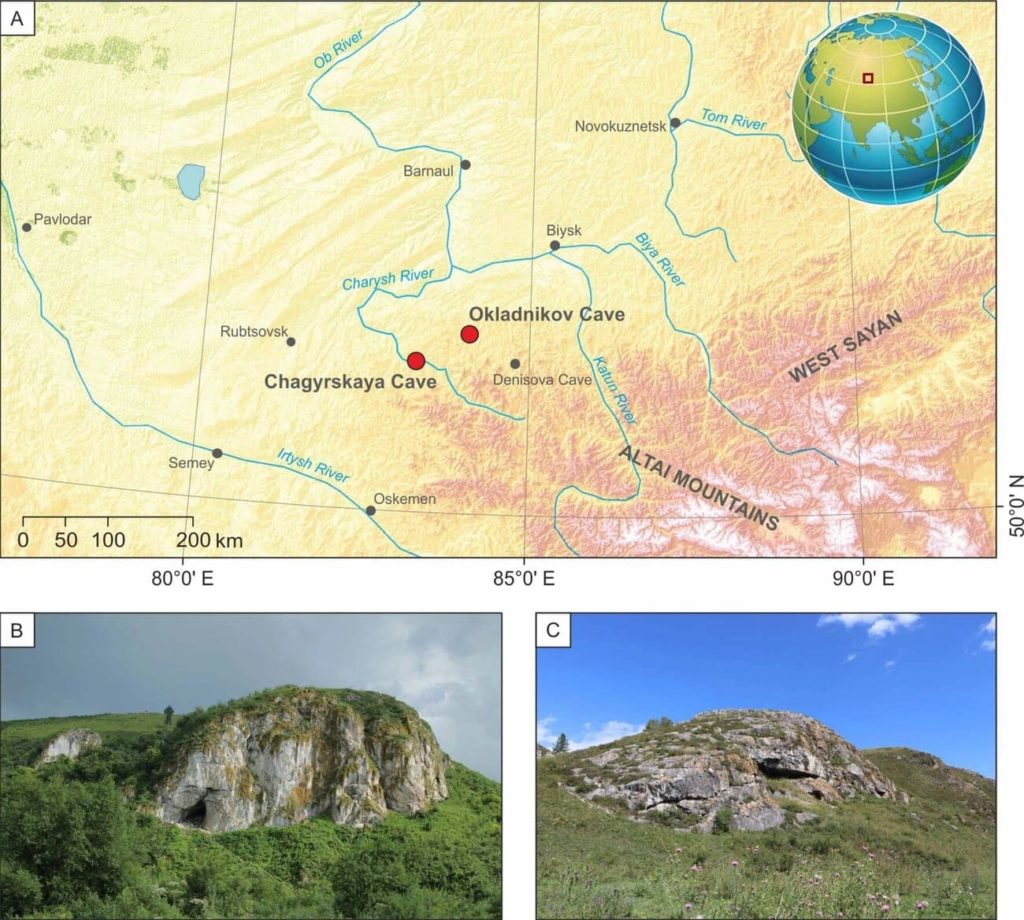 Chagyrskaya cave (left) and Okladnikova cave (right). Image: Laurits Skov et al., Nature
Previous studies have shown thatNeanderthals and Denisovans have lived in this region for hundreds of thousands of years and interacted with each other, as evidenced by the discovery of a child born to a Denisovan father and a Neanderthal mother.
Despite the long history of settlement by ancientspecies of this region, Chagyrskaya Cave and Okladnikova Cave were used by ancient people for a short time about 54 thousand years ago. Due to this, all fossil bones belong to approximately the same period and may be the remains of representatives of the same social group.
During the study, the scientists collected andsequenced the genomes of 17 ancient human remains. The study showed that they belong to 13 Neanderthals - seven men and six women. Among them were eight adult Neanderthals and five children or teenagers.
First confirmed relatives
To determine if any remains occurredfrom related individuals, the scientists calculated the discrepancy in a random sample of 250,785 genome regions for nuclear DNA, and also analyzed the heteroplasmy of mitochondrial genes. This is a special type of genetic variant that lasts only for a small number of generations, usually no more than three.
Among the ancient remains, scientists have found the remains ofNeanderthal father and his teenage daughter. In addition, the scientists also found two people who were second-degree relatives: a young boy and an adult woman. She could be his cousin, aunt or grandmother.
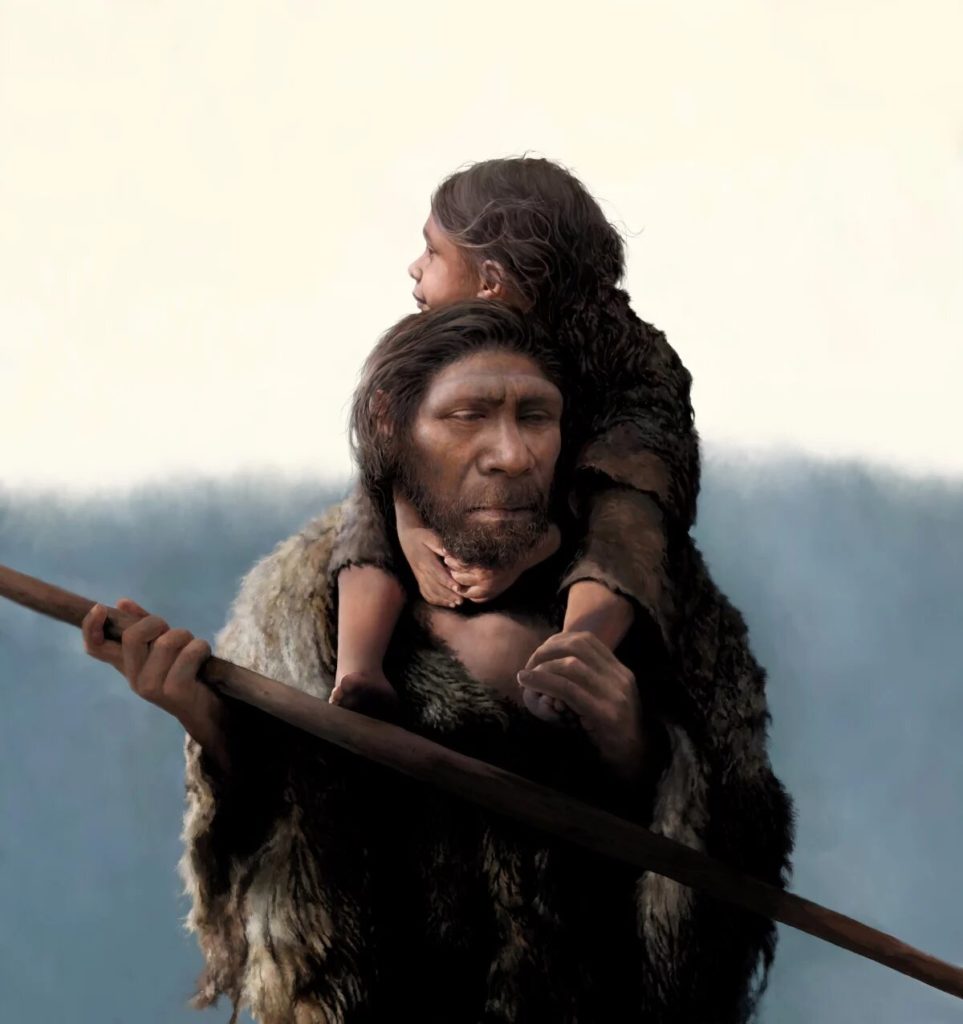 Neanderthal father with daughter. Artistic Illustration: Tom Bjorklund
This discovery shows that Neanderthals inPeople lived and died in the Chagyr cave at about the same time, scientists say. At the same time, according to one of the authors of the work, Laurits Skova, “this is the first time that genetics has been used to study the social organization of a group of Neanderthals.”
Social interactions
In addition to establishing family ties,The researchers also note extremely low genetic diversity in this Neanderthal community. Variations between genomes in different remains correspond to groups containing only 10 to 20 individuals. This bears little resemblance to modern societies of humans and apes, with the exception of mountain gorillas. This species is endangered. Perhaps this explains the similarity.
But still groups of Neanderthals did not live in fullisolation, scientists say. By comparing the genetic diversity of the Y chromosome passed down from father to son with the diversity of mitochondrial DNA passed down from mother to child, the researchers found that female diversity is much higher than that of males.
This means that genetic diversityprovided mainly by the migration of females. Summarizing, scientists draw the following picture: Neanderthals, at least in the most recent period, lived in small groups consisting of 10-20 related individuals. At the same time, girls who reached puberty left the community to enter into relationships with representatives of other groups.
Genetic research for the first time allowedlook into the history of an ancient species, the representatives of which are so little known. The researchers hope that future finds in other ancient human habitats will show how social habits have changed over time and in different places.
Read more:
A monster black hole was found in the "backyard" of the Earth: it is very close to our planet
NASA revealed the origin of Haumea - the most mysterious planet in the solar system
Webb photographed the Pillars of Creation. Compare how Hubble shot them before
Cover: Artist: John GurchePhotographer: Chip Clark, CC0, via Wikimedia Commons