The bipedal dinosaur Issi saaneq was a herbivorous dinosaur that lived in what is now
Scientists conducted micro-computed tomographybones to create digital 3D models of internal structures and bones. “The anatomy of the two skulls found is unique in many ways, such as the shape and proportion of the bones. These samples certainly belong to a new species, ”said lead author Victor Beccari, who performed the analysis at the University of Lisbon NOVA.
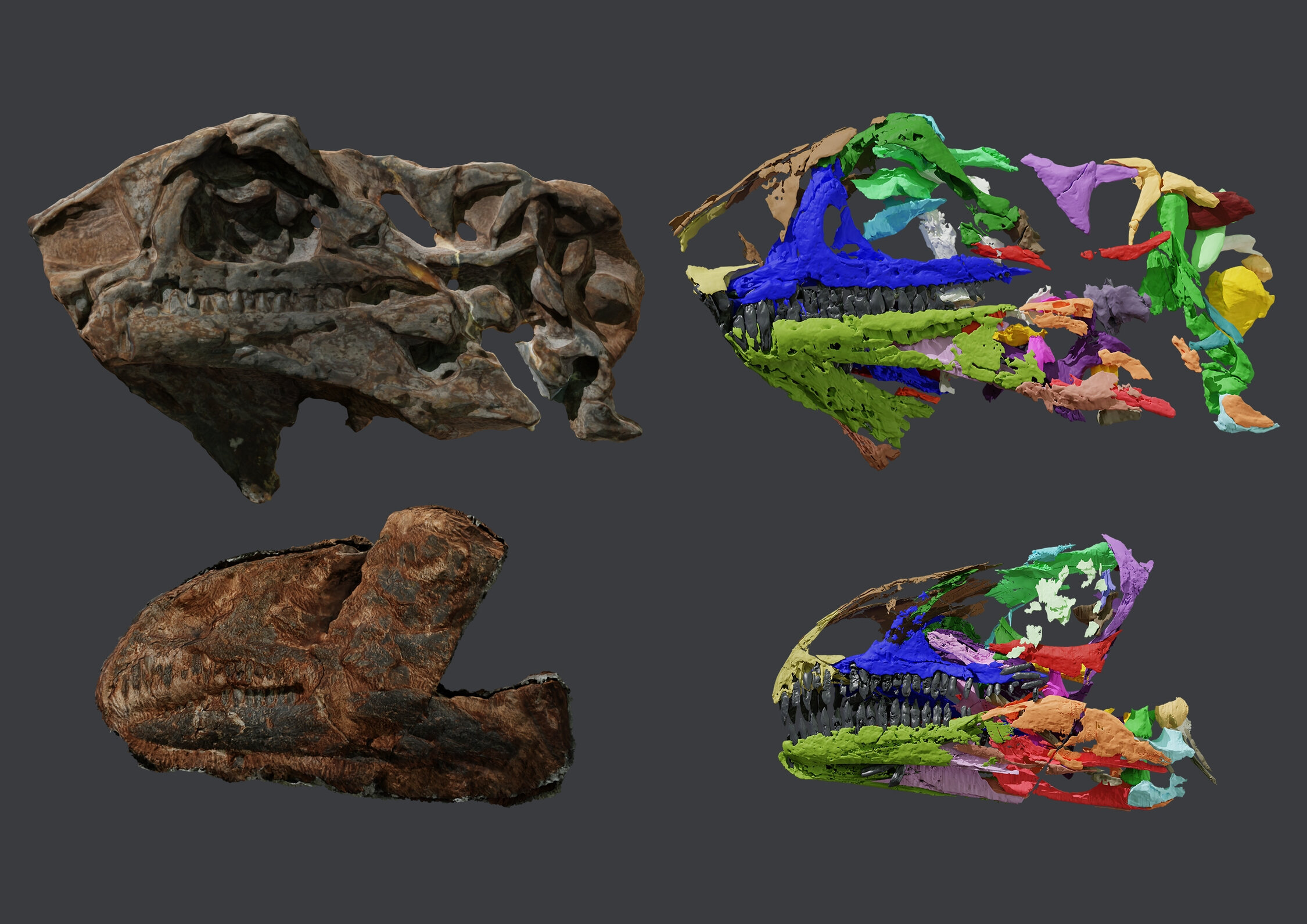 Issi saaneq skulls. Photo: Victor Beccari
A pair of herbivorous dinosaurs lived in the lateTriassic. It was during this time that the supercontinent Pangea was disintegrating and the Atlantic Ocean began to form. “At that time, the Earth was undergoing climatic changes that allowed the first herbivorous dinosaurs to reach Europe and beyond,” explains Professor Lars Klemmensen of the University of Copenhagen in an article for the MLU website.
The two skulls of the new species belong to a juvenile and an almost adult individual. Perhaps they were part of the same family.
New finds are the first evidencethe existence of a special species of Greenlandic dinosaurs, which not only expands the diversity of the late Triassic dinosaurs (235-201 million years ago), but also makes it possible to better understand the evolutionary paths and the timeline of the iconic group of sauropods that inhabited the Earth for almost 150 million years.
Read more
Look at pictures of two merging galaxies, taken 9 years apart
A new way of delivering a substance makes cancer cells self-destruct
American scientists received a record energy yield during the experiment
Before the onset of the Triassic, all continents made up a single giant supercontinent - Pangea. With the onset of the Triassic, Pangea began to gradually break apart.
N. V. Koronovsky, A. F. Yakushova, “Fundamentals of Geology”.