The results of a study of a new superconducting qubit, published in the journal Nature Communications, show
Superconducting qubits
Traditional computational models rely onphysical solutions corresponding to the laws of classical mechanics. This is how most modern processors work, for example. Quantum computing uses phenomena that occur at the scale of atoms and subatomic particles to communicate and process information.
There are various models of quantum computing,however, the most popular ones involve the use of qubits and quantum gates. Recall that a qubit is a system with two possible states, which can be in one of them or in a superposition of both. A quantum gate is a basic element of a digital circuit that performs an elementary logical operation. It describes how the state of qubits will change, taking into account the initial values, after applying a certain law to them.
Since quantum effects appear only inAt ultra-small scales, creating qubits and gates is an extremely difficult task. Of the many approaches to building useful quantum computers, superconducting qubits have gained the most popularity. To create them, engineers use temperatures close to absolute zero, at which quantum effects begin to appear at the macro level. For example, it is this technology that is used by the recently introduced IBM quantum processors containing a record 433 qubits.
cooper couple and transmon
In a superconductor, the majority charge carriersare Cooper pairs. This is a bound state of two electrons interacting through a phonon. It has zero spin and a charge equal to twice the charge of an electron. It is these particles, acting as a whole, that are used for quantum computing.
The simplest charge qubit, or blockCooper pairs is an element whose state determines the presence or absence of excess Cooper pairs in the island. Such a component is formed by a tiny superconducting island connected by a Josephson junction into a superconducting reservoir. In this junction, the critical current is suppressed, and a tunnel current flows through a thin insulating or non-superconducting layer between the two superconductors.
The state of the qubit depends on the numberCooper pairs that tunneled through the connection. The tunneling effect is used to design quantum anharmonic oscillators that act as qubits.
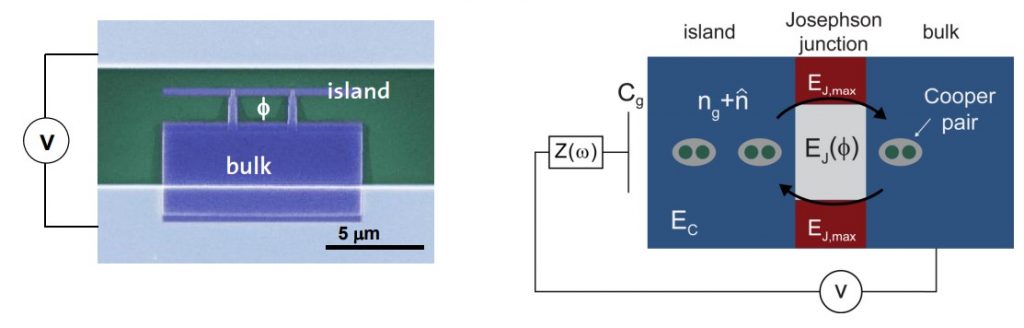 Schematic diagram of a charge qubit circuit. The island is formed by a superconducting electrode between the gate capacitor and the junction capacitance. Image: ETH
Charge qubits are made usingtechnologies similar to those used in microelectronics. The devices are typically built on silicon or sapphire wafers using electron beam lithography and thin metal film evaporation.
In this case, Josephson junctions are formed withusing shadow evaporation. This is a process in which the parent metal alternately evaporates at two angles through a lithographically defined mask in an electron beam resist. This results in the formation of two overlapping layers of superconducting metal, between which a thin layer of insulator is deposited.
Although such qubits are quite easy to make withUsing mature technology used in classical computers, their disadvantages include rapid decoherence (breakdown of entanglement) under the influence of external noise. For quantum computers to perform useful calculations, the information they contain must be close to 100% accurate. Charging noise caused by the imperfection of the material environment in which the qubits are located negatively affects the accuracy of the information.
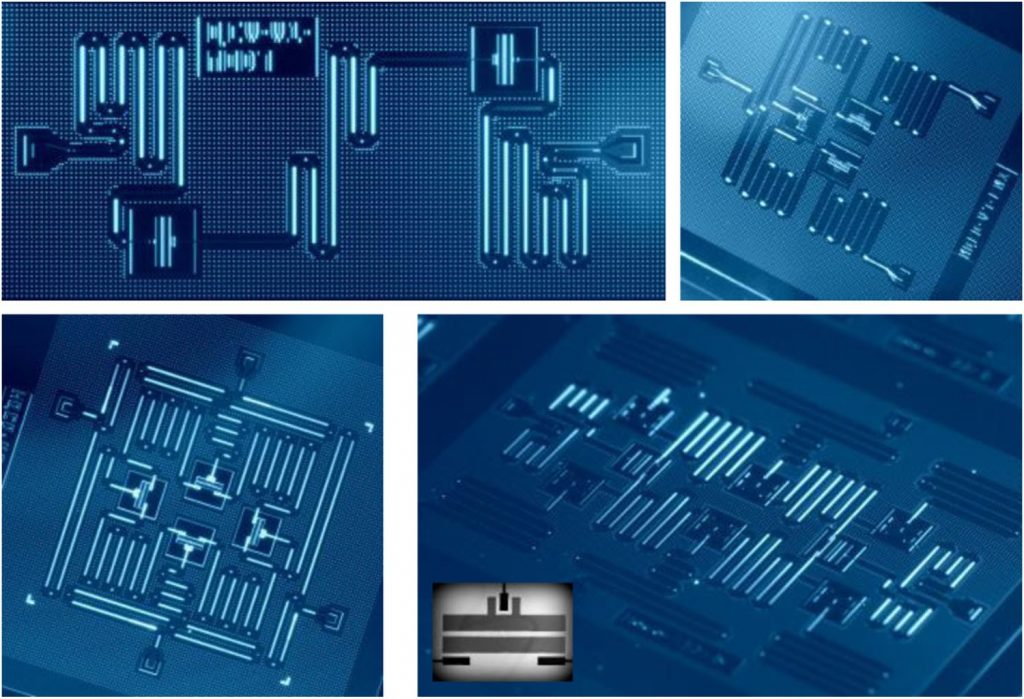 An IBM device consisting of four transmons. Image: Jay M. Gambetta et al., Quantum Information
To increase the "life" of such qubits, inIn 2007, researchers from Yale University finalized the system and created the transmon. This is a block of Cooper pairs, in which the Josephson junctions are additionally shunted with a large capacitive capacitor. The decrease in sensitivity to capacitive noise resulted in an increase in the coherence time from 1–2 ns for a block of Cooper pairs to almost 100 ns for a transmon.
Unimon is a new superconducting qubit
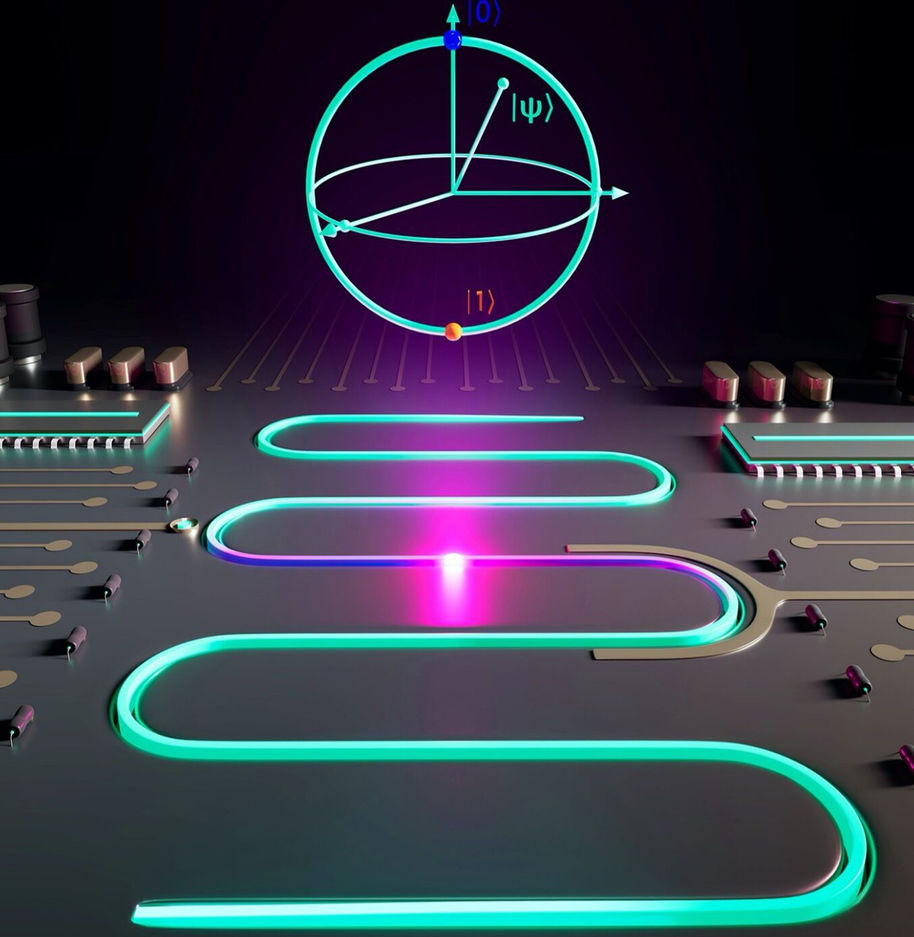 Artistic illustration of a unimon in a quantum processor. Image: Alexander Kakinen, Aalto University
Despite significant progress in developmentQuantum computing, qubit designs and methods currently in use do not provide high enough performance for widespread practical use. The complexity of the implemented calculations is mainly limited by errors in quantum elements with one and two qubits.
To solve this problem, researchersdeveloped a new type of superconducting qubit. They combine increased anharmonicity (deviation of the energy of the system from harmonic "fluctuations"), complete insensitivity to DC noise, reduced sensitivity to magnetic noise, and a simple structure.
The device consists of one Josephsona junction shunted by a linear inductor, and a capacitor operating in a mode in which the inductive energy is mainly compensated by the Josephson energy. This property results in a high level of anharmonicity with full immunity to low-frequency charge noise and partial protection from flow noise, the researchers note.
For the experimental demonstration of the unimon, scientistsdesigned and manufactured chips, each consisting of three unimon qubits. They used niobium as the superconducting material, with the exception of Josephson contacts, in which the superconducting leads were made of aluminum.
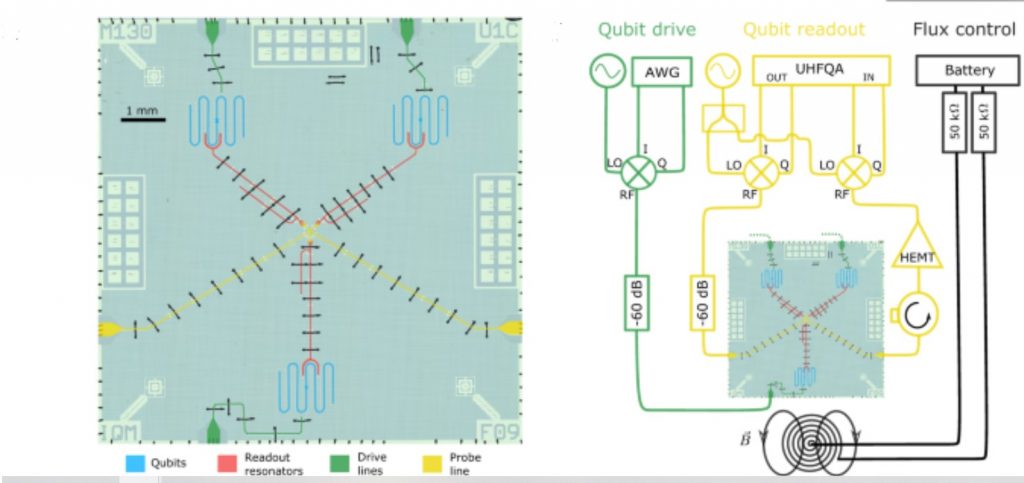 Left:Faux-color microscopic image of a silicon chip containing three unimons (blue) along with their readout cavities (red), drive lines (green), and probe connection line (yellow). Right: A simplified experimental setup used to measure unimons. Image: Eric Hyyppä et al., Nature Communications
With their devices, scientists have achievedaccuracy from 99.8% to 99.9% for 13 ns single-qubit gates on three different unimon qubits. The researchers note that due to the higher anharmonicity or non-linearity than in transmons, unimons can be worked on faster, resulting in fewer errors per operation.
Unimons are very simple but have many advantages.in front of the transmons. The fact that the very first unimon ever created worked so well opens up a lot of room for optimization and major breakthroughs.
Mikko Mettonen, Professor of Quantum Technology at Aalto University
Researchers will continue to work on improvements indesign, materials, and unimon gate times to exceed the target of 99.99% accuracy to create a useful quantum advantage and efficient error correction in practical devices based on a large number of qubits.
Read more:
The main theory of the origin of man was refuted: where did we come from
Results of first cancer drug trial published
8 billion people now live on Earth: is overpopulation threatening the planet?