A successful mixture of several viruses created HeLa cells on which drugs were tested for polio, COVID-19,
How cancer can help in medical research?
We are talking about cervical cancer cells, they were named HeLa after the first two letters of the patient’s name, Henrietta Lacks. They are immortal and continue to divide even after the death of all other cells.
HeLa survived even after an infinite number of generations of cells. This ability makes them invaluable to scientists, as they can perform any of their experiments on individual cells.
Why are these cells so important?
Before HeLa, scientists were looking for a way to grow and study human cells in the laboratory to conduct research that couldn't be done on a living person.
In 1951, cervical cancer cells thatfound in Lax, successfully grown in a Petri dish. From that moment, scientists had a source of cells that were easy to use and produce, so they began to use them for research.
They were used in a huge number of works:from vaccines against polio and COVID-19 to cancer research and human genome sequencing. HeLa cells have played a huge role in many scientific discoveries and advances.
The story of Henrietta Lacks is still very important, butit developed into a huge conflict in the field of bioethics. The fact is that these cells were taken from her during a routine biopsy of cervical cancer. Then the cells were transferred to other researchers without her consent. This was common practice at the time.
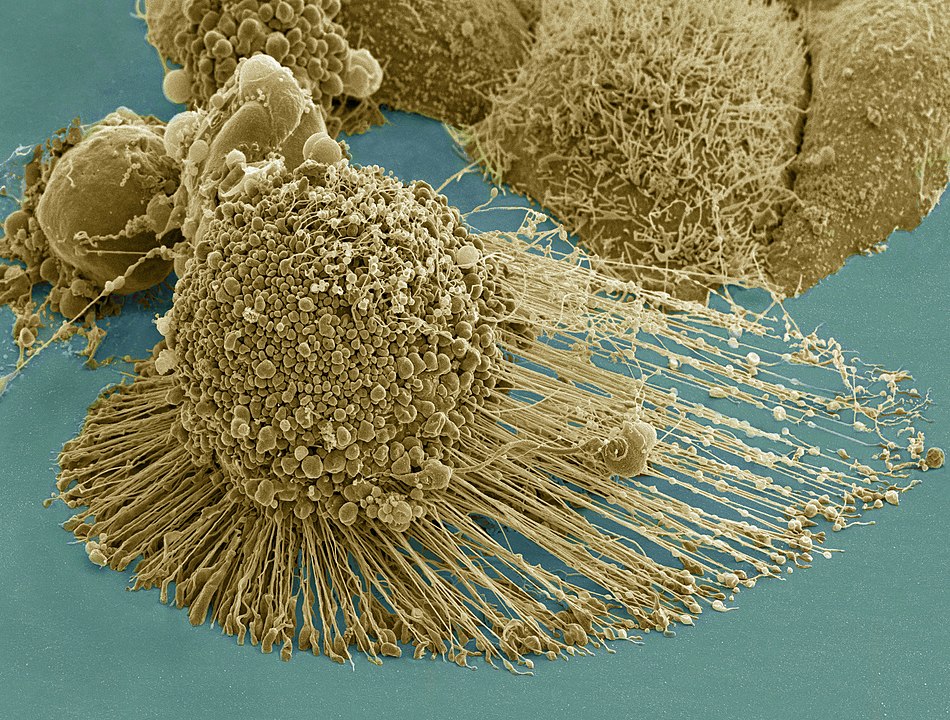 HeLa cells under an electron microscope
The Lacks family has long been trying to suecompanies they say have unfairly profited from Henrietta's cells. In a 2010 book, journalist Rebecca Skloot detailed how HeLa cells influenced both science and the Lacks family. As the journalist writes in her book “The Immortal Life of Henrietta Lacks,” the scientist wanted to find a cure for cancer and therefore spent several decades learning how to grow tumor cells in culture.
How did Lax's cells become immortal to science?
Lax didn't know that the cells in her cervix were infected with a virus that causes one of the most common sexually transmitted diseases, human papillomavirus, or HPV.
There are over 150 different types of HPV, but only a small group is known to cause cervical cancer. In fact, 99.7% of people with cervical cancer are HPV positive.
Fortunately, most people infected with HPVcan get rid of the virus before it becomes cancerous. HPV vaccination can prevent more than 90% of HPV-related cancers. But 10% of people with HPV infection develop cervical cancer. Unfortunately, Henrietta was one of the unlucky ones.
The tragedy that happened to her helped to figure out how HPV works. In 1976, the Nobel Prize was awarded for the fact that scientists proved the important role of HPV in the development of cervical cancer.
How do these cancer cells work?
It turns out that the ability of the virus to cause cancerassociated with two dangerous proteins that it produces. They can find and destroy two major human cancer-protective proteins, p53 and retinoblastoma (Pb).
P53 and Rb work as sentries:they make sure cells don't accumulate harmful genetic mutations and stop dividing after a certain number of cycles. Researchers recently conducted a study to understand how HPV proteins interact with tumor-suppressing proteins when found in various human cell types, including HeLa.
Most cells divide by about 40 to 60times before they get too old to function properly. After that, they naturally die. But HPV can allow cells to multiply forever because they attack the very sentinels that hold back uncontrolled division.
After Lux contracted HPV 18, thisthe second most common type of virus, her cervical cells have lost the ability to produce the necessary control proteins. Without growth control, her cells were able to divide indefinitely and became immortal. They live today as in test tubes and have become part of 70,000 different studies.
 Human cancer cells HeLa. The nucleus (especially the DNA) is highlighted in blue. The cells in the center and on the right are in interphase. The cell on the left is in the process of mitosis
After years of studying HeLa cells, biologists discoveredeverything about them: what they eat, how they reproduce and protect themselves, as well as what proteins they build and what genes they use. As a result, scientists realized that HeLa are not at all like ordinary human cells. They reproduce faster and have almost twice as many chromosomes.
And even after many years of research, the numberchromosomes in cells remained virtually unchanged. This means, the researchers believe, such a genomic anomaly was successful. Other HeLa attempts to rearrange its genome failed, and other samples did not survive in the laboratory.
Only 20 years later, the field of study of HeLa doctorHenrietta Lacks Howard Jones found that HeLa is not a mutation in the epithelium of the cervix, as previously thought, but adenocarcinoma - a type of cancer that forms from the tissue of the uterine glands. He is considered more aggressive.
Lax also suffered from syphilis all her life, soher body simultaneously encountered HPV and the causative agent of syphilis. The first virus turned ordinary cells into cancer cells of a rare aggressive type, and the second, apparently, averted the immune system's suspicions from them and allowed the tumor to grow.
As a result, cell division and changes beganin the number of chromosomes. And at a certain fortunate moment, the cells created a particularly successful combination, which fell into the hands of a surgeon, then into the laboratory and then began to move around the world.
Read more
Chinese AI predicts the course of hypersonic missiles. The retaliatory strike will be ahead
Evolutionists announced a breakthrough: they understood how life could have arisen on Earth
Scientists reveal what killed galaxies in the early universe