Scientists examined fossilized rostral teeth of Ischyrhiza mira. This species belonged to an extinct group of sawfishes,
Experts have long debated the origins of teeth.There is a hypothesis that they are part of the outer covering, particles of which migrated into the mouths of ancient vertebrates and adapted to food. This idea is called “outside-in.” Scientists also suggest that teeth evolved independently of “scales,” originating deep in the oral cavity and eventually descending onto the jaws. In a new study, scientists from Penn State University have proven the “outside-in” hypothesis.
According to Todd Cook, vertebrate paleontologist,As an associate professor of biology at Penn State, the scientists weren't about to get involved in the debate about the origins of teeth. They studied the tissue structure of the rostral teeth. They are found along the elongated snouts of sharks and sawfish and are used in foraging and self-defense. Cook, who is the lead author of the study published in the September issue of the journal Anatomy, noted that sawfish belong to the same group as rays and are closely related to sharks.
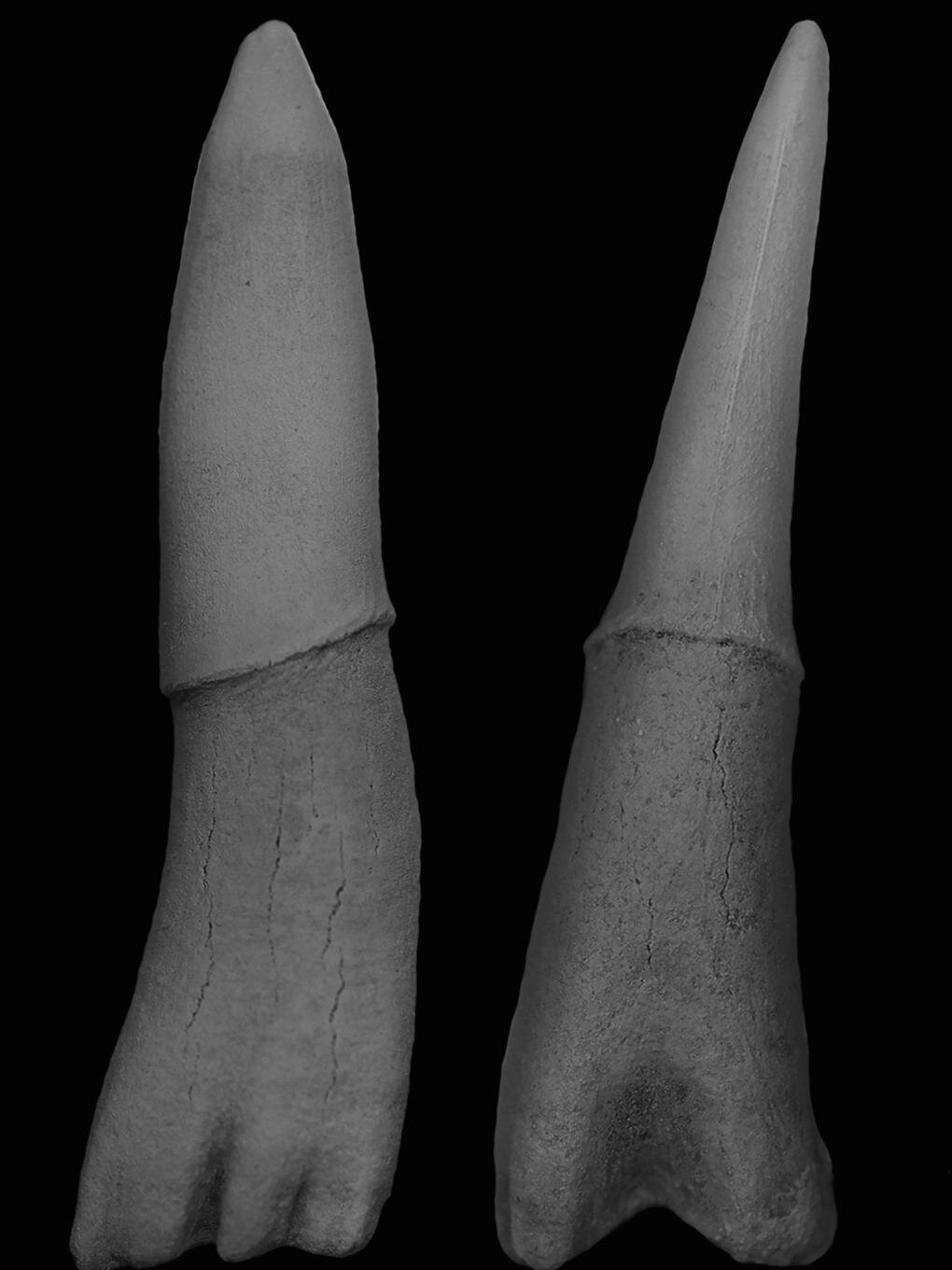 Rostral tooth of Ischyrhiza mia.
Image Credit & Copyright: Todd Cook, Penn State, Wiley Publications
In the course of the study, scientists found thatThe rostral teeth of Ischyrhiza mira, like those of modern sharks, have an enamel coating. It mainly consists of fluorapatite microcrystals packed together in individual “bundles.” They go in different directions. This is what allows the shark's teeth to withstand the mechanical stress associated with feeding.
However, the most surprising and important resultof this study is that it helps to resolve the dispute about the origin of teeth and confirms the “outside-in” hypothesis. The fact is that the scales can create a complex tooth-like enamel outside the mouth. This means that millions of years ago, scales created a similar microstructure in the mouths of ancient creatures.
Read more:
The largest migration in the history of the Earth will affect all living organisms on the planet
Astrophotographers have collected a detailed photo of the Moon from 200 thousand images
Nearly half of cancer cases linked to preventable risk factors