Scientists from Tokyo University of Science and the National Institute of Technology in Japan
Over the past few decades there have beenmany electronic devices have been developed that are becoming thinner and more compact. Traditional heatsinks used for heat dissipation take up a lot of space and can no longer fit into such devices. At the same time, as the power of devices grows, the need for heat removal only increases.
In a new study, scientists presenteda composite film made from cellulose nanofibers filled with carbon fibers. As a basis, the researchers chose cellulose fibers extracted from the mantle (one of the internal elements) of the sea squirt. This chordate lives in many seas.
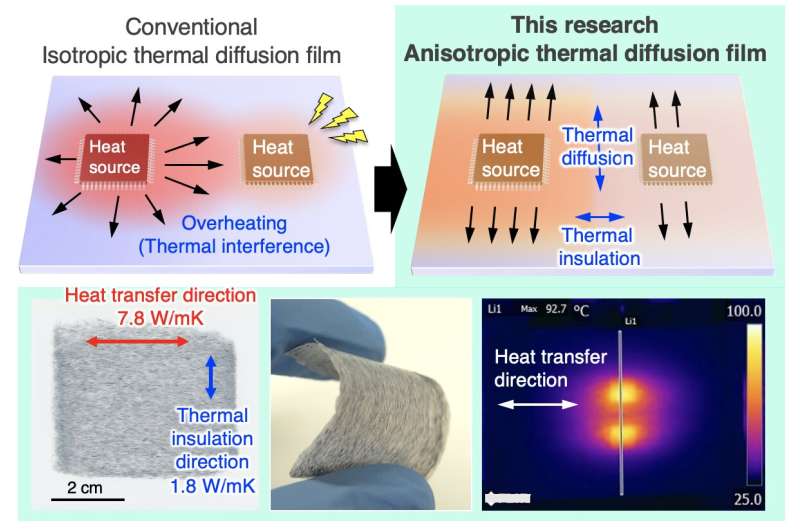 Traditional coating distributes heat throughoutside (top left), which can lead to overheating of adjacent elements. The new fiber (top right) only distributes heat in the intended directions, isolating one source from another. Image: Kojiro Uetani et al., ACS Appl. mater. Interfaces
To synthesize the material, the researchers preparedan aqueous suspension of fibers from both components, and then applied liquid 3D modeling. As a result, a nanocomposite was obtained, consisting of a cellulose matrix with uniaxially oriented carbon fibers.
The scientists tested the thermal conductivity of the films usinglaser point thermometry with periodic heating and radiation. They found that the material exhibited a high in-plane anisotropy of thermal conductivity of 433% along with a conductivity of 7.8 W/mK in the aligned direction and 1.8 W/mK in the orthogonal direction of the plane. In addition, the nanocomposite film could cool two closely spaced pseudo-heat sources without any thermal interference.
Read more:
It became known which tea destroys protein in the brain
Planetologists have found signs of life on Saturn's moon
Look at the first photos of Mars that Webb took: they are literally dazzling