Engineers from the University of Manchester have presented a simple technology for the production of construction materials.
Delivery of materials from Earth for lunar bases andexploration of other planets is too expensive. Scientists around the world are exploring production technologies from "local" materials that will maximize the use of substances available to astronauts and cosmonauts directly on the planet or satellite.
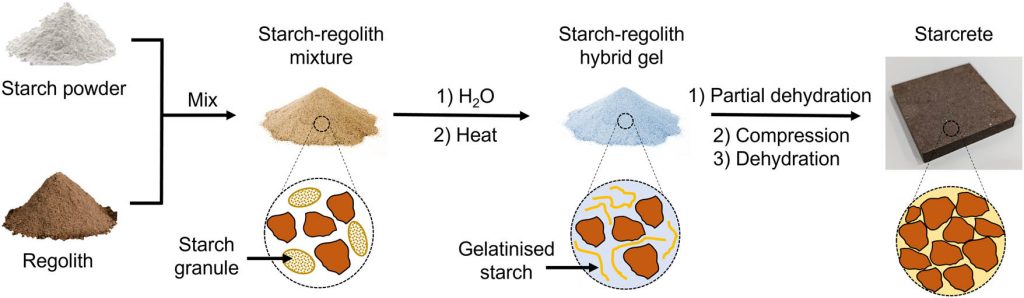 Scheme of StarCrete production. Image: Aled D. Roberts, Nigel S. Scrutton, Open Engineering
Engineers from the University of Manchestershowed that an analogue of terrestrial concrete can be obtained from regolith (soil), blood and urine. The new study is an attempt to create a method that does not require regular bloodletting.
The study showed that by mixing the Martiandust with starch and grains of salt, you can get concrete with a compressive strength of 72 MPa. For comparison, the strength of ordinary concrete is 32 MPa, and that obtained from Martian regolith, urine and blood is 40 MPa. The use of a material imitating lunar soil further increased the strength of concrete: up to 91 MPa.
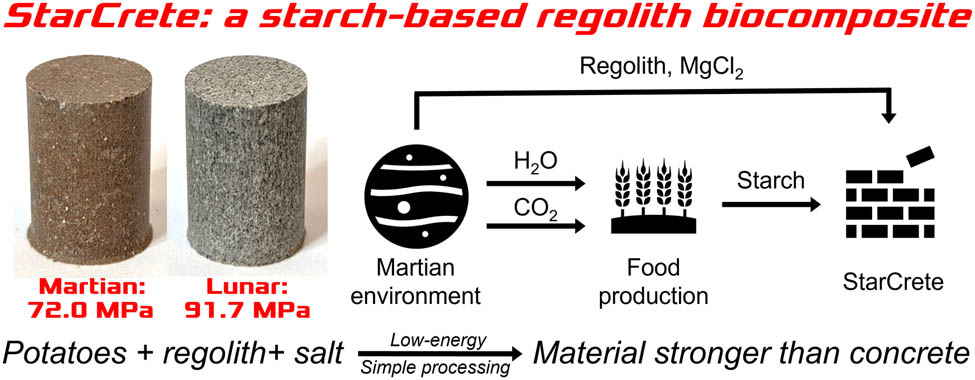 Scheme of production and properties of StarCrete. Image: Aled D. Roberts, Nigel S. Scrutton, Open Engineering
Engineers calculated that for the production of 0.5 tonsconcrete will require only 25 kg of dehydrated potatoes. Technologies for the production of potato starch are being developed to feed cosmonauts and astronauts, so there will be no problems with the main component of the material, scientists believe. A small amount of salt, necessary to increase the strength of the material, can be obtained from local soil or the tears of mission members.
The developers believe that StarCrete can alsobe used as an environmentally friendly alternative to concrete on the ground. It does not require extreme heat to produce and can be cooked in a conventional oven or microwave at temperatures suitable for home baking. As a result, such production requires less energy and reduces carbon dioxide emissions.
Read more:
The secret of longevity is revealed: scientists have figured out how to start the necessary mechanism in the human body
Named a new cause of autism
Notre Dame fire helps scientists unravel the secret of the cathedral's construction
Cover image: Aled Roberts, University of Manchester