Laboratory module "Mengtian" (approximate translation - "Dreams of Heaven") launched into orbit by launch vehicle
On the night from Monday to Tuesday, the module successfullydocked with the station. And already in December, the second crew will arrive on board the station, and the taikonauts (Chinese astronauts) will carry out a crew change on board for the first time in the history of the station.
History of habitable orbital astronauticsbegan in 1971, when the USSR launched the first long-stay station, Salyut-1, into orbit. Over the past 50 years, only three states have been able to design and build their own space stations - the USSR (Russia), the USA and China. In addition, Japan and the European Union have developed their own modules for the International Space Station.
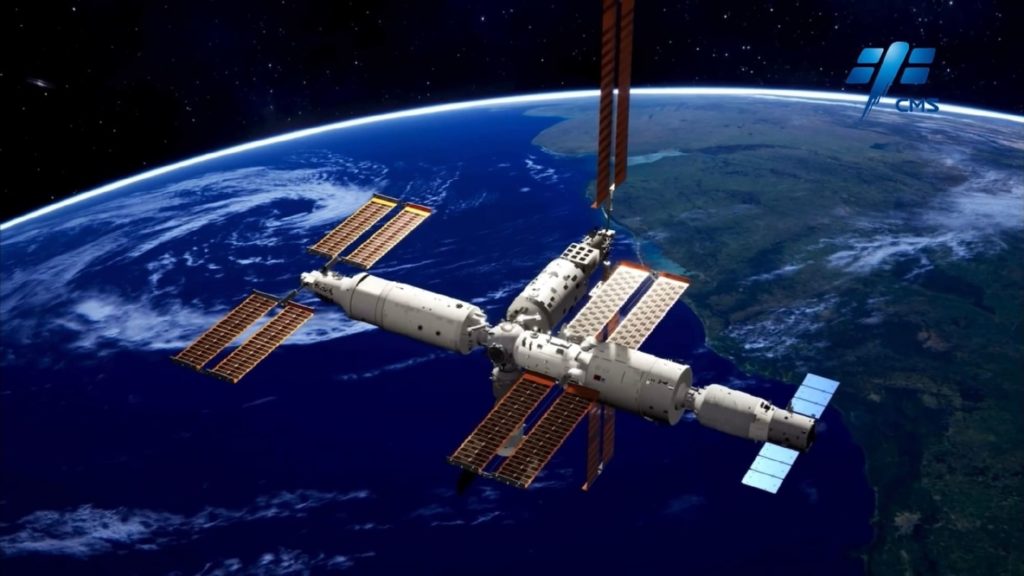
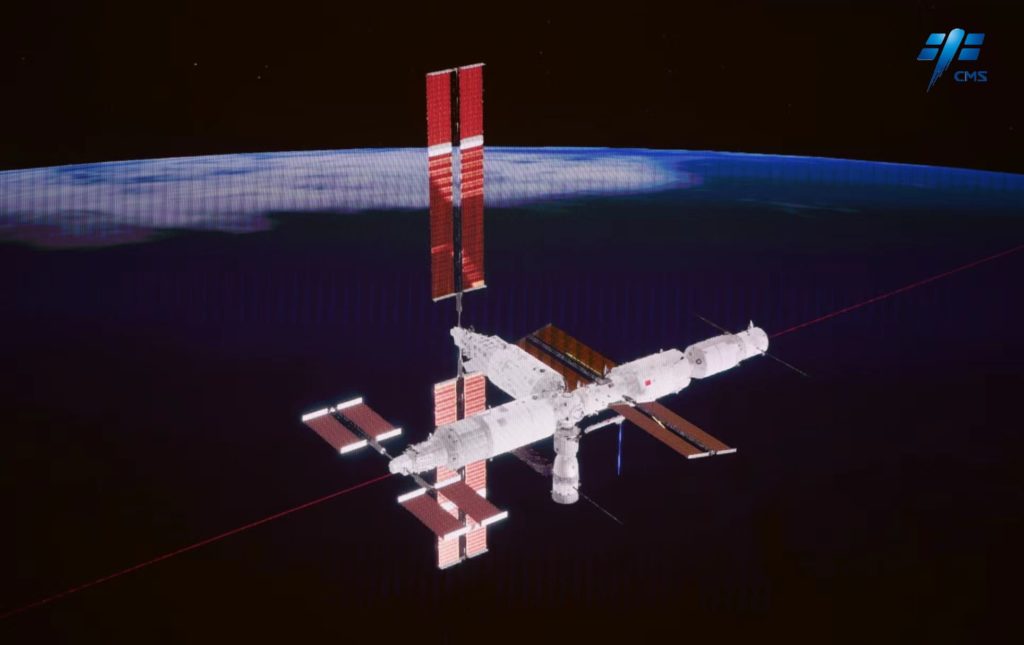
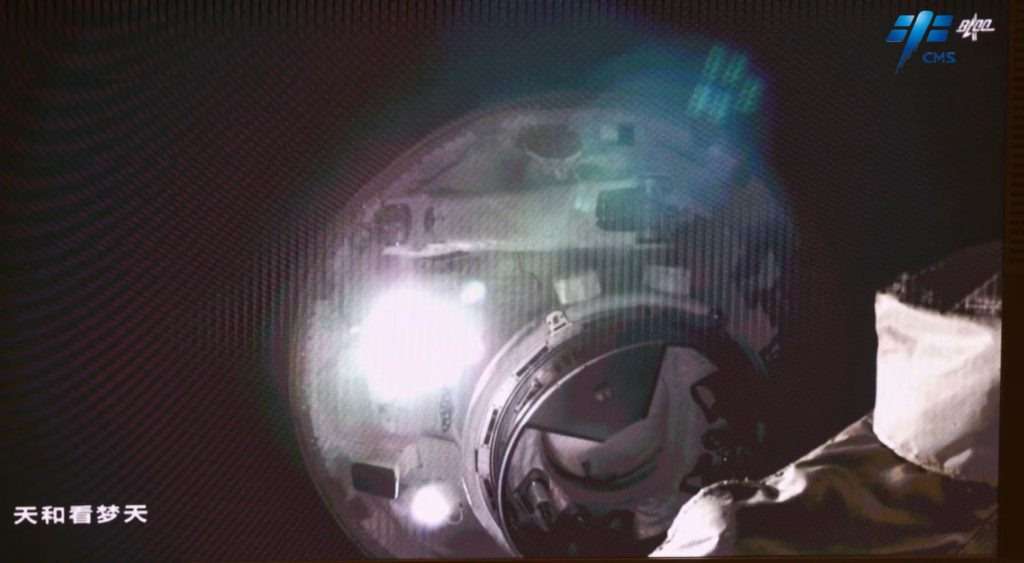
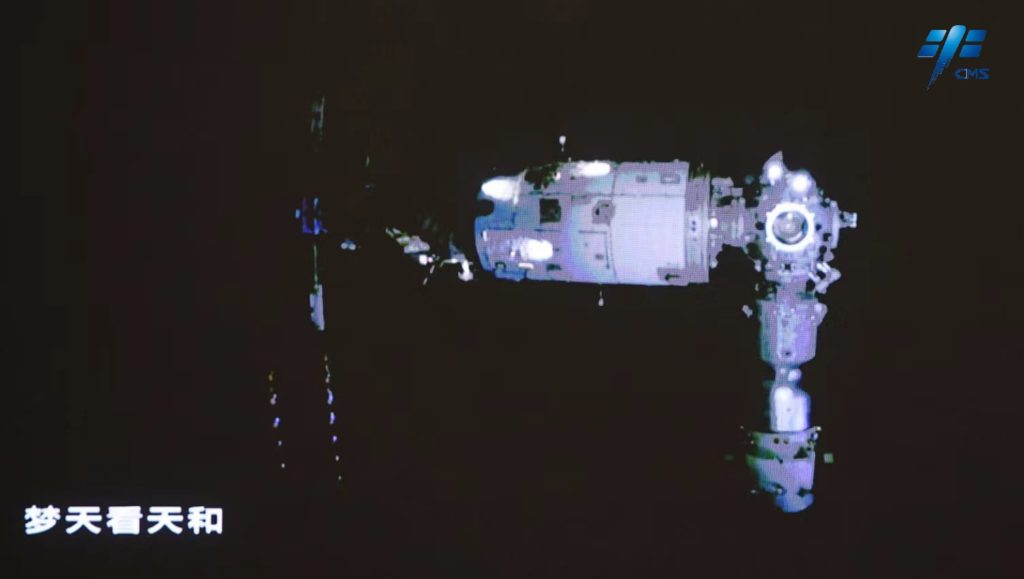
Docking of the third module to the Tiangong space station. Images: China Manned Space Engineering Network, Weibo
"Salyut-1" - "Salyut-7"
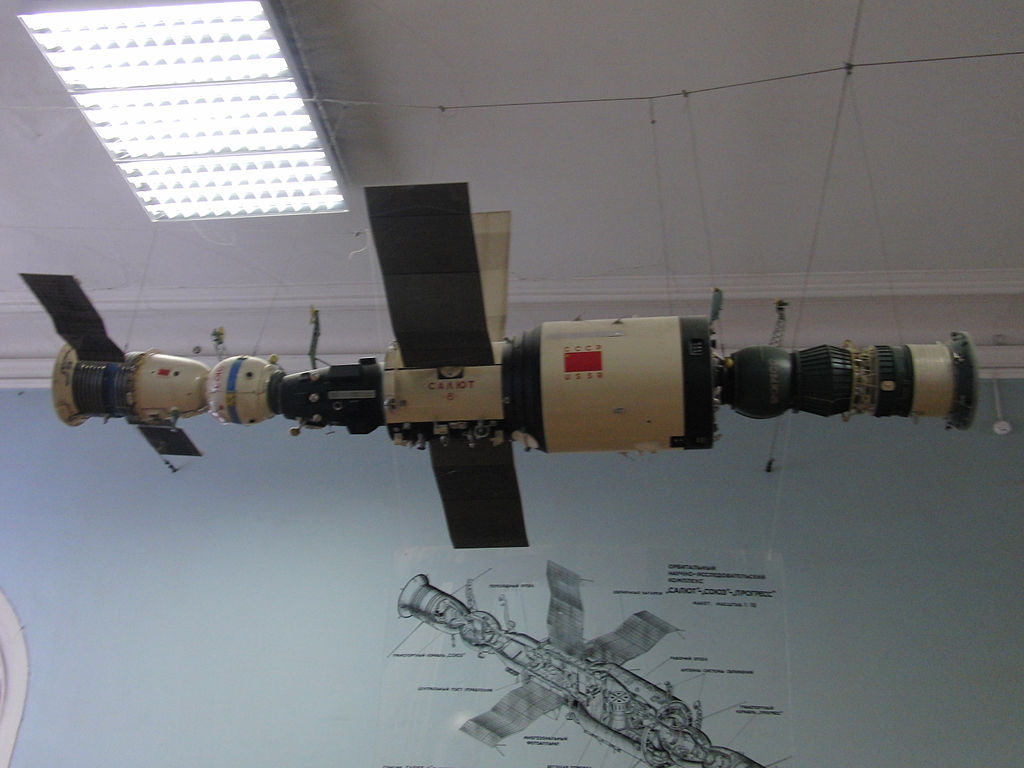 Station "Salyut-6". Image: Mikhail (Vokabre) Shcherbakov, CC BY-SA 2.0, via Wikimedia Commons
The first space station Salyut-1a stepped cylinder 14.6 m long with a diameter of the widest part of 4.25 m. The artificial satellite consisted of two cylinders with different diameters, forming a working compartment, and two outer areas: spacecraft, and an aggregate compartment with fuel tanks and an orbit correction system.
The end surfaces of the working compartment wereformed by spherical shells, and a special frame was installed inside the hull, which formed a standard rectangular space for the crew. The smaller diameter cylinder housed the station's central control post, seating area, food storage and canteen, as well as sleeping quarters.
The second cylinder contained scientificequipment, sports simulators designed to correct the negative effect of weightlessness on the body of astronauts, a shower unit, and a space toilet in a separate isolated compartment.
"Salyut-1" was launched into low Earth orbitlaunch vehicle "Proton-K" April 19, 1971. And the first crew on the Soyuz-10 arrived on April 24. But the docking went wrong, and the team could not get on board the station. The astronauts were unable to create an airtight airlock and were forced to return to Earth the next day.
After the malfunction was eliminated, the Soyuz-11 crewspent 23 days aboard the station in June. But on the way back, a tragedy occurred: the ship successfully separated from the station, but after separation, depressurization occurred, and the crew died during the descent and landing phase. On October 11, 1971, having spent 175 days in orbit, the station was deorbited and entered the dense layers of the atmosphere, where it was destroyed. Unburned debris fell into the Pacific Ocean.
After that, the Soviet Union launched similarmilitary stations ("Salyut-2", "Salyut-3" and "Salyut-5") and civil purposes ("Salyut-4"). Military satellites differed from civilian ones only in the reverse location of the transition compartment, otherwise they were identical. An important advance occurred in 1975, when two crews lived aboard the Salyut 4 for 30 and 63 days, respectively, and carried out scientific experiments.
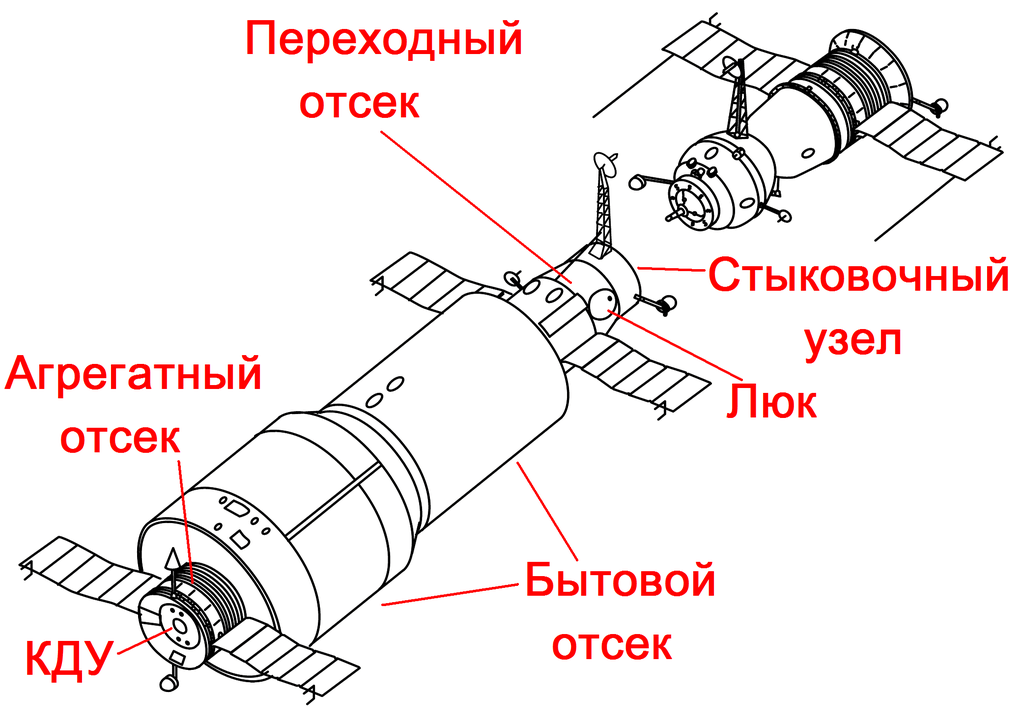
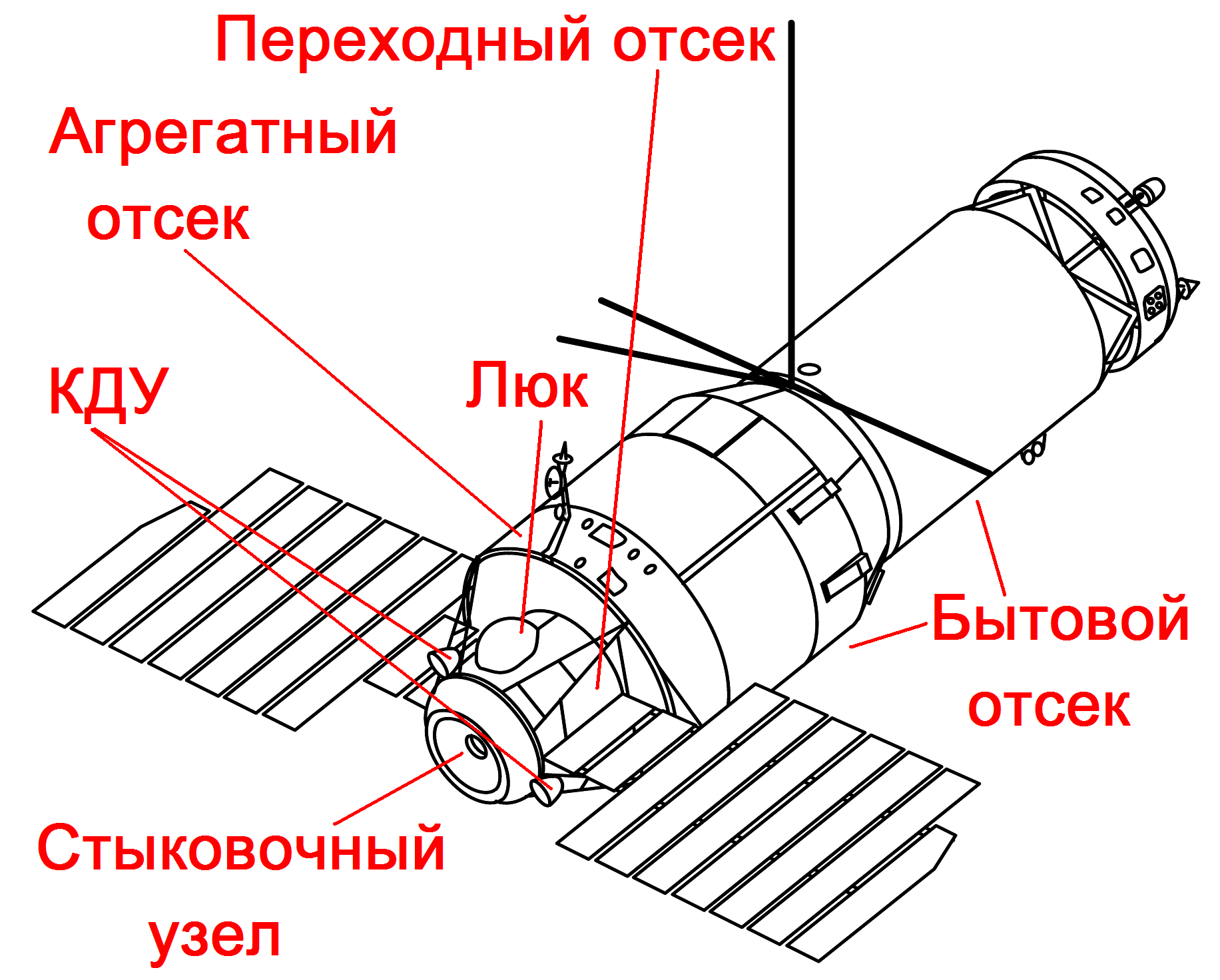
Diagram of the civilian station "Salyut-1" (left) and the military "Salyut-2", "Salyut-3" and "Salyut-5" (right)
Substantial modification of this programwere "Salyut-6" and "Salyut-7". Launched in 1977 and 1982 respectively, they were equipped with two docking locks at once. Such a system, for the first time, allowed for a crew change, in which one team passed the station to the next in working order.
Skylab
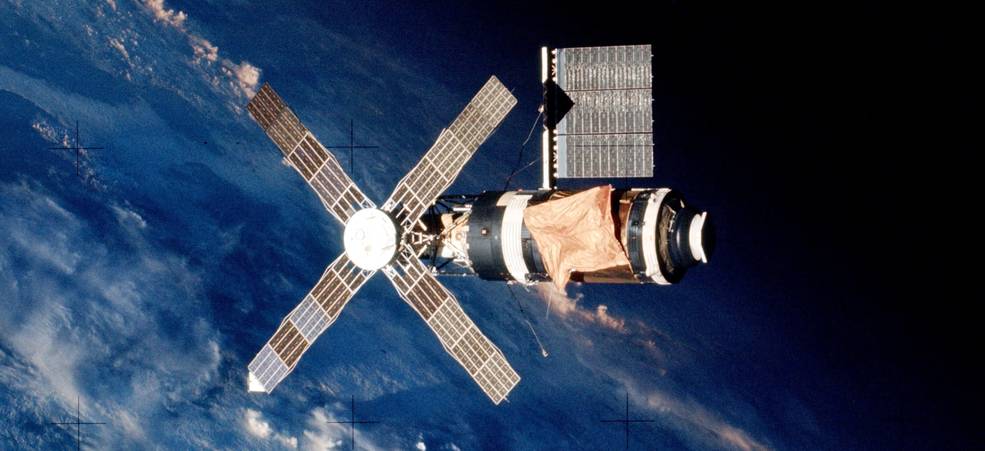 Skylab station. Image: NASA
In parallel with the Soviet Salyutov program, itsThe orbital station was developed by the United States. Launched in May 1973, Skylab is the first and so far the only space station operated exclusively by the United States.
The station was built on the basis of the upper stagethe Saturn 5 spacecraft that launched the Apollo mission to the moon. The main payload of the mission was the Apollo Space Telescope, the first solar observatory to be launched into space.
The mass of the station, in many respects similar in designon the Soviet Salyuts, was over 90 tons, in addition, a telescope control module weighing another 14 tons was additionally attached to it. A workshop and more than a hundred scientific experiments in the field of physics and natural sciences were also located on board the station.
The ship was launched using a modifiedversion of the Saturn 5 rocket. In this case, a finished ship was used as the last stage. A distinctive feature of the American station was a multi-docking module with two ports. In addition, the station was equipped with airlocks with hatches for access to outer space.
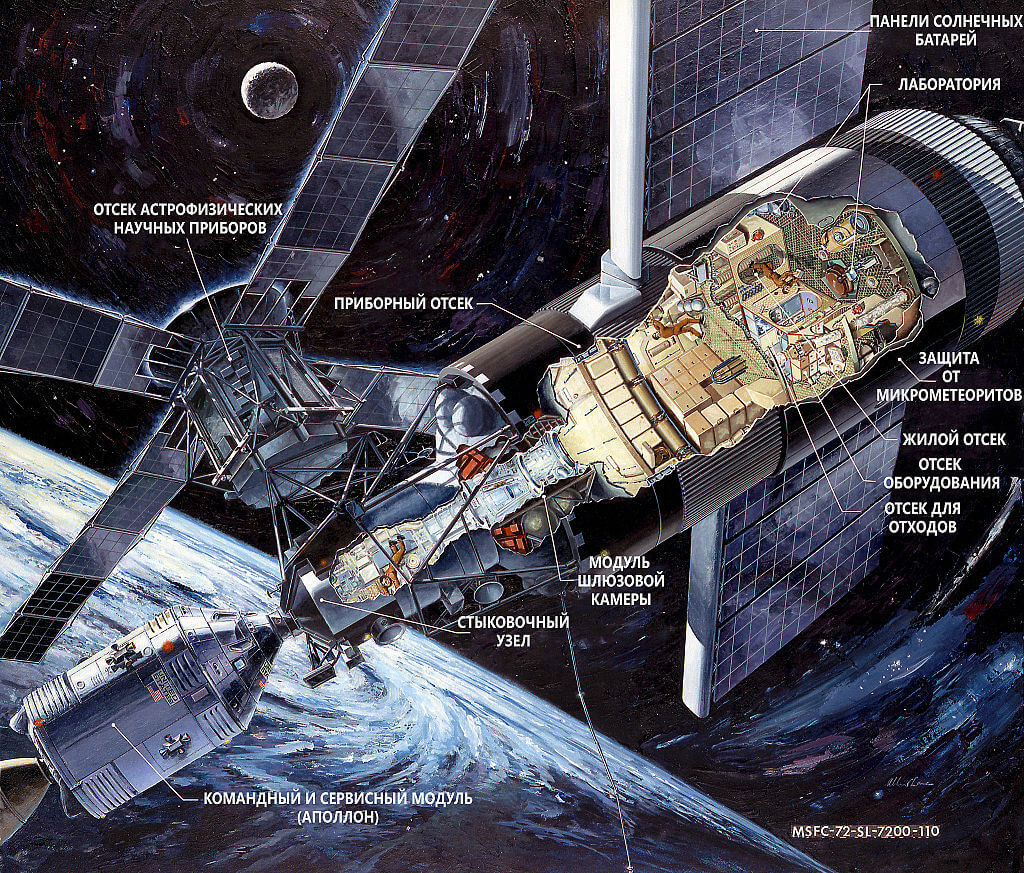 Skylab station. Image: Niksoon, CC BY-SA 4.0 via Wikimedia Commons
The station was occupied by three crews fora total of 171 days from May 1973 to February 1974. It was flown by three separate crews of three astronauts each: Skylab 2, Skylab 3 and Skylab 4.
Initially, it was assumed that the useThe station will be resumed after the completion of the creation of the "Shuttle" - reusable spacecraft. But due to delays in their development and the reduction of the station's orbit, which could no longer be stopped, NASA decided to end the mission. On July 11, 1979, the station entered the Earth's atmosphere, part of the ship burned out, and individual fragments collapsed in a sparsely populated area in Australia.
Station "Mir"
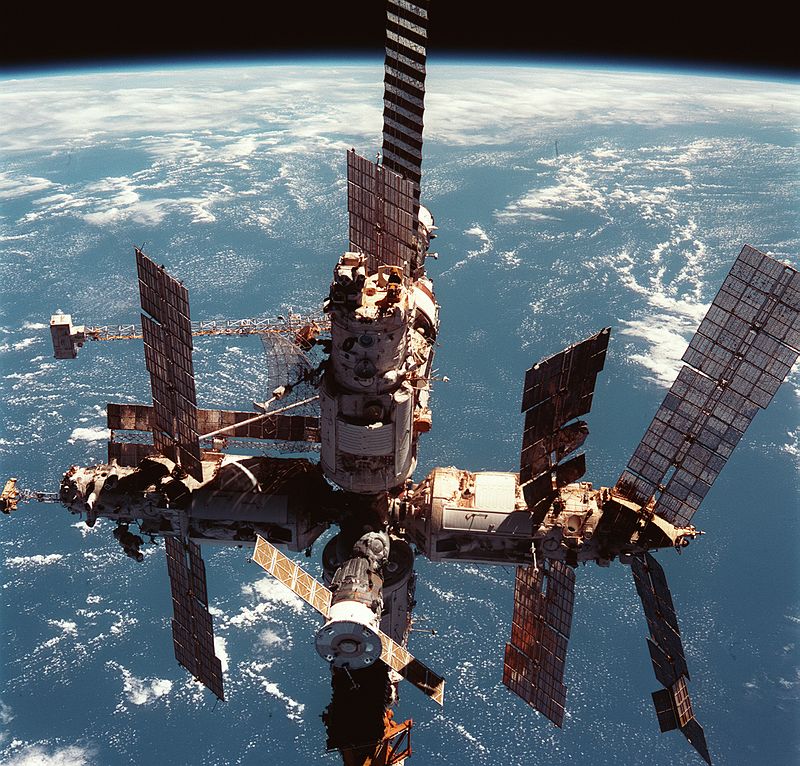
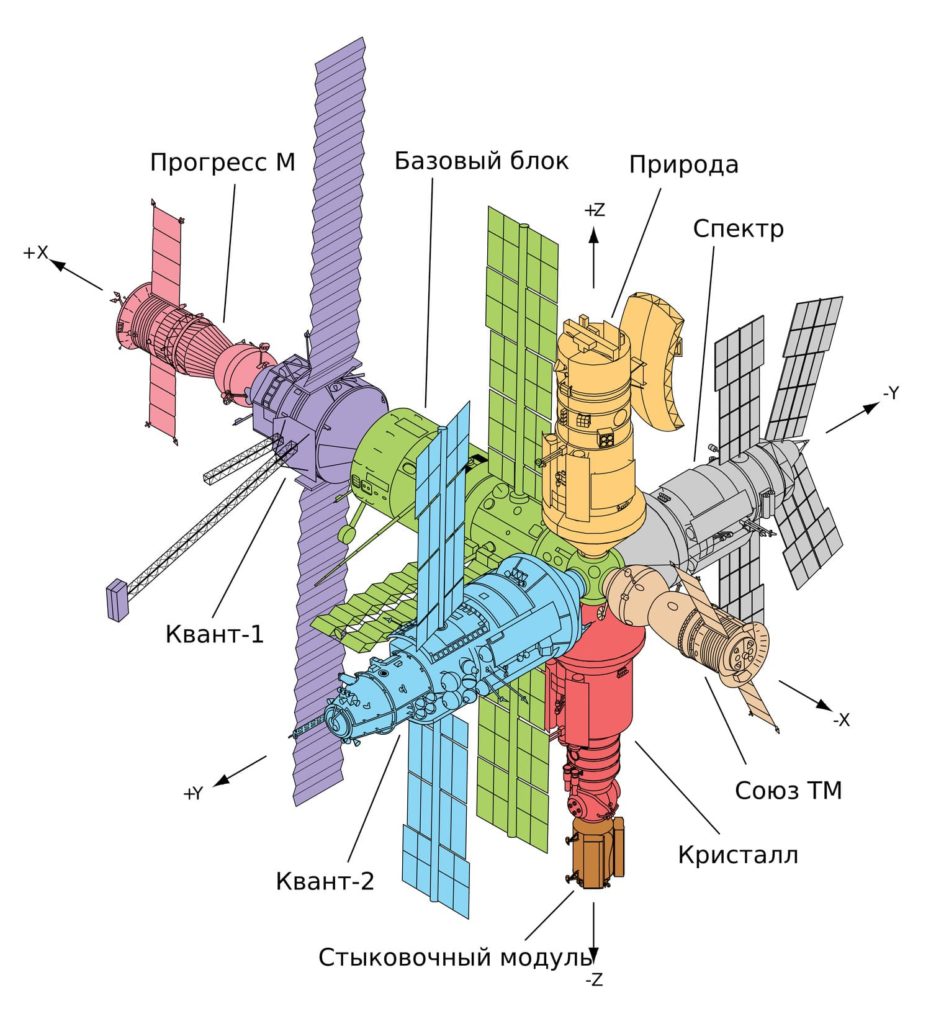
Mir station. Left: 1998 photo (NASA, Public domain, via Wikimedia Commons). Right: station diagram (Orionist, CC BY-SA 4.0, via Wikimedia Commons)
Station "Mir" - the world's first modularspace station. Unlike previous developments, it was not delivered to orbit in finished form, but was assembled directly in space from individual components. The station, which had an initial lifespan of five years, operated from 1986 to 2001 and set many records.
Due to the prefabricated structure, which allowedto reach a mass higher than the carrying capacity of an individual ship, it had a mass record at that time and was the largest artificial satellite of the Earth. The station served as a microgravity laboratory where various crews conducted experiments in biology, anatomy, physics, astronomy, meteorology, and space systems for long-term space exploration.
Mir was the first permanently inhabited long-termresearch station in orbit. The duration of continuous human stay at the station (due to crew turnover) was 3,644 days. This record was only broken on the ISS on October 23, 2010. In addition, the station holds the record for the longest continuous stay in space: Valery Polyakov spent 437 days and 18 hours at the station in 1994 and 1995.
The first module of the station, known as the main onemodule, or base unit, was launched in 1986, followed by six more modules. All but one of the modules were launched into orbit by Proton rockets, the docking module being launched by the US space shuttle mission STS-74 in 1995. When completed, the station consisted of seven pressurized modules and several non-pressurized components. Power was provided by several photovoltaic batteries attached directly to the modules.
International space station
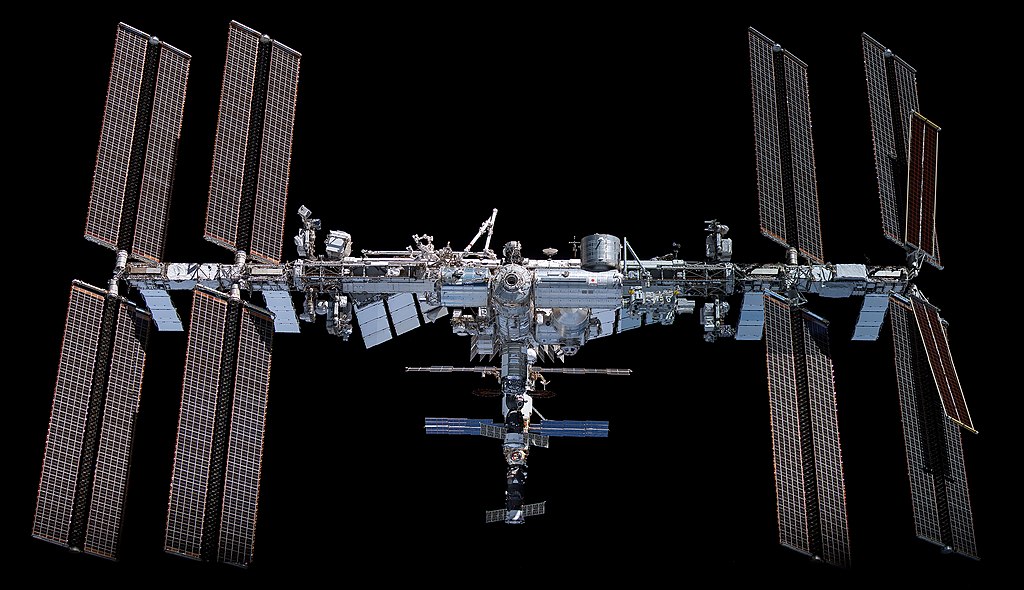 ISS. Image compiled from Expedition 66 images, NASA
Back in the late 80s, the USSR planned to createupgraded space station "Mir-2". In parallel, the United States was developing a project of its own multi-module bridgehead in space - Freedom. Due to NASA budget cuts in the United States, the end of the Cold War and the arms race, as well as the economic recession in Russia, in 1992 the countries agreed to join forces and build a single station. Other countries have also joined the project.
The ISS is by far the largest modularspace station in low-Earth orbit. This project is being implemented by five space agencies: NASA (USA), Roscosmos (Russia), ESA (European Union), CSA (Canada) and JAXA (Japan).
The station is divided into two parts:Russian (ROS) and American orbital segment (USOS). Currently, the Russian part includes six modules, and the US zone ten modules, the support services of which are distributed at 76.6% for NASA, 12.8% for JAXA, 8.3% for ESA and 2.3% for CSA.
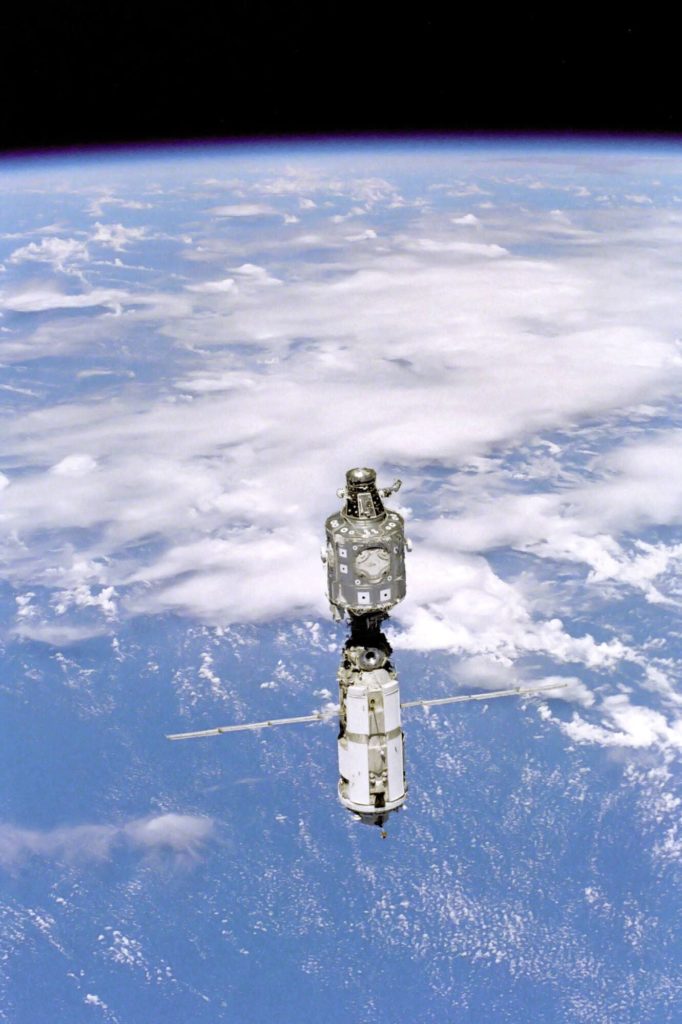 ISS in July 1999. Unity module (top) and Zarya module (bottom). Photo: NASA, Public domain, via Wikimedia Commons
The first component of the ISS was launched in 1998, andthe first long-duration crew arrived at the station on November 2, 2000. The station has been continuously used for "habitation" for almost 22 years. The station serves as a laboratory for the study of microgravity and the space environment, in which scientific research is carried out in the fields of astrobiology, astronomy, meteorology, physics, medicine and many other fields.
Despite numerous statements aboutobsolescence and wear and tear of the station, the service life of the station was repeatedly extended. Previously, the US Administration approved the continued operation of the American segment until 2030, and Roscosmos approved the continued operation of domestic modules as part of the station until 2024.
At the same time, representatives of the Russian authorities statedabout plans to withdraw from the international project and create their own station, including using components intended for the ISS. "Hi-tech" told what is known about the plans for the construction of the Russian orbital station.
Tiangong program
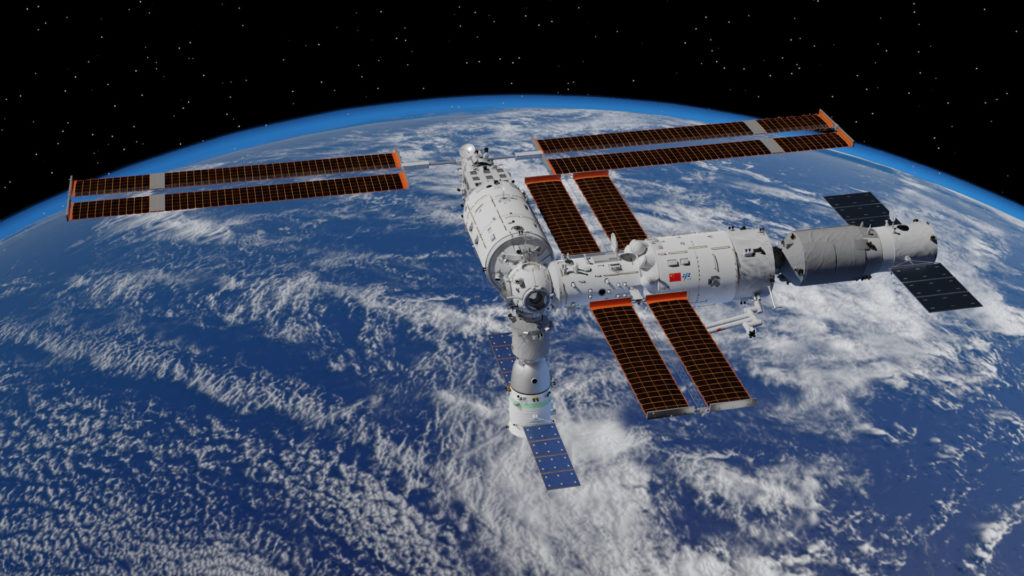 An artistic illustration of the Tiangong station after the assembly of all modules was completed. Image: Shujianyang, CC BY-SA 4.0 via Wikimedia Commons
Tiangong is the world's third multi-modulemanned orbital station, after Mir and ISS. The finished artificial Earth satellite consists of three modules. Although this space station is inferior in size to the first two, its assembled mass will be 60 tons, and in the future it can be increased up to 100 tons due to additional modules.
The space station is China's third visitedfacility launched under the Tiangong program. The first two were the Tiangong-1 and Tiangong-2 space laboratories, where the taikonauts worked out the processes of docking, operation and conducting experiments related to a long stay in space.
"Tian Gong", which means "Heavenly Palace", willconsist of "Tianhe" ("Harmony of heaven and earth"), the main habitat of astronauts launched into orbit in 2021, and two modules designed for experiments, "Wentian" ("Searching for Heaven") and "Mengtian" ( "Dreams of Heaven").
Module sizes vary from 14 to 18 m in lengthand 4.2 m in diameter. At the same time, the space is equipped both for a comfortable habitation of a permanent crew of three (and a short stay of two crews during a shift), and for conducting scientific experiments.
China has become the third country to developown habitable zone in Earth orbit, but it is unlikely to be the last. India previously announced plans to create its own space station, in addition, a number of commercial organizations, primarily from the United States, plan to build private research modules that can be operated independently. This means that a truly crowded period is yet to come.
Read more:
Archaeologists have officially confirmed the legends from the Bible
The grave of the "priestess" of Aphrodite was found: scientists showed what they found there
Scientists have seen what is on the territory of the Mayan capital. The find surprised them.