What does the Science module consist of?
For laboratory research, the Science module provides more than 30
Outside the module will be installed 13universal workstations and the European ERA manipulator for their automated maintenance. 20 universal internal workplaces are organized in the module's pressurized compartment. There will also be:
- bathroom,
- port for docking of the Soyuz and Progress spacecraft,
- equipment for pumping fuel from the tanks of the Progress transport vehicle to the ISS,
- the ISS attitude control system by roll, with the help of engines,
- oxygen supply complex for up to six people,
- device for the regeneration of water from urine,
- a cabin for the third crew member, which is protected from radiation by a 10mm aluminum plate,
- universal platforms for placing on them equipment for remote sensing of the Earth.
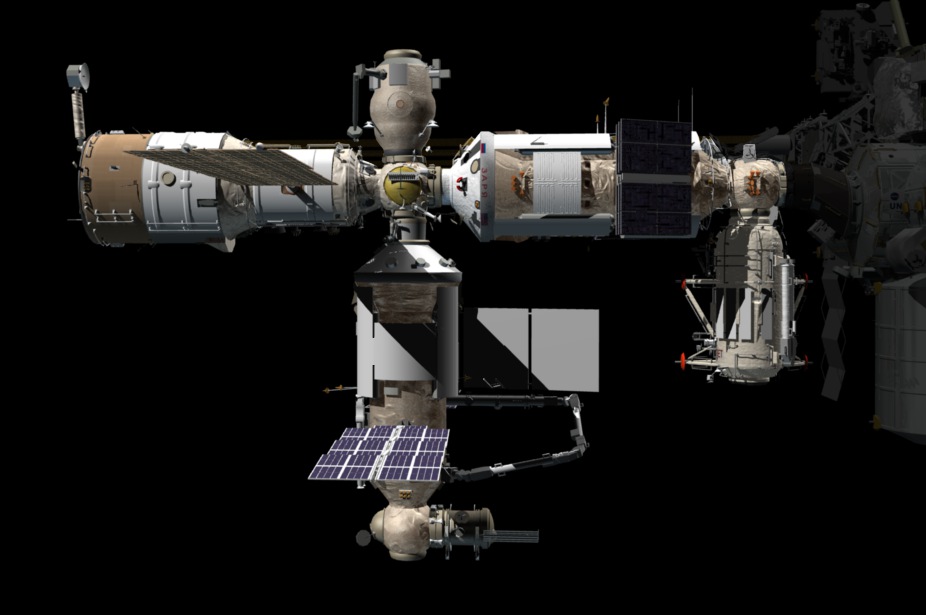 Computer image of the external view of the ISS Russian Segment after attachment of the Nauka module
External equipment of the “Science” module
- ERA manipulator
The module "Science" will be equipped with a Europeana robotic arm ERA (European Robotic Arm) with a length of 11.3 m, a mass of 600 kg, with a maximum payload of 8 tons, designed to service the Russian segment of the ISS without going into outer space. The robot can move individual large ISS modules, and is also capable of gripping and moving objects with an accuracy of 5 mm.
Before the MLM is launched, the ERA manipulator is stored at RSC Energia in a container filled with nitrogen.
October 22, 2020 ESA and Airbus specialistsDefense and Space arrived at Baikonur and on October 23 began working with the ERA manipulator. This is the first of several planned trips by ESA specialists to Baikonur as part of the preparation of the robotic arm for launch.
In May 2021, the European Robotic Arm (ERA) was installed on the multifunctional laboratory module "Science".
- SKKO system (means of fastening large-sized objects)
Using the SKKO system located on the externalsurface of MLM-U, there will be 5 universal workstations URM-N, each of which is equipped with three payload adapters, due to which the total number of places for placing scientific equipment will be 16 pieces.
- Hermoadapter with porthole
A removable pressurized adapter in the shape of a ball with two more and the only porthole for the entire “Science” is docked to the docking device (DS) of the “Nauka” module.
If you close the hatch cover between the main room of the module and the pressurized adapter, the latter can become the airlock itself, from where the cosmonauts go into outer space.
- Airlock
The automated lock chamber has dimensions of 1200 × 500 × 500 mm, weight is 1,050 kg and consumes 1.5 kW of energy at its peak. It is intended:
- for extracting payloads from the MLM pressurized adapter and placing them on the outer surface of the station;
- for receiving payloads from the ERA manipulator and moving them into the internal volume of the airlock and further into the MLM GA;
- for conducting scientific experiments in the internal volume of the airlock;
- for conducting scientific experiments outside the airlock on an extended table and in a special organized place.
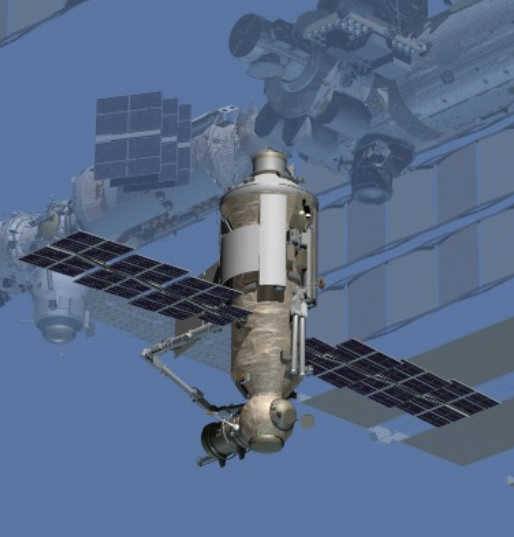 MLM "Science" docked to the ISS (sketch)
Scientific program of the module “Science”
The MLM research program includes experiments in three areas of the “Long-term program of targeted work planned on the ISS until 2024”:
- Experiments and research of scientific research andof a fundamental nature in the field of space biology and physiology, space materials science, extra-atmospheric astronomy and cosmic ray physics, exploration of the Earth from space and the study of the Solar system.
- Space exploration technologies fortesting the elements of advanced space technology systems in the field of data transmission, monitoring the state of structures, monitoring the tightness of compartments, ensuring the life of the crew, as well as predicting the development of natural and man-made disasters.
- Practical tasks and educational activitiesto improve curricula, expand the experimental base of vocational training and orientate young students to promising space research projects.
Planned experiments
- Embryogenesis
It is planned to use an incubator withquail eggs to study the development of embryos. The research equipment includes a centrifuge, that is, eggs will be exposed both in artificial gravity and in zero gravity.
- Experiment "Vampire"
Experiment "Vampire" ("rotating magneticfield") will make it possible to create uncooled matrices with unique technical characteristics for infrared sensors. The new IR devices created as a result are in great demand in small Earth remote sensing devices, a group of which will be formed within the framework of the Sphere program.
During the experiment, it is planned to growcrystals for infrared sensors in zero gravity in a rotating magnetic field. As a result, crystals with a high degree of homogeneity of properties can be obtained, which cannot be done under Earth conditions.
- "Drop-2" will be dedicated to testing a droplet cooler-emitter for a nuclear space tug.
- "Vitacyc-T"dedicated to growing lettuce in a conveyor greenhouse.
- "Capture-E"is dedicated to testing the Russian remote manipulator on the external surface of the module.
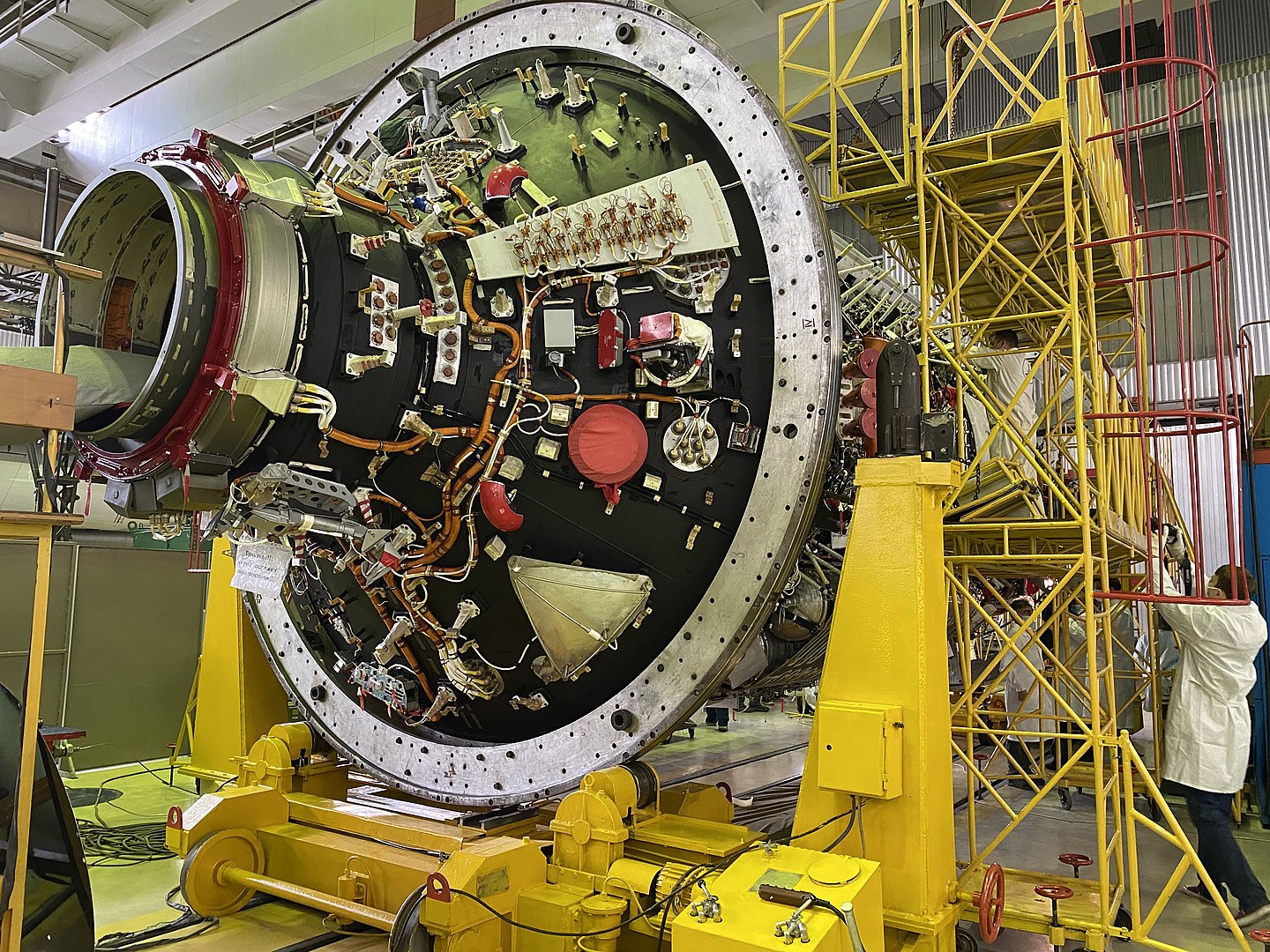 Module MLM-U "Science" at the Center. Khrunichev before leaving for Baikonur
How the “Science” module was put into operation
Some of the equipment for Nauka was delivered toThe ISS back in May 2010, together with the Rassvet module - in particular, the airlock chamber and the radiator of the cooling system, a spare arm of the ERA manipulator and a portable workstation for working outside the station.
Flight tests and full commissioning of the module are given 12 months from the date of launch.
- September 2021 - spacewalk of the ISS-65 crew for docking cables between the Zvezda module and MLM as part of EVA-49.
- September 2021 - spacewalk of the ISS-65 crew for docking cables between the Zvezda module and MLM as part of EVA-50.
- Not earlier than November 2021 - spacewalk of the ISS-65 crew to work with the European manipulator ERA as part of EVA-51.
- Not earlier than November 2021 - spacewalk of the ISS-66 crew to work with the European manipulator ERA as part of EVA-52 (Petr Dubrov, Matthias Maurer).
- Not earlier than November 2021 - spacewalk of the ISS-66 crew as part of EVA-53 (Anton Shkaplerov, Petr Dubrov).
On January 22, 2021, the flight director of the Russian segment of the ISS, Vladimir Solovyov, told the media that 7-8 spacewalks will be required to integrate the module with the station.
Read more
Scientists have found anomalously large viruses at the bottom of the Mariana Trench
For the first time in history, 9 stars disappeared in half an hour and did not return
"Imminent radiological threat": what is known about the leak at the Chinese nuclear power plant "Taishan"