Astronomers have a rough idea of the size and shape of the Milky Way's arms, so when
To learn more about our galaxy, the authors focused on the nearest part of one of the arms, called the Sagittarius Shoulder.The authors used NASA's Spitzer telescope to search for newborn stars located in clouds of gas and dust.
Previously, scientists have deduced a pattern that youngstars and nebulae are closely related to the shape of the arms in which they are located. To obtain a 3D image of the arm segment, the scientists used the latest information about the area from ESA (European Space Agency).
The combined data showed that the long, thin structure of the Sagittarius Shoulder consists ofof young stars moving at almost the same speed and in the same direction.This group of stars and star-forming gas clouds literally sticks out of the spiral arm.
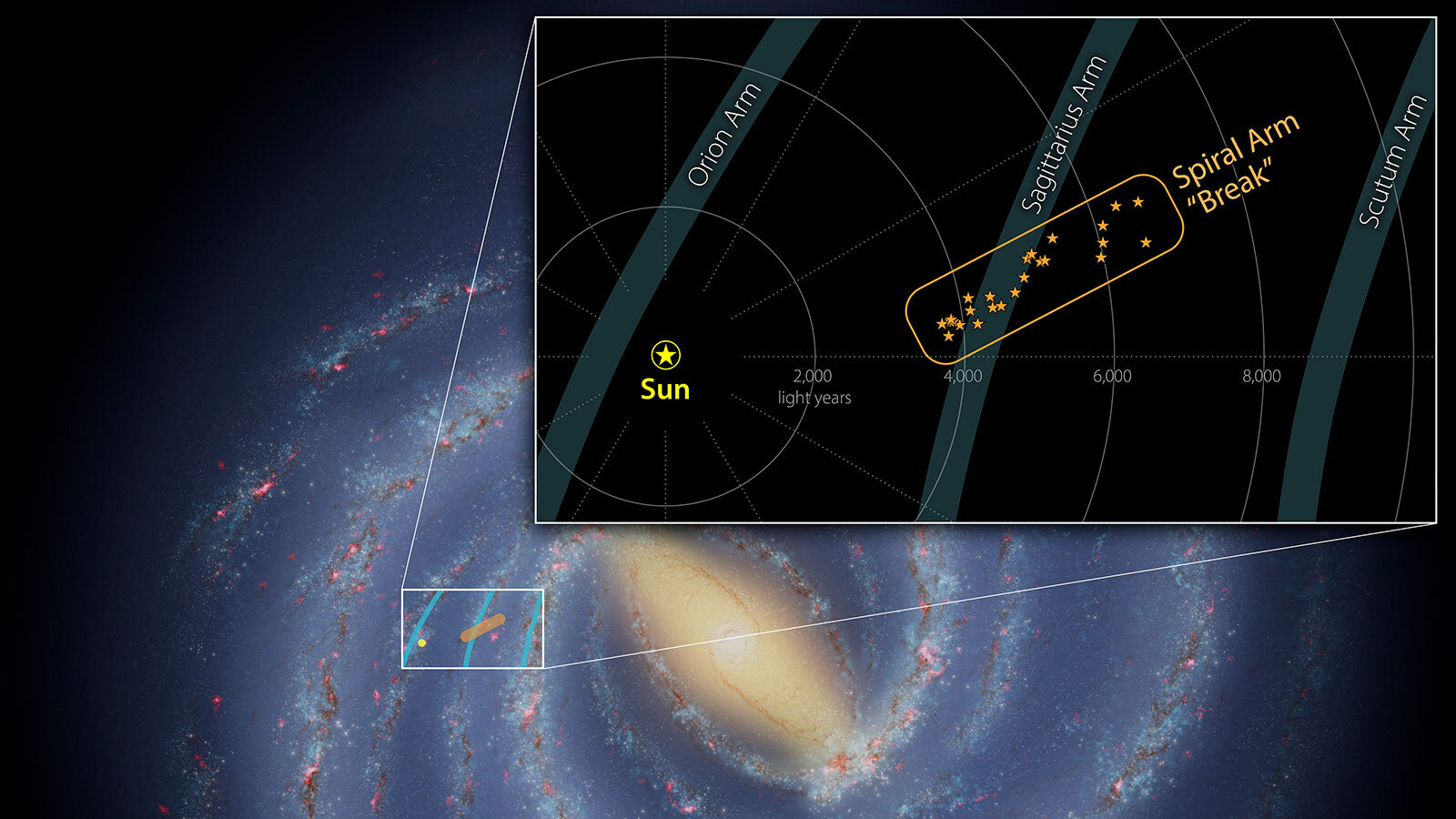 Schematic representation of the gap
There are four nebulae in this group:
- Eagle nebula,
- the Omega Nebula,
- the Trifid Nebula,
- the Lagoon Nebula.
 Image of nebulae
Astronomers don't yet fully understand how spiral arms form in galaxies like our own.
Read more:
Giant iceberg A74 collides with the coast of Antarctica
The Earth has already experienced a sharp rise in temperatures during global warming
Two new dinosaur species discovered in China