The Geminid meteor shower is observed annually from November 19 to December 24, and its peak occurs on the night of November 13-14
Unfortunately, this year the peak of the flow passesclose to the full moon (December 8), and therefore the night sky will not be dark enough to observe this phenomenon in all its splendor. Because of this, at its peak in the northern hemisphere, NASA estimates that 30 to 40 meteors per hour will be seen, depending on weather conditions. However, the Geminids are so vibrant that it must still be beautiful.
Geminid meteor shower. The red line shows the orbit of the Earth, the orange line shows the orbit of Mars. Video: Meteorshowers.org, Hi-Tech
How did the Geminids form?
The Geminid stream comes from the debris of an asteroid3200 Phaeton. It was first discovered on October 11, 1983 using an infrared astronomical satellite. This asteroid orbits the Sun in 1.4 years and moves in a strange orbit, reminiscent of the movement of a comet. It is believed that in the past, this asteroid survived a collision that formed the debris through which the Earth passes annually.
Phaeton is the first and one of the fewasteroids associated with meteor showers. All other known stellar streams are formed by comets. Although researchers have no doubt that it was this cosmic object that gave rise to the Geminids, astronomers have not yet come to a consensus about the origin of the asteroid itself and the meteors associated with it.
Phaeton has a non-icy shell, which distinguishes comets, but some believeits "dead comet," suggesting that it was once covered in ice that melted.Other astronomers call it a "rocky comet" because Phaeton is passing throughIn theory, this should lead to heating and cracking to form a cloud of debris and dust.
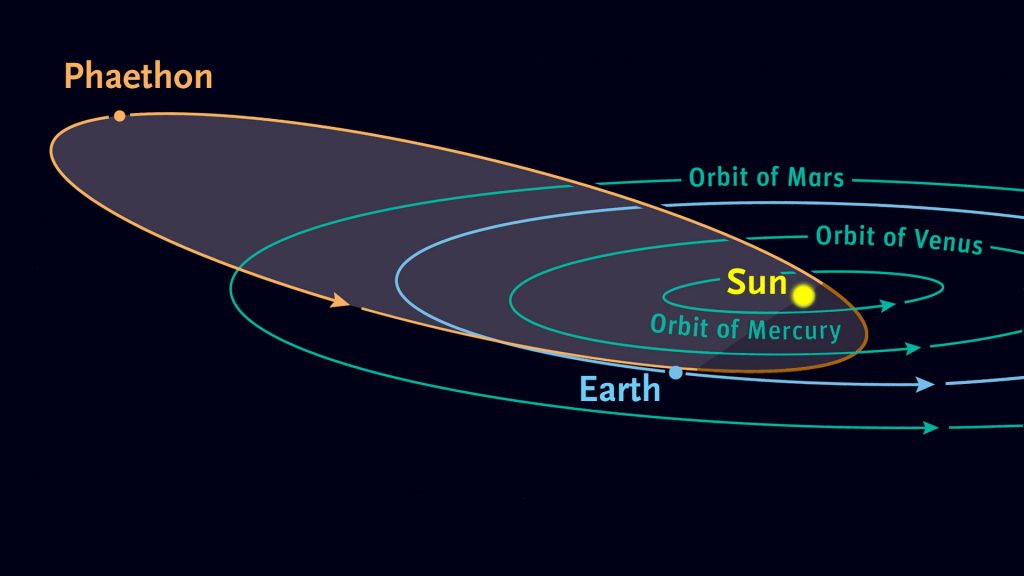 The orbit of Phaethon. Image: Sky & Telescope
Geminid Stream
Despite the relatively late discovery of the source of the meteor shower, it is known that people observed the Geminids as early as the 19th century.The first confirmed records of the observation of this phenomenon date back to 1862, and according to some estimates, to 1833.
The stream gets brighter over time, and the number of individual objects increases.This is because Jupiter's gravity gradually pulls in a stream of particles fromasteroid 3200 Phaeton is closer to Earth, according to NASA.
Geminids move at a speed of about 34 km/s.This is about 40 times faster than a flying bullet. Despite the impressive speed, most of these space objects, colliding with the Earth's atmosphere, burn out in its upper layers: at an altitude of 70 to 90 km. Rare particles reach up to 40 km above the Earth's surface, but they do not threaten people in any way.
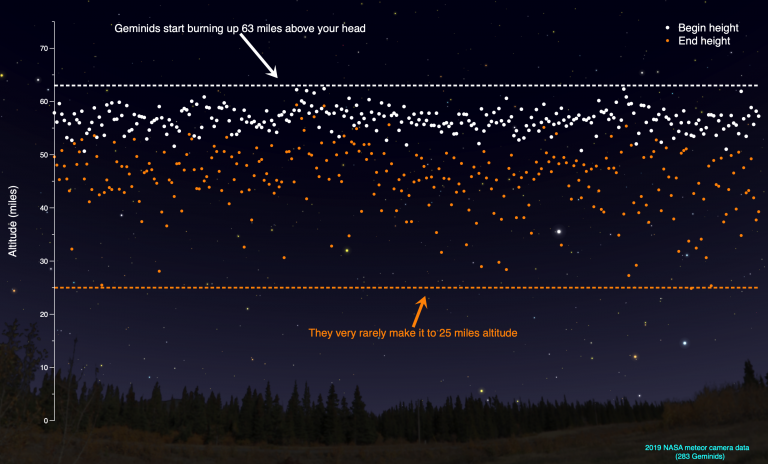 Meteor Destruction InfographicGeminids based on observations in 2019. The white dot is the area where the object begins to glow, the orange dot stops due to destruction. Altitude is in miles (dotted white line is about 100 km above ground, orange is 40 km). Source: NASA
How to find meteors in the sky?
Although the Geminids meteors are best seen fromnorthern hemisphere, they can be seen, and from the southern hemisphere they are visible only in the middle of the night and in much smaller numbers. The meteor shower is named after the constellation Gemini (from the Latin Gemini - twins), from which the meteors come.
Gemini is quite easy to find in the night sky:they are located northeast of the constellation Orion, between the constellations Taurus and Cancer. The two brightest stars in the constellation, Castor and Pollux, represent the heads of Gemini.
In December, the constellation Gemini, in whichthe radiant of the stream is located, it is clearly visible in the northern hemisphere high above the southern horizon all night, starting from 21:00 Moscow time and until sunrise, the Moscow Planetarium notes. At the same time, the Geminid radiant reaches its highest height above the southern horizon around 2 am.
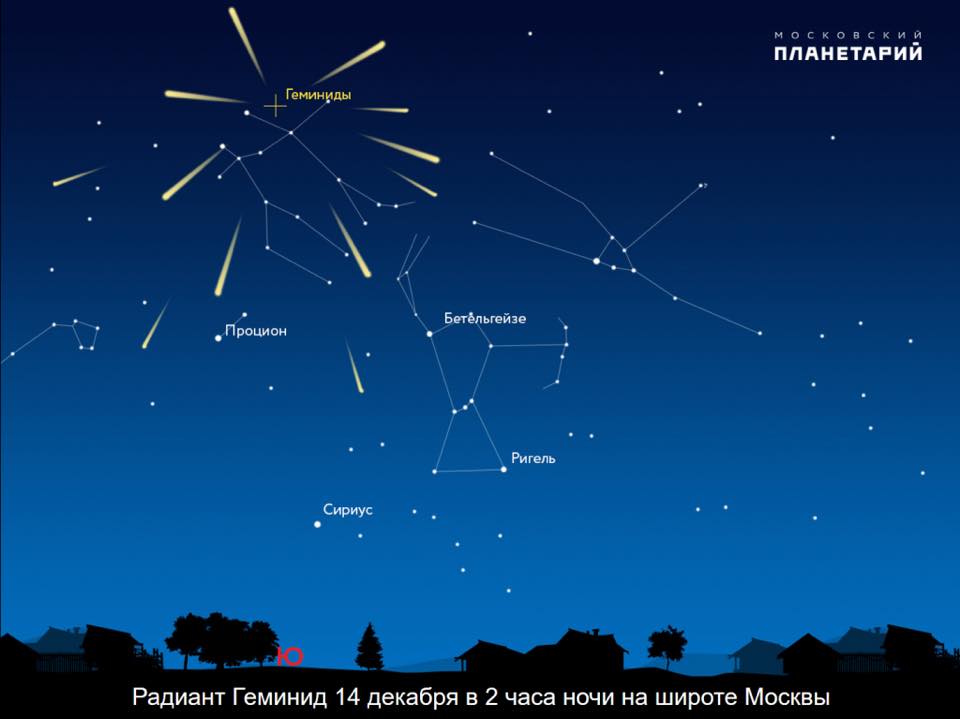 Constellations and geminids in the night sky at the latitude of Moscow. Image: Moscow Planetarium
Although the source of the meteor shower is located inarea of the constellation, the observation process does not need to concentrate only on it, astronomers say. Meteors that fall closer to the radiant leave shorter trails and are harder to spot. On the contrary, those that fly a little to the side produce long and bright trails.
Where and how to watch?
The Geminid stream is visible at the southern horizon of the sky allnight in the northern hemisphere and at the northern horizon in the middle of the night in the southern. City illumination interferes with observation, so it is advisable to go out of town to the darkest place, farthest from lamps and other sources of illumination.
No need to observe stellar fluxno special devices - binoculars or telescopes - these falling “stars” are visible to the naked eye. In this case, special equipment will only narrow the observation area, making it difficult to detect particles flying across the sky.
Observers in the northern hemisphere should notforget about winter weather conditions. It may take up to 30 minutes for your eyes to adjust to the dark, and it is not recommended to use a phone or other bright objects.
For those who, due to weather conditions or othercircumstances will not be able to observe the Geminids at night, NASA publishes observations from telescopes. Videos are posted daily on the All Sky Fireball Network project website. Events related to the Geminids are posted under the GEM tag.
Observation of the Geminids in 2020
Read more:
Scientists from the permafrost zone: how they develop smart clothes and a cancer vaccine
Scientists "cheated" time and sent a photon into the past: how this breakthrough will change physics
10 scientific facts that turned out to be fakes. Cards