An international team of paleogeneticists analyzed the variability of the genomes of more than 2,800 people who lived in
Researchers have recreated the evolution of hundreds of thousandsgenetic mutations over time and identified those that had an evolutionary advantage - more common as humanity evolved. The analysis showed that most of these mutations are located in 89 genes associated with the innate immune response. The OAS genes, which are responsible for antiviral activity, and the gene that determines blood groups, changed especially actively.
However, the study showed that mostof these positive mutations, demonstrating genetic adaptation to the pathogenic environment, formed relatively recently: from the beginning of the Bronze Age, or about 4,500 years ago. The authors of the work believe that this is due to population growth and the corresponding spread of severe infectious diseases, such as plague.
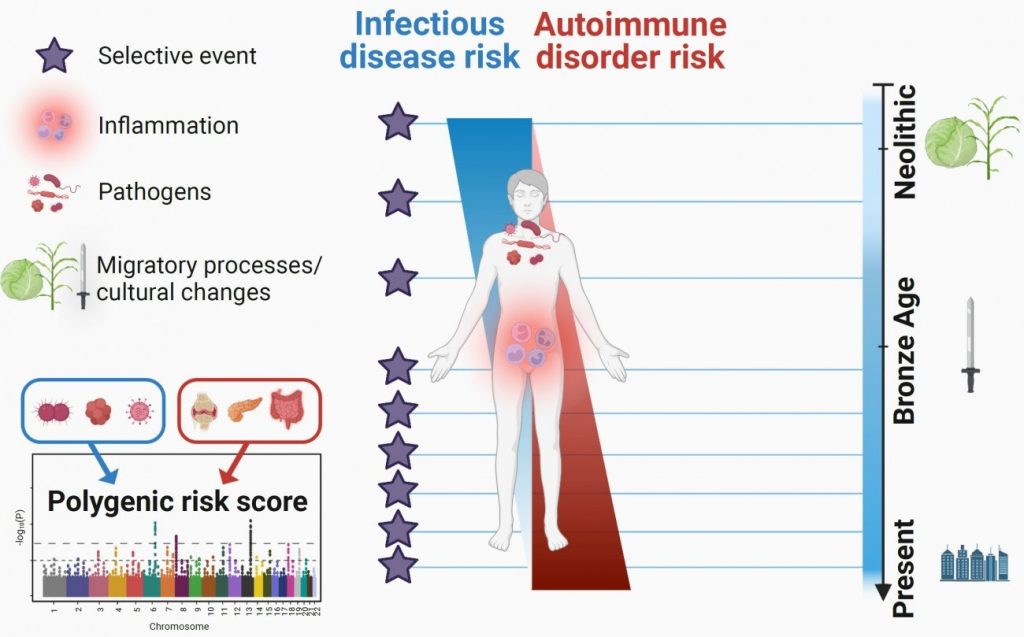 Reducing the risk of developing infectious diseases and increasing the likelihood of autoimmune diseases in the course of human evolution. Image: Gaspard Kerner, Institut Pasteur
In addition, researchers have shown thatgenetic selection associated with resistance to pathogens in the past has favored alleles (forms of a single gene) that confer resistance to infectious diseases, but has also increased the risk of autoimmune or inflammatory diseases.
The study showed that the geneticthe predisposition associated with the development of inflammatory diseases, such as Crohn's disease, systemic lupus erythematosus or rheumatoid arthritis, has increased over the past 10,000 years. At the same time, people have become more resistant to infectious diseases.
The results indicate that the riskinflammatory diseases in Europeans has increased since the Neolithic due to positive selection for mutations that increase resistance to infectious diseases.
Luis Quintana-Mursi, Head of Research and Head of Human Evolutionary Genetics at the Pasteur Institute
This is not the first such study. Previously, Hi-Tech spoke in detail about the consequences of the “Black Death”: a medieval pandemic “gave” humanity a tendency to Crohn’s disease.
Read more:
Scientists have come up with a new treatment for hypertension. It has proven to be effective
Humans still have fur genes, but they are temporarily turned off
Look at the unusual "family portrait" of the Moon and the ISS. This photo was taken by an amateur