A group of scientists from the Institute of Vertebrate Paleontology and Paleoanthropology of the Chinese Academy of Sciences identified
The dinosaur was a small omnivorous animal of the sizewith a peacock with long tail feathers. In the early Cretaceous period, he wandered along the shores of small lakes in the Jehol biota - an ecosystem that developed in northeastern China 133-120 million years ago in the territory of the modern Liaoning province. Scientists note that in the Jehol biota, the fossils are well preserved due to the fine volcanic ash that buried dead animals and protected the bodies from the external influences of the changing environment.
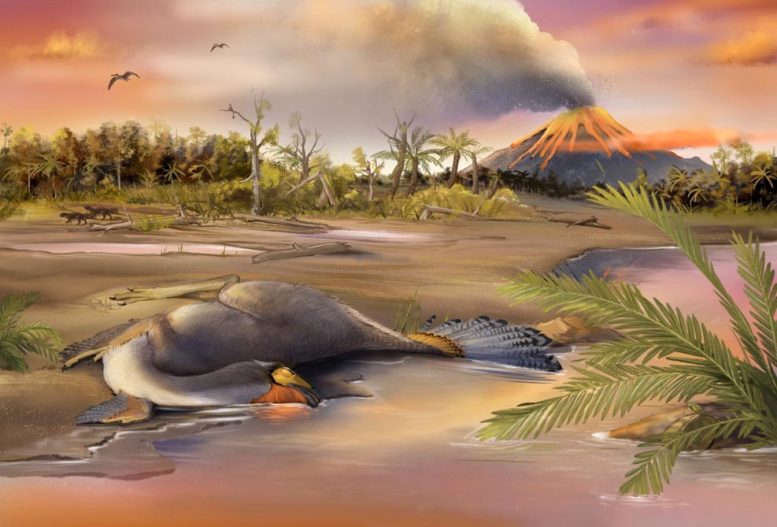 Reconstruction of the Jehol biota and a well-preserved specimen of caudipteryx. Credit: Image by ZHENG Qiuyang.
During the study, paleontologists extracted a piecedistal articular cartilage from the right femur of the specimen, decalcified and used various microscopic and chemical methods of analysis. All cells were mineralized by silicification after the death of the animal. This silicification, most likely, contributed to the excellent preservation of the dinosaur cells.
The safety of the find turned out to be so unique thatthat experts were able to examine some original biomolecules in cells and chromatin threads. According to the authors, such research brings science closer to successfully sequencing dinosaur DNA. Caudipteryx cells are not completely fossilized and still contain remnants of organic molecules. In the future, scientists plan to find out whether they have retained any biological information and DNA remains.
Read more
Astronomers accidentally find two galaxies at the edge of space and time
People first descended to the bottom of the "Hell's Well": what did they find there
Chinese jet drone flies a record 20 hours at a speed of 800 km / h