Scientists from Tsinghua University, Zhejiang University and the Chinese Academy of Sciences have developed an algorithm
In their work, the researchers usedsystem consisting of two plasmids. These are small DNA molecules isolated from chromosomes and capable of autonomous replication. The scientists injected two of these CRISPR-edited molecules into Escherichia coli (Escherichia coli) cells.
To ensure efficient recording, storage andreliability of rewriting information, geneticists have used various CRISPR-associated proteins (Cas) and recombinase. They used CRISPR RNA molecules matching the right information to find and overwrite the right information. In doing so, the recombinase remodeled the DNA to prepare it for encoding new information.
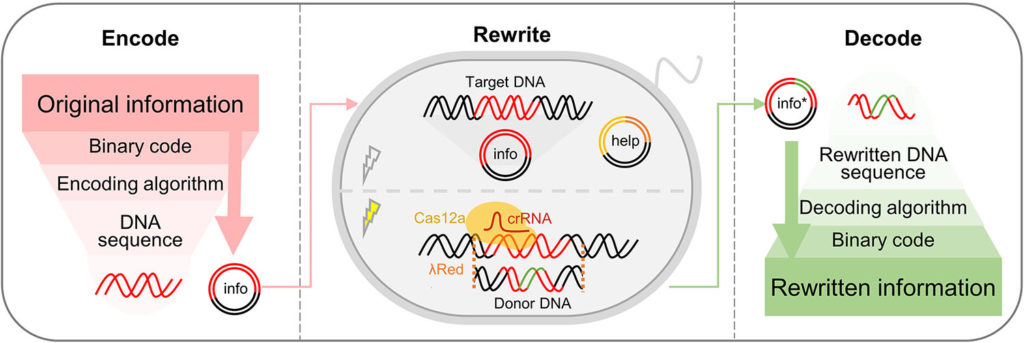 Experimental design.Digital information was encoded into DNA sequences using a high-density encoding algorithm. The sequences were then cloned into a living cell plasmid. Rewriting of information was carried out using a two-plasmid system based on CRISPR-Cas12a-λRed, the coding matrix of which was cloned into the plasmid. The original information was specially rewritten by replacing the target DNA fragment in the infoplasmid with a donor DNA fragment. After verification, the transcribed information was deciphered by decoding the DNA sequence in the new plasmid. Image: Yangyi Liu et al., Science Advances
Experiments have shown that with thistechnology, the optimized CRISPR RNA sequence is easily adapted to record changes in any complex information. Geneticists have been able to achieve an overwriting reliability of 94%. At the same time, the rewritten information was stably preserved and amplified over hundreds of generations of the bacterium.
DNA data storage technology has two modes,explain the authors of the work: "in vitro hard disk mode" and "in vivo CD mode". The advantage of storing information in living cells is inexpensive and reliable replication. This mode can therefore be used to distribute copies of data quickly and inexpensively.
The researchers believe that the plasmid systemcan serve as a universal platform for rewriting information based on DNA "in vivo". It can be used as a new strategy for information processing and targeted rewriting of large and complex data at the molecular level. However, the same approach can be applied to a living host with a larger genome, such as yeast, to store more data.
Read more:
“This is science fiction”: scientists create a fundamentally new type of quantum computers
The length of the earth day is increasing. Scientists don't know why
What are supergenes and how do they make animals so weird