Scientists in China have isolated a 100-kilobase genome from one type of oil-producing microalgae by deleting genes
The resulting microalgae with a “minimal genome” will potentially be useful as a model organism for further study of the molecular and biological function of each gene.
The study is published inThe Plant Journal.
Creating a "minimal genome" —a genome stripped of all duplicated or apparently non-functional "junk genes" —is useful for investigating fundamental questions about genetic function and for designing cellular factories that produce valuable compounds.
Such minimal genomes are made for simpleorganisms, but rarely for eukaryotic organisms, including algae or plants. In higher eukaryotes, garbage regions can occupy up to 70% of the genome. Removing what appears to be unwanted genes can actually have harmful effects on the body or even kill it.
For the first time, QIBEBT researchers have created a genome with target deletions of 100 kilobases each for a type of algaeNannochloropsis oceanica.
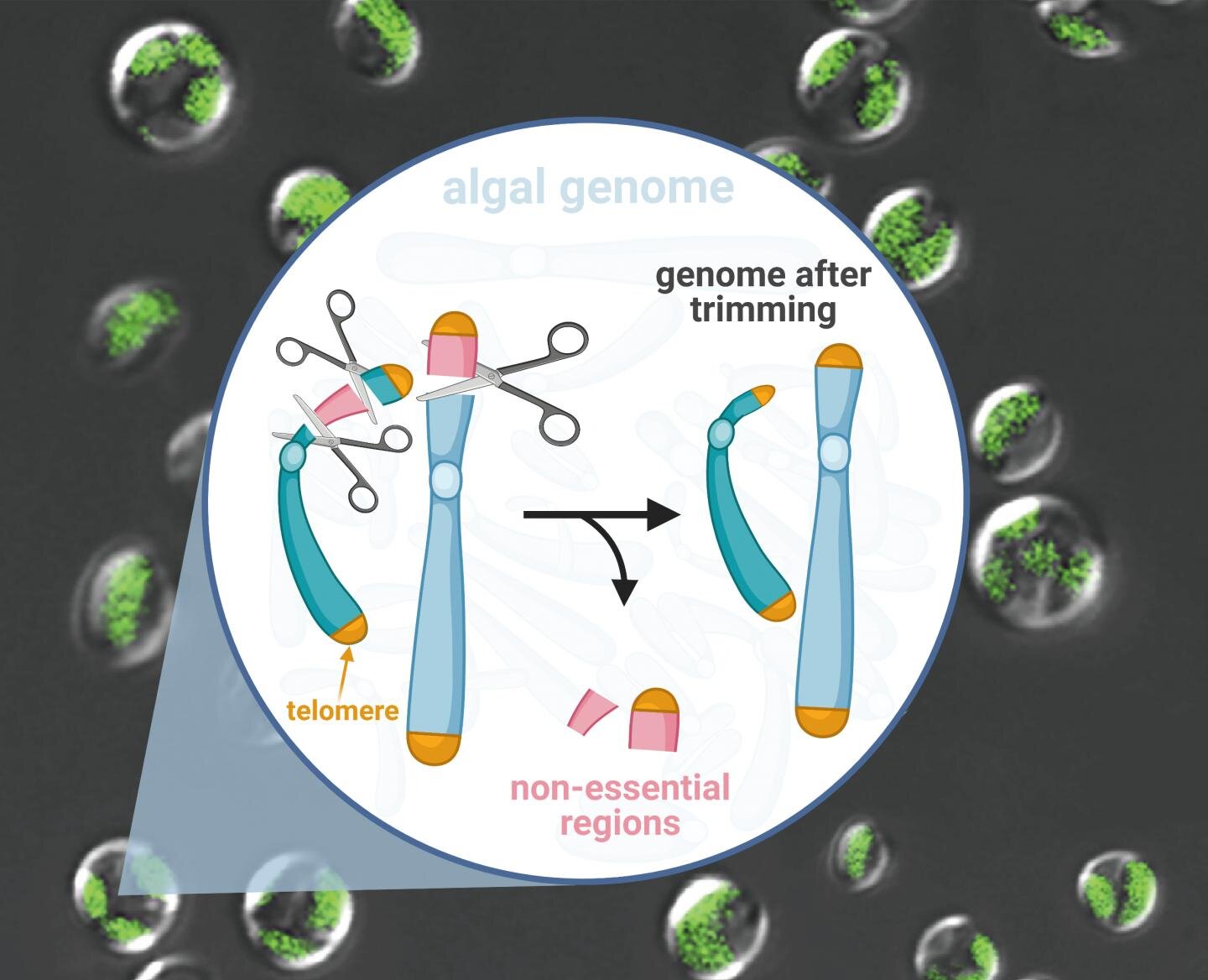 Deletion of hundreds of kilobase fragments in microalgae by cleavage of Cas9. This drawing was done with BioRender. Credit: Liu Yang.
N. oceanicaare microalgae (single-celled algae) that have great potential for the production of biofuels and biomaterials.However, realizing the potential of these microalgae requires extensive genetic engineering of the body to maximize yields and minimize production costs.
The QIBEBT team first identified non-essentialchromosomal regions are those whose genes are rarely expressed or activated. They identified ten such "Low Expression Regions" (LERs). They then used the CRISPR-Cas9 gene editing technique to cut out the two largest LERs - over 200 kb in size.
Despite all the surgeries, the microalgae still showed normal growth, lipid content, fatty acid saturation levels, and photosynthesis.In some cases, the growth rate and productivity of the biomass was even slightly higher than that of the organism in the wild.Thus, the application of genomic scalpel technology has made the eukaryotic algae a real generator of biofuels.In addition, the scientists found normal telomeres in mutants with telomere deletionThis phenomenon implies that the loss of the distal portion of the chromosome caninduce telomere regeneration.
Now that they've proven they can carvegenome of such a complex eukaryote, researchers will try to excise even more LER and other non-lethal regions. The goal is to create a completely minimal Nannochloropsis,which produces biofuels from CO₂ with maximum efficiency.
Read more
Physicists have created an analogue of a black hole and confirmed Hawking's theory. Where it leads?
Solar energy made liquid fuel in China
Oxygen will definitely disappear: what will happen to the Earth without the main source of life
LER - low-expression regions
Cas9(Eng.CRISPRassociated protein9, CRISPR-associated protein) is a controlledwith the help of RNA guides, an endonuclease associated with the adaptive immune system CRISPR (Clustered Regularly Interspaced Palindromic Repeats) in a number of bacteria, in particularStreptococcus pyogenes.S. pyogenesuses Cas9 to store, inspect, and cut foreign DNA, such as bacteriophage or plasmid DNA.
Telomeres are the ends of chromosomes. Telomeric regions of chromosomes are characterized by the lack of the ability to connect with other chromosomes or their fragments and perform a protective function.
Deletions (from lat.deletio - destruction) - chromosomal rearrangements, in which there is a loss of a portion of the chromosome. The deletion can be due to a broken chromosome or the result of unequal crossing over. By the position of the lost chromosome region, deletions are classified into internal (interstitial) and terminal (terminal).