Physicists have created and discovered for the first time high-energy “ghost particles” inside the world’s largest
What are neutrinos?
The name neutrino is consonant with the word“neutral” for a reason. They have zero electrical charge and almost zero mass. This means that they almost never interact with other types of matter. Neutrinos are called ghost particles for a reason—they “fly” through ordinary matter at a speed close to the speed of light without changing. Every second, about 100 billion neutrinos pass through every square centimeter of the human body.
Where did neutrinos come from?
Neutrinos are space wanderers.Some of them arise from nuclear reactions in the Sun, when atoms fuse deep inside the star. They release neutrinos, which fly away from the star in a matter of seconds. Some ghost particles come from nuclear fission here on Earth, such as in nuclear reactors. Even decaying potassium inside a banana can emit neutrinos, according to the US Department of Energy.
Neutrinos were first discovered escaping from a nuclear reactor in 1956. After photons, they are considered the most abundant subatomic particles in the Universe.
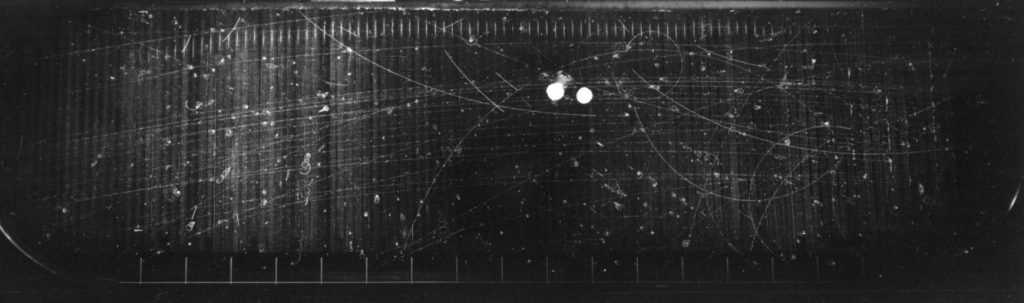 Two neutrinos. Photo taken July 4, 1959, NARA & DVIDS Public Domain Archive — GetArchive
But despite their ubiquity,the minimal interaction of chargeless and nearly massless particles with other matter makes them incredibly difficult to detect. To catch them, scientists and engineers are building neutrino detectors around the world. The most famous of them is the IceCube Neutrino Observatory, which is located at the South Pole.
The unique manifestation of neutrinos was explained after almost 10 years: why is it so important
He and other famous neutrino detection experiments such as Japan's Super-Kamiokande detector, MiniBooNE Fermilab detected neutrinos generated by sunlight.
The most "important" neutrinos
Most of all, scientists are intrigued by neutrinos at highenergies. They are born when stars merge, supernovae are born, and when particles from deep space crash into the Earth's atmosphere. These high-energy ghosts have until now remained a mystery to scientists.
Now physicists have discovered neutrinos usingFASER detector at the Large Hadron Collider (LHC), the world's largest particle accelerator, located at the European Organization for Nuclear Research (CERN) near Geneva, Switzerland. The scientists presented the research results at the 57th Rencontres de Moriond Electroweak Interactions and Unified Theories conference in La Thuila, Italy. “We discovered neutrinos from a completely new source—particle colliders—where two beams of particles collide with each other at extremely high energies,” said Jonathan Feng, a physicist at the University of California, Irvine and co-chair of the FASER Collaboration.
FASER experiment
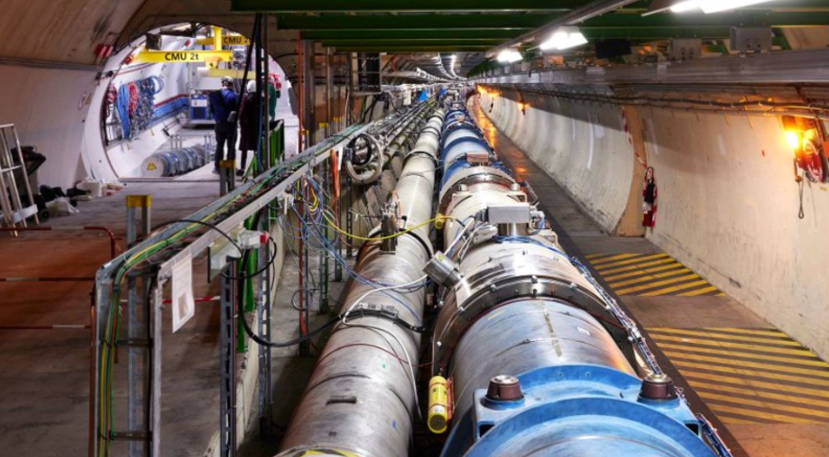
Forward Search Experiment (FASER) - detectorparticles, designed and built by an international team of physicists from CERN. While particle detectors at CERN are famous for being several stories tall and weighing thousands of tons, FASER is an exception.
FASER weighs about a ton and fits in a smallCERN's side tunnel. Interestingly, it was developed in just a few years and uses spare parts from other experiments conducted at the facility.
 FASER
FASER
On Sunday, FASER team scientists announced at a conference in Italy that they had successfully detected neutrinos after two beams of extremely high-energy particles collided inside the LHC.
In addition to neutrinos, the FASER project also aims todark matter. Dark matter, which is believed to be present in most of the matter in the Universe, has never been detected before. As with neutrinos, FASER may also be the first experiment to help detect dark matter when in CERN will begin a new round of particle collisions in a few months.
How did physicists do it?
To catch "subatomic ghosts", physicistsbuilt a particle detection trap: dense metal plates of lead and tungsten, sandwiched with several layers of a light-detecting emulsion. When powerful beams of protons collided inside the LHC, they produced a stream of side particles, a small proportion of which were neutrinos. They crashed into atomic nuclei in dense metal plates and disintegrated into other particles. The emulsion layers worked the same way as old-fashioned photographic film—reacting with neutrino byproducts, they imprinted the traceable outlines of particles as the neutrinos zipped through them.
Working with this film-like emulsionand by analyzing the particle tracks, physicists found that some of the marks were the result of jets of particles created by neutrinos as they passed through the plates. Scientists have even determined which of the three “flavors” of neutrino particles—tau, muon, or electron—they found.
Six neutrinos discovered in the courseexperiment, was first identified in 2021 . It took physicists two years to collect enough data to confirm that it was them. Now scientists hope to find many more neutrinos and plan to use them to study environments throughout the Universe where high-energy ghost particles are formed.
Why is it so important?
“These very high energy neutrinos in the LHC are importantto understand truly exciting observations in particle astrophysics,” Jamie Boyd, CERN physicist and co-chair of FASER. With new discoveries, physicists hope to explain how stars burn and explode; how high-energy neutrino interactions lead to the formation of other particles in space.
Read more:
Scientists believe that the shape of the universe is not what everyone thinks
NASA helicopter showed sunset on Mars. It doesn't look like earth.
Named a plant whose extract helps to lose weight without side effects