The human brain is the most sophisticated computer that has ever existed, and mapping this onecompact
The researchers started with a sample taken fromthe temporal lobe of the human cerebral cortex, measuring only 1 mm³. It was subdivided into 5,300 slices, each about 30 nanometers (nm) thick. Then the samples were scanned using an electron microscope with a resolution of up to 4 nm. As a result, the scientists created 225 million two-dimensional images, which were then combined into a three-dimensional image.
Machine learning algorithms scanned the sample,to identify the various cells and structures inside. After several passes through various automated systems, the scientists checked the data to make sure the algorithms were correctly identifying it.
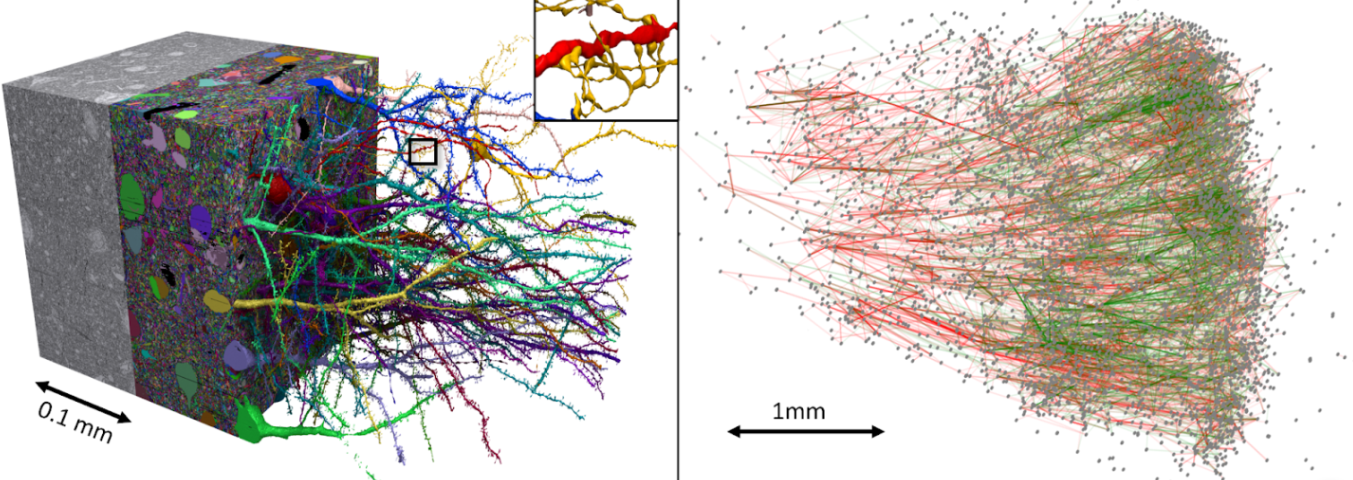 Right: A subgraph of neurons, excitatory neurons in green and inhibitory neurons in red.
Google / Lichtman Lab
The end result that Google callsdataset H01, is one of the most complete maps of the human brain ever produced. It contains 50,000 cells and 130 million synapses, as well as smaller segments of cells - axons, dendrites. The map is composed of 1.4 petabytes of data - that's over a million gigabytes.
A companion job preprint is available on the bioRxiv website.
Read more
A combat drone for the first time without a human order tracked down the enemy and attacked
New exoskeleton reduces human stress while walking
A mathematical model of the brain will allow AI to think like a human