Nurse - point of contact for patients
— Does outpatient treatment have an advantage over
- Economists have concluded that the costs ofthe contents of hospitals and outpatient clinics are approximately the same, but the latter satisfy patients' needs much better. Certain things do not change: symptoms, patient behavior. But the quality of service, the effectiveness of treatment, the availability of the environment improved significantly with the advent of outpatient hospitals. There is a problem with the system based on long-term hospitalization. When treatment ends, the patient enters a different environment, and he often immediately relapses, he again enters the hospital. That is, there is no continuity in treatment.
- How does the system of outpatient psychiatric treatment work?
- We have created new principles for an ambulatory systempsychiatry. Services and services should be as close as possible to the place where people live. Different types of teams of outpatient psychiatry work with patients: district, territorial and specialized.
When we started this project in the 90s, in the southLondon lived 1.2 million people. We drew lines on the map, dividing the territory into sections of 50-60 thousand people, and created an outpatient team of doctors, nurses, psychologists and therapists for each territory. Teams can be formed depending on what kind of staff is available: in some countries there are more doctors than nurses, and somewhere, on the contrary, there are no doctors at all.
 Photo: “Healthy Moscow”
Service offices are located outside hospitals, on normalshopping streets with good transport links so that patients and their families can easily reach them. Basically, contacts with patients took place either at home, or in clinics, or even in a cafe, but not in a hospital. In addition to receiving at the office, 1-2 cars were attached to the team so that patients could be visited at home.
We use a system calledcare coordinator, or case manager. For example, a nurse can sometimes have 20–40 patients, and this nurse is the main point of contact for them. And its task is to coordinate for the patient all aspects of care, including communication with doctors.
- Can the results of the reform in England be analyzed and accepted as recommendations by world organizations?
- WHO has developed a very large numberpractical and very useful documents. Most of them are now translated into Russian, and are in the public domain. The overall strategy, a toolkit called the “Implementation System”, is now being updated in Geneva. These are recommendations for the organization of primary health care, evidence-based outpatient psychiatry, control, monitoring, and detailed implementation instructions. And now more than 100 countries are using this approach.
“We can assume that society has gone crazy, but people with mental illness need treatment”
- There is a stereotype that people suffering from mental illness need to be isolated from society. Is outpatient psychiatric care possible?
- In many countries of the world, the provision of psychiatriccare is conducted at a hospital base in a hospital setting. And this is an important part of a quality mental health system. But when such services are provided only in the hospital, problems can arise. For example, if patients are in very poor condition, they simply will not come to the clinic to meet with the doctor. Therefore, it is necessary to provide access for services at home to the patient to check how well he is feeling.
In addition, it is very important to take into account the attitudeemployees. Do they listen to patients or not, do they know their preferences? What are the priorities of doctors in matters of treatment? Does the psychiatrist respect the patient's dignity during the interaction or not?
After all, creating and developing public services,we have a big problem: in general both in society and among the population there is a certain stigma. When you want to open a new mental health hospital somewhere, of course, the whole community that lives there is very unhappy. I live and work in England. And this is precisely what we have encountered.
- People tend to evaluate their adequacy by correlating actions with public attitudes. Can a person determine that this society is crazy, and he is in a sober mind and sound memory?
“There are people who say that.” I have been working as a psychiatrist in my country for 30 years, treating people with psychoses and schizophrenia. And usually people with these disorders do not feel very well. For example, they can hear voices, see something, they may have paranoid thoughts that they are being pursued. It is difficult for them to speak clearly and think. That is, it is obvious that these people feel bad.
There are three types of treatment that makepeople can greatly improve their condition or fully recover. Often psychological treatment is needed - conversation therapy. The second option: social rehabilitation, so that they go to college or work. And the third: they need medicine. Often, patients need all three of these factors together.
Of course, sometimes we may think that society has gone crazy, but people with mental problems need effective treatment, help and care.
- Is it possible to somehow treat persistent social phobias?
- Social phobias occur when people find it difficultbe in society. And they strive to avoid this, sitting in some quiet corner or even not even leaving home. Yes, it can be cured, this is called behavioral cognitive therapy. The most effective is psychological treatment through conversation. It is necessary to gradually include people in difficult situations for them using some psychological techniques, for example, “My heart beat faster, but it does not explode” or “I began to breathe faster, but I won’t suffocate”.
- How do approaches to treatment in psychiatry differ in different countries? For example, in the UK, Russia and some less developed country.
- Let's start with what is common between differentcountries. In every country, very little money is spent on mental health. If you take 100 people with mental problems, then even in the richest countries, for example, in the USA, only 30 people (i.e. 30%) will receive any help or treatment. That is, even about 70% of people with mental illness do not receive any help. And if we turn to the opposite - to the poorest countries, for example, to Ethiopia, then here the indicators are generally 10 out of 100, or maybe just two. That is, 2% actually receive treatment for mental illness.
According to WHO, the level of development of psychiatric care primarily depends on the overall level of economic development of the country.
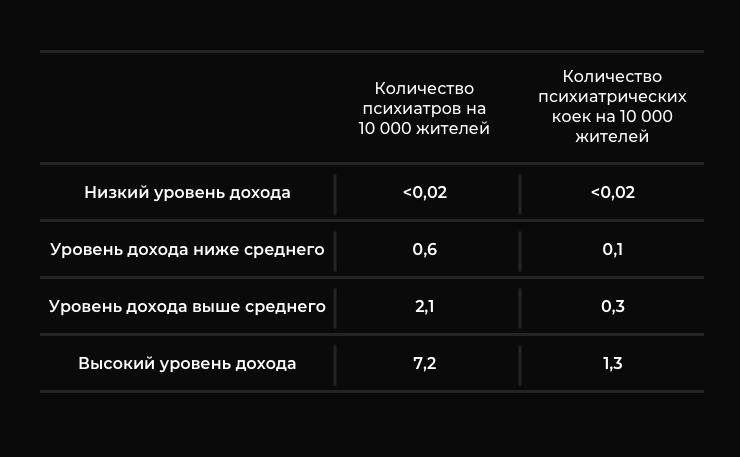
What all countries have in common is that we do extremely little in terms of mental health. That is, services are provided in insufficient quantities. And speaking of quality...
All countries from the point of view of mental health care can be divided into three categories.
In the poorest countries, psychiatrists or specialiststhere is virtually no mental health. There remains only the primary link of health care - the only one where people can get some help. And then the question arises: how should we train employees working in this link so that they can detect mental illness? This is exactly what WHO prescribes - to help employees working in primary care.
The second category of countries - most of ithealth care is concentrated in hospitals. There, of course, high-quality treatment is possible, but there are also places where people get into a psychiatric institution and stay there forever. Some hospitals do not provide a system that facilitates patient release and support during rehabilitation. Hospital staff can sometimes act tough and insensitive instead of showing empathy for the patient.
 Photo: Healthy Moscow
And there is a third category of countries wherehospital-level service, and social orientation. This is, of course, polyclinics, clinics, psychiatric hospitals, but, in addition, there are community mental health centers and medical dispensaries. They can act more flexibly. Employees can come to the patient's home or to work, chat with his boss. For example, someone had a bad time, but now he is in the process of improving, and he wants to return to his work. Maybe to start working 2-3 days a week. This is called a gradual return to work. Then it will be 3-4 days a week, and then full five days. Over the course of several months, this time increases to help a person recover completely.
“We won’t let schizophrenics go!”
- What does society fear when it comes to psychiatric patients? How did you manage to change public opinion?
— We gradually involved members of the localcommunities into dialogue. For example, plans were made to open a day visiting center in a residential area in south London to provide rehabilitation and recovery opportunities for patients. So that they feel independent in matters such as shopping, cooking or cleaning. When the local community heard about these plans, they were completely against it. They said: “We are afraid that these patients will attack us. We are afraid for our children - they will be at risk. We are afraid that there may be needles contaminated with hepatitis or HIV in the trash containers.”
Daria Dovbysh, a clinical psychologist and family therapist, says:
"That all people with mental illnessdeviations, dangerous to society - a myth. Most of these statements are incorrect and based on ignorance, on the repulsive, punitive image of psychiatry, on one’s own fear, on the impossibility of even assuming that a mental illness can happen to every person, including a successful, educated, wealthy, intelligent person. In fact, only a few mental illnesses are really associated with low intelligence. ”
Explains Arkady Shmilovich, psychiatrist, headmedical and rehabilitation department of the PKB No. 1 named after N. A. Alekseev: “About 10 years ago, specialists of the Scientific Center for Mental Health of the RAMS conducted a whole study, trying to understand where such myths come from. It turned out that in 80% of the materials of our leading media, patients are presented as rapists. Less is like unpredictable people and ridiculous cranks, but it's hardly better. ”
Therefore we met with people representingthe local community, church, parents, and explained: “The people who enter this center are not new people at all. These are those people who already live among you. What do you like best: so that these people get good treatment, bad or none at all? And if, for example, you start to get depressed or do I get depressed and need care? ” Usually, after a considerable number of meetings and conversations, the local community still agrees with this plan.
- How can you convince society not to tear away sick people, but to help them in socialization?
- A barrier at the community level, this stigma orthe stigma can only be reduced gradually, using social contact methods - that is, patients talk about their experiences to help others learn about mental illness and gain sympathy. When we started developing outpatient services, we had a strong negative reaction from local people. For example, protests with the slogans “We will not let schizophrenics go!” or "Get out!". I was involved in the development of six different outpatient centers in London, and each time we had such a reaction from the local community. We had to spend a lot of time and explain why there will be fewer patients in each district of the city.
How to help society understand? Western countries have adopted national anti-stigma programs. For example, in England there is a program called “It's time to change.” And now we have many famous people talking about their experience of mental illness - these are actors, musicians, athletes, politicians. A lot of people can now openly talk about their experience, and studies show that it really reduces stigma over time.
- You consistently advocate for socialadaptation of persons with mental illness. Does this approach pose a danger to society itself? How incapable are people able to control their actions?
- The idea that people with mental problemsdangerous, greatly exaggerated. Most people who have mental problems are no more dangerous than people without these problems. If you take patients with anxiety, panic attacks and attacks or depression, then they are no more dangerous than all other ordinary people. We must help society understand this in order to reduce the stigma and exclusion of these people.
However, there is a very small group of patients withmental problems that have a risk. This is especially true for people with schizophrenia. Moreover, they have not only schizophrenia - it can be associated with drugs and alcohol, as well as with antisocial behavior or violence. And, of course, these patients should be kept in hospitals.
But most of these people live just incommunity with very close clinical contact and observation. Many of them regularly take medication. They often visit a nurse (once or twice a week) and are constantly monitored to see if they pose a risk to other people.
- People are ashamed to suffer from a mental illness due to the attitude towards them in society. Is stigma so big a problem?
— Because in every country in the world there is stigmatizationis a big problem, we are developing ways to reduce this aura of shame in all countries. First of all, we identify those patients suffering from mental illness and ready to talk about their problems. This has an even greater impact if they talk about their problems on television, through films, social networks or on the radio.
We want to introduce mental problemshealth as something normal, like a regular illness like diabetes or epilepsy, since everyone can have these problems. This year, a quarter of the world's population will experience mental illness, but with the right treatment, people can recover, and then reintegrate into society and continue to live a normal life.
For example, my own mother.When she worked as a nurse in her youth, she developed severe depression and had thoughts of suicide. And she felt very bad. She wanted to kill herself, and my sister, and me. Luckily, she received treatment, made a full recovery, was cured, and never suffered from depression again. She returned to work, but never told her boss why she was not at work - she was afraid of this very stigma, even within the health service.