In the 1920s, debate raged among scientists about the size of the Universe and the nature of nebulae. Some of them
The scientist calculated the distance to the nebulaAndromeda and showed that it is larger than the size of the Milky Way, which means that we are talking about a separate galaxy. And in 1929, the scientist published a paper in which, based on observations of several known galaxies, he showed that they are moving away from the Earth in different directions. The rule that establishes the relationship between the distance to a galaxy and its radial velocity is called the Hubble law or the Hubble-Lemaitre law.
Belgian priest and astrophysicist Georges Lemaitre came to the same conclusions two years before Hubble, but his paper, published in French and in an unpopular magazine, went unnoticed.
The modern cosmological model is based onprinciple of the expansion of the universe. However, alternative methods of observation give different values for its speed. Scientists continue to develop new ways to finally put an end to this issue. And after that, accurately determine the age, evolution and composition of the universe.
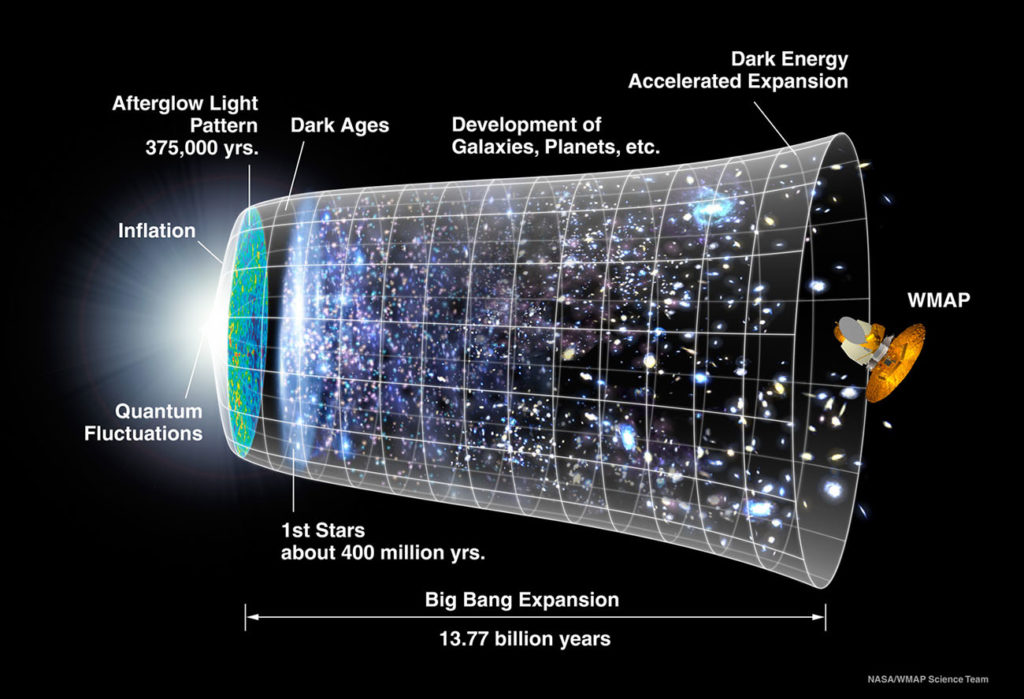 Map of the expansion of the universe. Image: NASA, WMAP Science Team
Is the universe expanding?
There is no exact answer to this question becauseit is impossible to go outside the system and see from the outside how things really happen. But the theory of the expanding universe best describes observations.
First, space exploration revealsredshift: it turned out that the farther objects are from us, the more radiation from them, shifts to the red part of the spectrum. In his paper, Hubble showed the relationship between distance and redshift. In addition, he found that the speed of receding objects is proportional to the distance to them. These observations are best correlated with metric (linear) expansion.
Secondly, large-scale cosmological observationswith deep resolution they found that although on local scales the Universe is a “lumpy” structure (galaxies form groups separated by voids), at large distances it is homogeneous.
Thirdly, the homogeneity of space, caused by the expansion of the Universe in all directions, confirms the homogeneity of the distribution of distant gamma-ray bursts and supernova explosions.
And finally, the observations of the European Spaceobservatories show that the CMB was much warmer in earlier times. The gradual uniform cooling of the traces of the Big Bang is also consistent with the theory of a uniformly expanding universe.
How is the Hubble constant measured?
The value of the constant that setsthe relationship between the speed of movement of galaxies and the distance to them is estimated by measuring the redshift of distant galaxies and then determining the distances to them by some other method other than Hubble's law.
The first measurements of the constant were carried out by Edwin himselfHubble. Observing the Andromeda Nebula using the 100-inch (254 cm) telescope at Mount Wilson Observatory, the scientist identified individual bright stars in its composition. Among them were Cepheids. This is a class of pulsating variables of yellow giants and supergiants, for which the relationship between the pulsation period and luminosity is well studied.
By measuring both parameters, the scientist calculatedthe distance to these stars, as well as the redshift of galaxies, which makes it possible to determine their radial velocity. The coefficient of proportionality obtained by Hubble was about 500 km/s per megaparsec (Mpc). This means that objects located at a distance of about 3.26 million light years (1 Mpc) from the Earth should move away from us at a speed of 500 km / s, 32.6 million light years - 5,000 km / s, and so on.
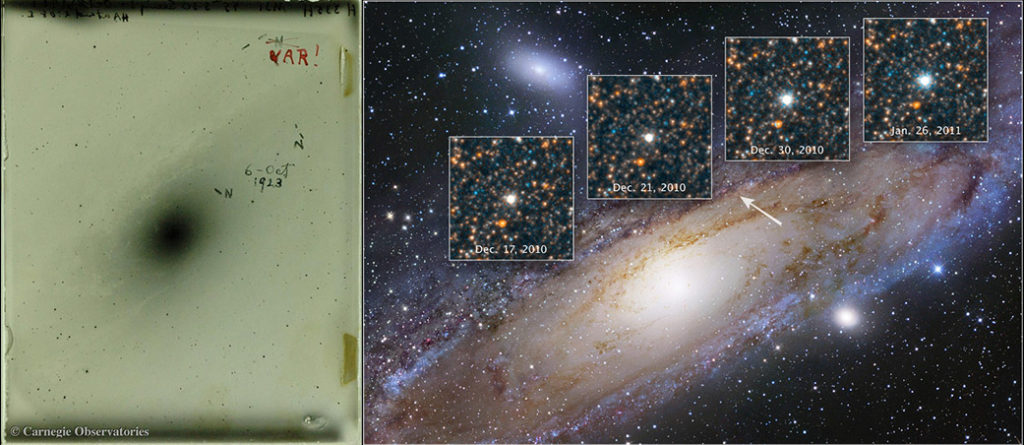 An image of the Andromeda galaxy in which EdwinHubble noted the discovered variable star (left) and its detailed Hubble image (right). Left image: Carnegie Observatories. Right Image: NASA, ESA, the Hubble Heritage Team (STScI/AURA)
The value obtained by Hubble is significantdiffers from modern observations. This is due to the fact that the scientist did not know the laws discovered later that affect the dependence of the period and luminosity of Cepheids, as well as the influence of the own speed of the local group of galaxies.
Modern observations give contradictoryresults. Late Universe measurements similar to those made by Hubble, but with new data and more powerful instruments (including a space telescope named after the scientist), predict a cosmological constant of 73 ± 1 km/s per Mpc. And the data obtained in the study of the cosmic microwave background radiation of the early Universe is 67.4 ± 0.5 (km/s)/Mpc.
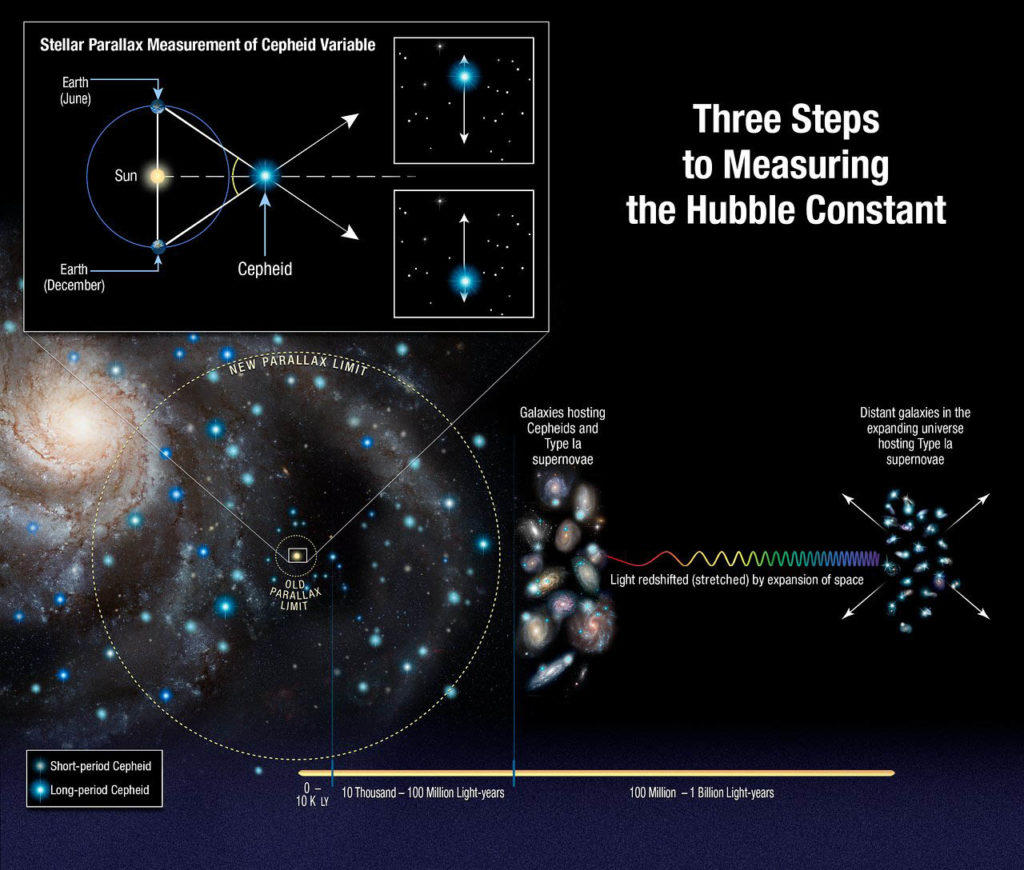 Scheme for measuring a constant using the Hubble telescope. Image: NASA, ESA, A. Feild (STScI), and A. Riess (STScI/JHU)
Are there alternatives?
In a paper published in August in the journalPhysical Review Letters, scientists at the University of Chicago propose using gravitational waves generated when black holes collide to measure the expansion rate of the universe.
An effect similar to redshift occursduring the propagation of gravitational waves. Collision of supermassive black holes, a powerful event. It causes gravitational waves in space-time that spread like ripples on water from a fallen stone.
This "ripple" is measured on Earth by the Americanlaser interferometric gravitational wave observatory (LIGO) and the Italian observatory Virgo. For several years, both observatories have collected data on the collision of more than 100 pairs of black holes.
The signal from each collision containsinformation about how massive black holes were. But due to the expansion of the universe, it is distorted. As a result, a black hole farther away begins to appear more massive.
Scientists propose to use accumulated dataabout black holes in order to “calibrate” the device. For example, current evidence suggests that most black holes discovered have a mass between 5 and 40 times the mass of our Sun.
Researchers believe that if you measure the massespairs of colliding black holes closest to us, and then gradually move on, then on a large number of examples it is possible to establish how much the “observed” masses of black holes change as the distance increases. It is this value that will determine the rate of expansion of the universe.
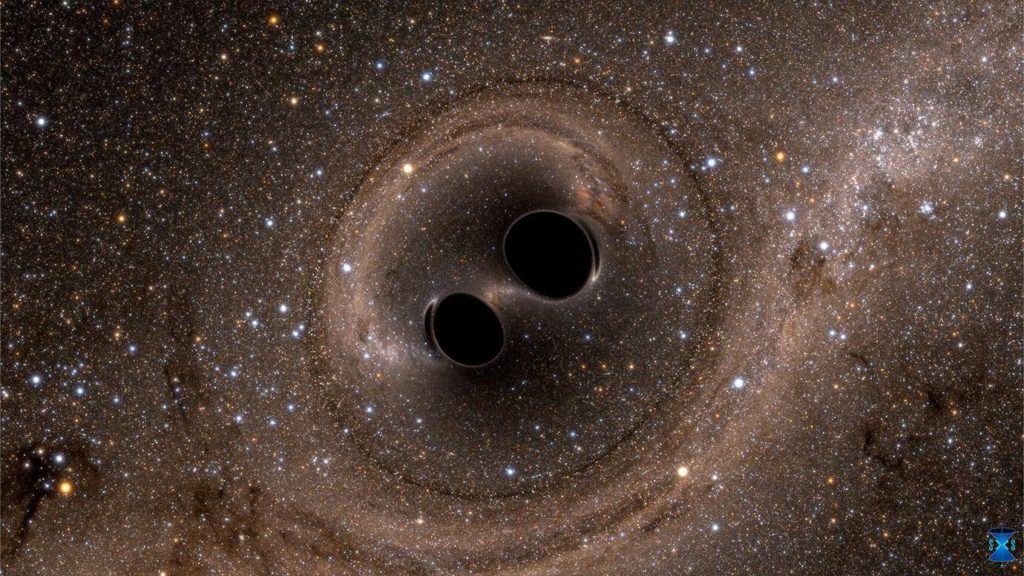 An illustration of the merger of two black holes. Image: Simulating eXtreme Spacetimes (SXS) Project, University of Chicago
The disadvantage of most modern methodsobservation of the expansion of space is that individual causes that distort the result obtained may not yet be known. Hubble did not know about all the factors that affect the relationship between luminosity and pulsation periodicity in Cepheids, so his measurements contained errors. Also, modern ideas about the Universe, matter and the propagation of electromagnetic waves may be incomplete.
Unlike cosmological observations, the methodproposed by scientists from Chicago, uses only the theory of gravity, which is much better understood. So, there was a chance to put an end to the issue of the rate of expansion of the universe.
Read more:
Record coronal mass ejection at Betelgeuse is 400 billion times larger than the sun
Megalodon ate an animal the size of a killer whale at a time
Everest found traces of DNA that should not be there