Tracking changes in vast bodies of ice is key to understanding the impacts of climate change on
The technology uses a fiber optic cable,which emits laser pulses along its entire length, extending from the surface of the shield to its base - 1,000 meters down. By analyzing the distortion of scattered light when the pulses hit ice, the system determines its temperature.
The new tool is already changing scientists' ideas about the distribution of temperature in ice sheets.
 Using fiber optic cables, scientists have developed a method to more accurately measure the temperature of the Greenland ice sheet.
Paul Christoffersen and the RESPONDER team
Previously it was believed that the temperature of ice sheetsmoves at a smooth angle. Moreover, the hottest segments are at the surface level, where sunlight enters, and also at the base, where they are heated by geothermal energy and friction, when the ice sheet slides along the subglacial scene towards the coastline.
A new study has shown that temperaturethe variance is more heterogeneous. It is characterized by spatial deformations that heat the ice. They accumulate at the boundaries between ice of different ages and types. Perhaps the deformations appeared due to volcanic emissions in the past.
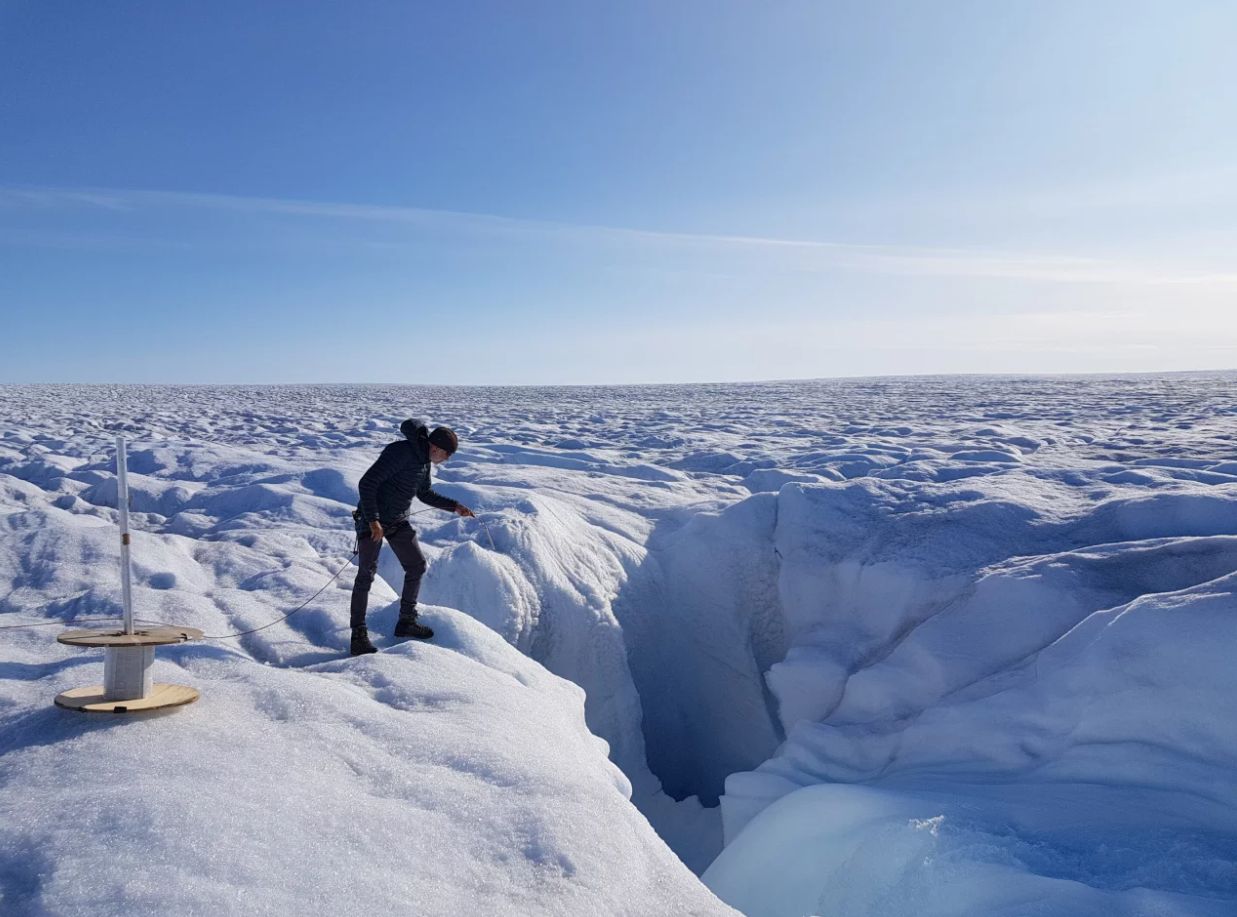 Researchers install fiber optic cable on the Greenland ice sheet.
Adam Booth and the RESPONDER team
Today the Greenland ice sheet is melting withat an alarming rate, with mass loss having increased sixfold since the 1980s and now contributes more to sea level rise than any other source. Understanding how ice moves and the thermodynamic processes below the surface will enable scientists to more accurately model the melting process and better prepare for the future.
Read also
Elon Musk: the first tourists to Mars will die
The first accurate map of the world was created. What's wrong with everyone else?
The first electric motor with 95% efficiency appeared