An agreement on the supply of spent uranium was concluded with Rosatom. The department claims that in Russia
What's the matter and what kind of waste are we talking about?
At every stage of nuclear production workEnergy creates tons of waste and materials that are almost impossible to reuse. Because of this, spent fuel began to accumulate in France.
This became a problem for the French nuclearindustry: the country is now actively promoting nuclear energy as environmentally friendly and convenient, but a large amount of waste stands out from this ideal picture.
To get rid of the spent material, the French companies EDF and Orano decided to resume selling regenerated uranium to Russia.
Greenpeace France conducted an investigation andfound that Orano, which produces and reprocesses nuclear fuel, is going to resume transporting radioactive waste to Russia after 10 years.
What is known about the nuclear waste that will be brought to Russia?
During their investigation, the authors of the report found inthe largest French port of Le Havre, several tens of tons of uranium, which were obtained as a result of fuel exploitation. He was loaded aboard the Kapitan Lomonosov vessel, which was heading to St. Petersburg on January 12 and 20, 2021.
Greenpeace France realized that it wasregenerated uranium according to labels and designations on containers. Orano confirmed that this is the cargo of the company. And they added that a contract has already been signed with Rosatom for the transportation of more than 1,000 tons of nuclear waste.
Where exactly is the waste being transported and what are they going to do with it?
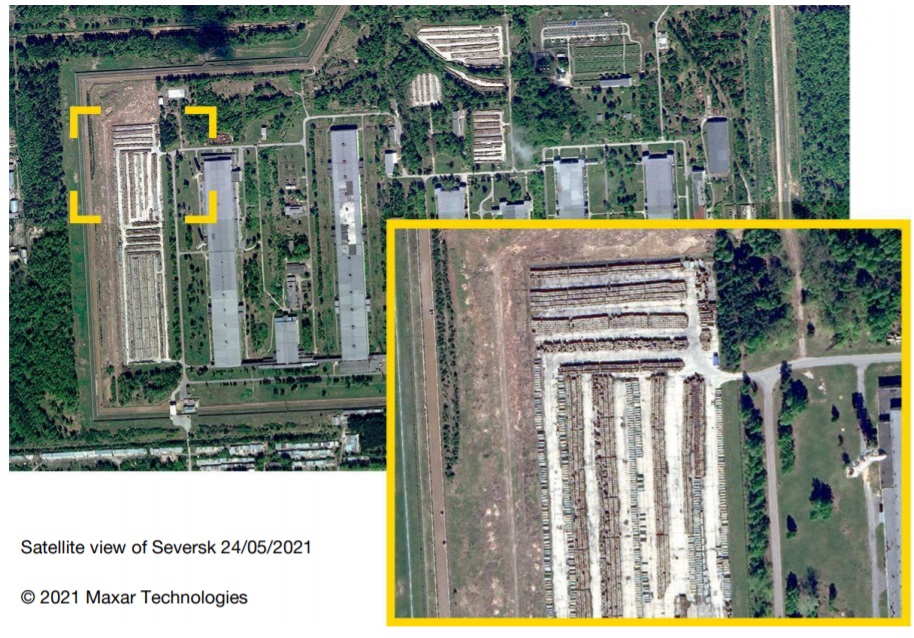
According to Greenpeace, reclaimed uraniumThey will take us to Seversk, a city in the center of Siberia. There is a uranium waste processing plant located there. After processing, the raw materials can be reused for nuclear reactors. The authors of the investigation suggested that Rosatom would first send the spent fuel for reprocessing to Seversk, and then the raw materials would be transported to nuclear reactors.
The report notes that there is already a lot of nuclear waste on the territory of Russia, so perhaps the French spent fuel will simply be stored in Seversk.
The authors published a satellite photograph showing that on the territory of Seversk there are thousands of barrels full of nuclear waste. They are outdoors.
How is nuclear waste processed in Russia and in the world?
In the late 90s, new technology appearedspent fuel reprocessing, which is based on an alternative recycling strategy: it does not release pure plutonium. Let us remember that plutonium can be used to create nuclear weapons. This means the new method reduces the risk that spent fuel will be used to make dangerous weapons.
Countries reprocessing nuclear waste: Great Britain, Russia and Japan - their commercial reprocessing capacity is 600, 400 and 800 tons per year, respectively.
In Russia, depleted uranium hexafluoride (DUHF)stored at four sites: Novouralsk, Seversk, Zelenograd and Angarsk. If we talk specifically about Seversk, where they plan to send the waste, then in the period from the 80s to the 90s they already processed DUHF, says the head of the energy program of the Russian Greenpeace, Vladimir Chuprov. At that time, the waste raw materials were simply divided into the enriched part and the poor part, the first was sold back, and the second was kept for storage.
He noted that French regenerated uraniummore difficult to process, so it still needs to be cleaned before separation. During this process, liquid, solid waste and aerosols are released in three levels of activity: low, high and medium.
It is assumed that high activity wastewill be vitrified - subjected to a method in which radioactive waste is mixed with fluxes and converted into solid glassy materials using heat treatment. It is not yet known what will happen to intermediate and low level waste.
As previously stated by representatives of Rosatom, inRussia has unique technologies that make it possible to once again enrich waste. But so far it is difficult to verify this information, since the representatives of the department do not disclose data on the concentration of isotopes in DUHF, which, for example, were imported into Russia earlier from Germany, citing trade secrets and the stamp of particle board (for official use).
Russian law prohibits the importfrom abroad nuclear waste for storage or disposal. At the same time, the import of nuclear materials for re-enrichment is allowed with subsequent return to a foreign supplier. In 2019, Russia resumed the import of spent nuclear fuel from Germany, which also sparked protests from environmentalists.
How much waste is still going to be imported into Russia?
According to Greenpeace, a new batch of reprocessed uranium is going to be imported to Russia from France; it is scheduled for the end of 2021 - from October to December.
Russia has a reliable way to reprocess spent fuel and enough capacity to harness the full potential of nuclear waste, government agencies say.
But information about how many DUHFs are imported intocountry, details on isotope concentrations, and data on processing technologies are almost absent. Therefore, it cannot be said for sure that the residents of Russia have nothing to worry about.
Read more
"Living fossils" hatched in the American desert. They slept for decades
Chinese open-top electric car maneuvers like a motorcycle and changes the position of the steering wheel
Geneticists found three living relatives in the mummy from Switzerland