An international team of scientists pooled data from more than 900 experts involved in the study of individual
Researchers believe that the key reasonextinction was the increasing destruction of the habitat of these animals. Reptiles are threatened by the same main factors that harm other tetrapods, the authors of the work say - agriculture, logging, urban development and other human interventions. At the same time, it is not completely clear how climate change affects these animals.
“We need to take a different look atpotential hazards because certain groups of reptiles are at greater risk, says Philipp Wagner, research and conservation curator at the Allwetterzoo in Münster, co-author of the study. “The study shows that 58% of all tortoise species and 50% of all crocodile species are endangered — not primarily because of habitat loss, but because of illegal hunting and trade.”
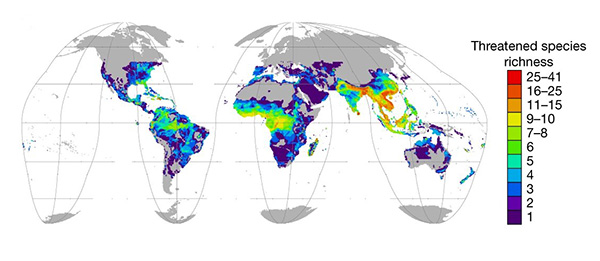 Distribution of endangered reptile species. Source: Neil Cox et al., Nature
Scientists note that for almost 1.5 thousand species(almost 15%) there is currently no data that would allow us to draw a conclusion about potential threats. Since these are mostly species with a small range, researchers believe that most of them are also endangered. This means that the real risks may be even more serious than predicted in the paper.
“Unfortunately, it can be assumed that the estimatesmade in the study are generally very conservative. That is, the degree of threat to many species is underestimated. It is often too late to realize how bad things are for many species, especially reptiles,” says Johannes Penner, co-author of the study from the University of Freiburg and curator of research and zoology at Frogs and Friends.
Read more:
Inexplicable duality found in elementary particle physics: what will it lead to
Look at the alignment of the planets in 2022: the brightest planets are visible in the photo from Earth
Scientists explain how a stem cell "understands" what it will become