Stephen Hawking was one of the greatest theoretical physicists of our time, whose career spanned over 50 years.
Hawking worked for advanced intellectualthe frontiers of physics, and his theories often seemed bizarre. In any case, at the time when he first voiced them. However, they are slowly but surely being accepted in the scientific community. From revolutionary views on black holes to explaining how the universe began, here are some of his theories that have already been confirmed and have not.
Big Bang won
Hawking began writing his doctoral dissertation inthat moment when there was heated debate in the scientific community about how the Universe began. Two competing ideas explained the beginning of everything in their own way: the Big Bang theory and the stability theory. Both accepted that the Universe is expanding, but in the first it is expanding from an ultra-compact, ultra-dense state, and the second assumes that the Universe is expanding forever, while new matter is constantly being created to maintain a constant density.
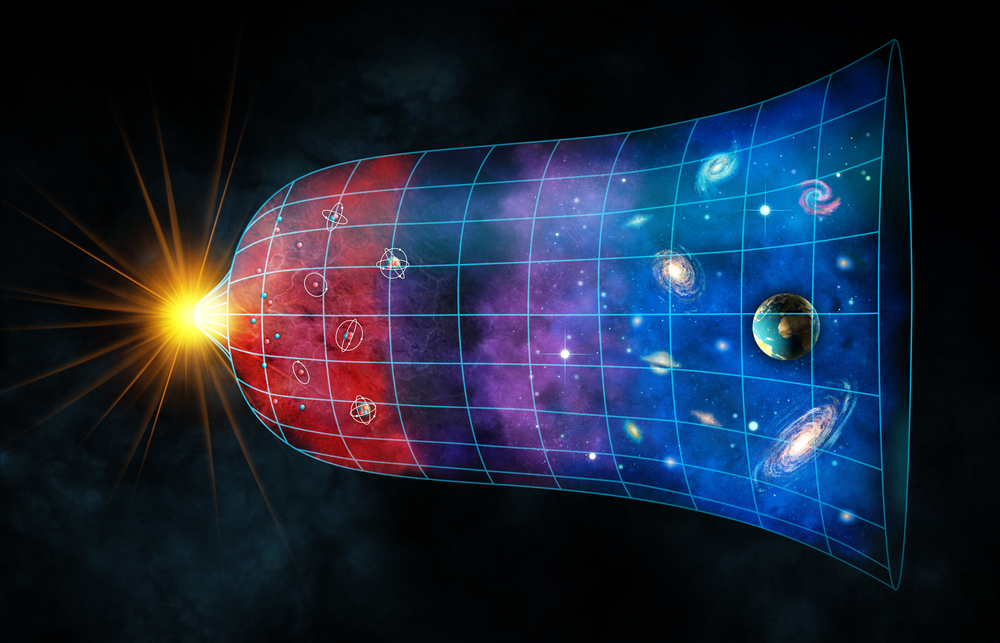
Hawking showed in his dissertation that the theorysteady state is mathematically contradictory to itself. The physicist argued that the universe began as an infinitely small, infinitely dense point - with a singularity. Today Hawking's description is almost universally accepted among scholars.
Black holes are real
Hawking's name is most associated with blacks.holes - another kind of singularity. These objects form when a star collapses under its own gravity. The problem was that, although the existence of black holes fit into Einstein's general theory of relativity, it contradicted quantum physics. Hawking drew attention to black holes in the early 1970s.
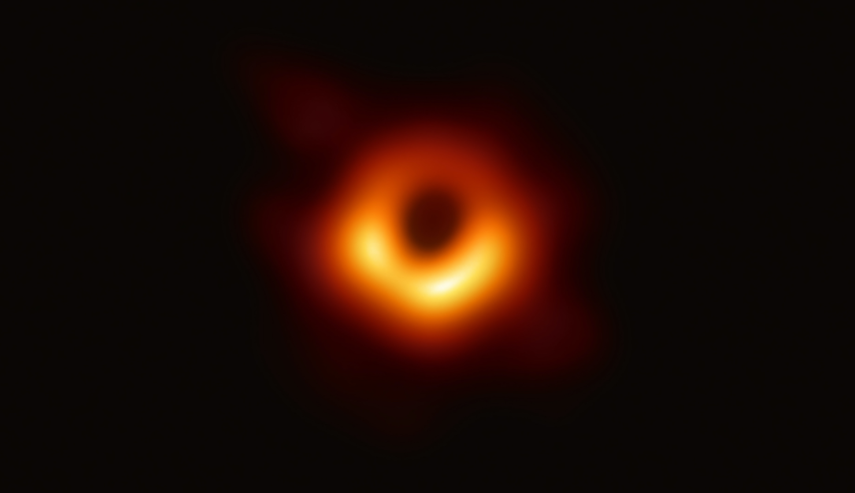 First Event Horizon image of a black hole - released by the National Science Foundation in 2019
According to an article in Nature, he combined the equationsEinstein with the equations of quantum mechanics to prove the possibility of black holes. As a result, what used to be a theoretical abstraction turned into a viable theory. The final proof that Hawking was right came in 2019 when the Event Horizon telescope captured a live image of a supermassive black hole lurking at the center of the giant galaxy Messier 87.
Black holes get their name from the factthat their gravity is so strong that photons or light particles cannot leave them. But in his early writings on the topic, Hawking argued that the situation is not so straightforward.
Hawking radiation
Black holes get their name from the fact that their gravity is so strong that photons or light particles cannot leave them. But in his early writings on the topic, Hawking felt differently.
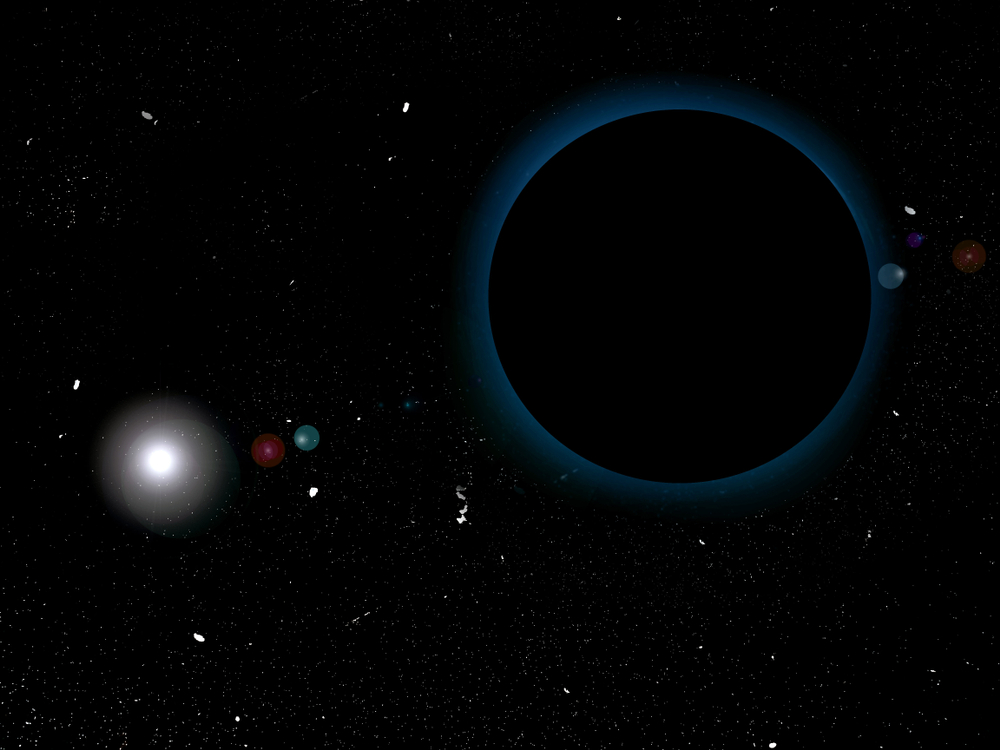
Applying quantum theory, namely the idea ofthat pairs of "virtual photons" could spontaneously be created out of nothing, he realized that some of these particles were apparently emitted from the black hole. This theory, now called Hawking radiation, was recently confirmed in a laboratory experiment at the Technion Israel Institute of Technology, Israel. Instead of a real black hole, the researchers used an acoustic analogue - a "sonic black hole" from which sound waves cannot escape. They found the equivalent of Hawking radiation exactly as the physicists had predicted.
Information paradox
The existence of Hawking radiation creates a seriousproblem for theorists. According to Hawking's calculations, black holes should emit elementary particles and evaporate over time. This seems to be the only physical process that "removes" information from the universe. This means that the basic properties of the material from which the black hole was formed are lost forever; the outgoing radiation tells us nothing about them. However, this is contrary to the general principles of quantum mechanics. This contradiction is called the "information paradox", and the scientist has been working on its resolution for the last 40 years.
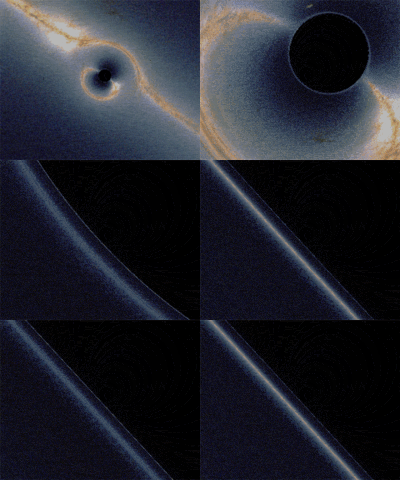
Hawking believed that in fact information aboutcomposition of black holes is not lost. In 2016, the professor stated that it is stored in a cloud of zero-energy particles that surrounds a black hole - the scientist called it "light fluff" in his article Black Hole Entropy and Soft Hair.
The title of the article is so strange at first glanceis a reference to the physical "no hair theorem" for a black hole, where "hair" is a metaphor for information about matter that the black hole absorbs and does not release back. It is devoted to the information paradox: the scientist has been trying for several decades to understand what is happening with information in black holes. But Hawking's “hairy” black hole theorem is just one of several hypotheses put forward, and today the information paradox remains unresolved.
Multiverse
One of the topics that Hawking worked with at the endlife, there was the multiverse theory - the idea that our universe, which appeared as a result of the Big Bang, is just one of an infinite number of coexisting "bubble universes".

However, Hawking was not happy with the assumptionsome scientists that any ridiculous situation that you can imagine is happening right now somewhere in this infinite number of parallel universes. So, in his last article of 2018, in his own words, Hawking "tried to tame the multiverse." He proposed a new mathematical framework that, without abandoning the multiverse as a whole, made it finite, not infinite. But, as with any speculation about parallel universes, we have no idea if his ideas are correct. And it is unlikely that scientists will be able to test his idea in the near future.
Hypothesis aboutsecuritychronology
As surprising as it sounds, the laws of physics are inin the sense in which we understand them today - do not prohibit time travel. Solutions to Einstein's equations of general relativity include "closed time curves" that will allow a person to return to their past. But, again, Hawking was not happy with this - he was sure that time travel backward generates logical paradoxes that are simply impossible.
Therefore, he assumed that somea currently unknown law of physics prevents closed time curves from occurring. He expressed his assumption in the "hypothesis of the protection of chronology." But this is just a guess, and it is not yet known whether time travel is possible or not.
Dark prophecies
In the last years of his life, Hawking made a series of dark prophecies regarding the future of humanity.
They range from the assumption thatThe elusive Higgs boson, or "particle of God," could trigger a vacuum bubble that engulfs the universe, before hostile alien invasions and artificial intelligence seize power on Earth. While Stephen Hawking was right about many things, we can only hope that he was wrong about that.
Read more
"Living fossils" hatched in the American desert. They slept for decades
Take a look at digital art made from analysis of Isaac Asimov's books
Branson, Bezos and Peresild: why famous people fly into space and what they do there
Cosmological Singularity - Impliedthe state of the universe at the initial moment of the Big Bang. It is one of the examples of gravitational singularities predicted by general relativity (GR) and some other theories of gravity.