Scientists from the Technical University of Denmark used data collected by a satellite of the European
The sound of the earth's magnetic field. Audio: ESA
The Earth's magnetic field is complex anda dynamic "bubble" that protects our planet from cosmic radiation and charged particles carried by the solar wind. When these particles collide with atoms and molecules - mainly oxygen and nitrogen - in the upper atmosphere, some of the energy is transformed into the blue-green light that is characteristic of auroras.
The magnetic field is formed by an "ocean" of superheated,rotating liquid iron, which makes up the outer core, located at a depth of 3 thousand km below the surface of the planet. Acting like a rotating conductor in a dynamo, it creates electrical currents, which in turn generate a constantly changing electromagnetic field.
Three Swarm satellites launched in 2013are used to accurately understand how our magnetic field is generated by accurately measuring the magnetic signals that come not only from the Earth's core, but also from the mantle, crust, and oceans, as well as from the ionosphere and magnetosphere.
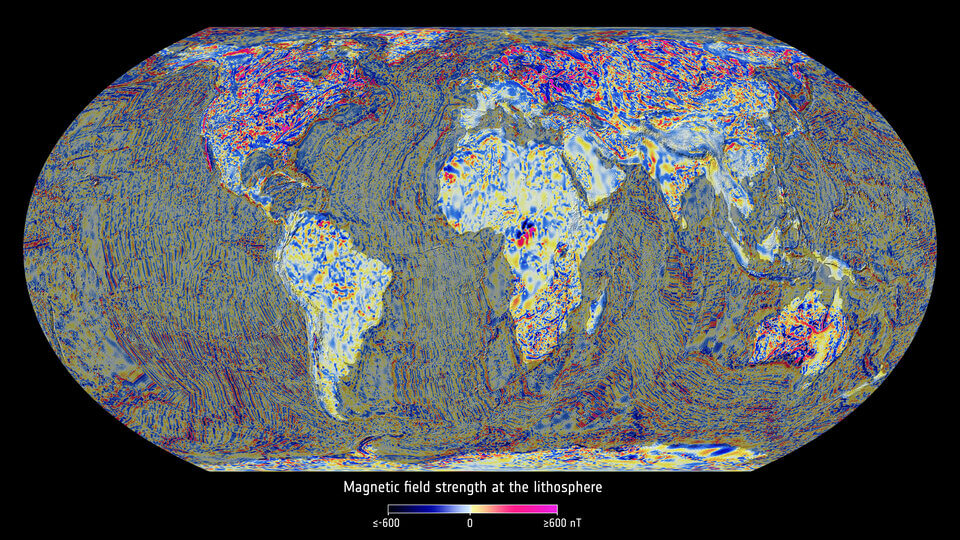 Results of satellite observations of the Earth's magnetic field in the lithosphere. Image: DTU, ESA
Scientists used data from ESA satellitesSwarm, as well as from other sources, to convert electromagnetic waves into sound. The resulting composition shows how the Earth's magnetic field "sounds" during a storm.
In addition to the record published in the public domain,scientists also created a full-fledged installation in Copenhagen. They buried more than 30 loudspeakers in Solbjerg Square in the center of the Danish capital. Each speaker represented its place on Earth, and the whole composition is complemented by a visual demonstration of the magnetic field. The exposition will be shown at 8:00, 13:00 and 19:00 until October 30.
Read more:
Starlink signal hacked to be used as an alternative to GPS
NASA revealed the origin of Haumea - the most mysterious planet in the solar system
Physicists Break Standard Quantum Limit With 'Quantum Horror'