Entropy is a measure of chaos in a system.It can be anything.
According to the second law of thermodynamics, the total entropy of a closed system cannot decrease. All this made scientists think about whether this property of hers could destroy the Universe.
Consequences of chaos
According to one of the hypotheses, the entropy in the Universewill increase to such an extent that randomness will create such a system that will be incapable of useful work. This will lead to the heat death of the universe. This hypothesis was put forward by Rudolf Clausius in the 19th century.
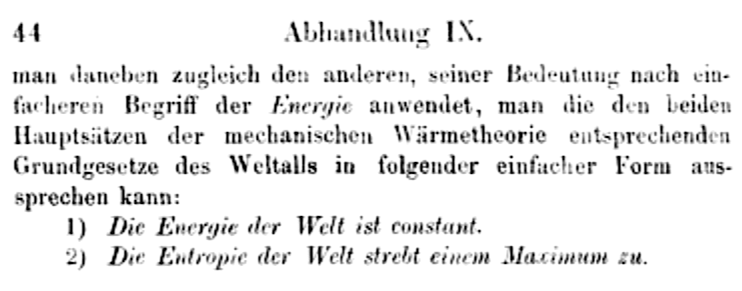 A fragment of a page from the book of Clausius with the famous statement: “The energy of the world is constant. The entropy of the world tends to the maximum. Author: Rudolf Clausius (1822-1888), Public Domain
The German physicist believed that the universe is a closed system, so eventually its entropy will reachAccording to Clausius's hypothesis, all macroscopic processes will stop in it.
Open or closed?
The peculiarity of entropy is that it is irreversiblegrows in a closed system. In non-closed, it can both increase and decrease. According to the hypothesis of a German physicist, our Universe is considered just a closed system.
 The concept of a closed universe. Image by Gerd Altmann from Pixabay
He argued this by the fact that with others notthere is a key exchange of energy (they simply do not exist). And if the Universe is a closed system, then it should tend to the maximum of entropy, which will lead to the same heat death. This does not mean that there will be no energy in it, nor does it imply any particular absolute temperature. It will reach thermodynamic equilibrium, which means that there will be no useful energy in it.
What is wrong with this hypothesis?
Some scientists believe that heat deathThe universe is impossible by definition. Among them is Max Planck, who argued that it makes no sense to discuss the entropy of the world at all, "because such quantities cannot be precisely determined." This means that the second law of thermodynamics simply cannot be applied to the entire universe as a whole.
 The universe is in red light. Image by WikiImages from Pixabay
In addition, supporters of the hypothesis of infiniteThe Universe is postulated to the fact that it is generally incorrect to evaluate it as a closed or open system. By themselves, these criteria are used only for finite objects. At infinity, the second law of thermodynamics simply does not apply. At the very least, it needs to be added.
What's the bottom line?
The principle of entropy increase itself is not subject to probabilistic laws. And due to random fluctuations in the system, it will always be below the maximum, which will lead to disaster.
This means that, most likely, if the Universe perishes, it will not be due to chaos. However, the ideas of scientists are not enough to assert something with 100% certainty.
Read more
Scientists have found the healthiest people on Earth: it's all about a unique lifestyle
The danger of free VPNs. Why can't they be downloaded and how to protect yourself?
Physicists have recreated the abilities of the T-1000 from the "Terminator-2" in the laboratory