Australian researchers have confirmed the existence of lonsdalelite, a rare hexagonal shape of diamond, in
Researchers used advanced techniqueselectron microscopy to capture hard and intact sections of meteorites to create images of how lonsdaleite and regular diamonds formed. The results of the study showed that the formation process resembles chemical vapor deposition under supercritical conditions.
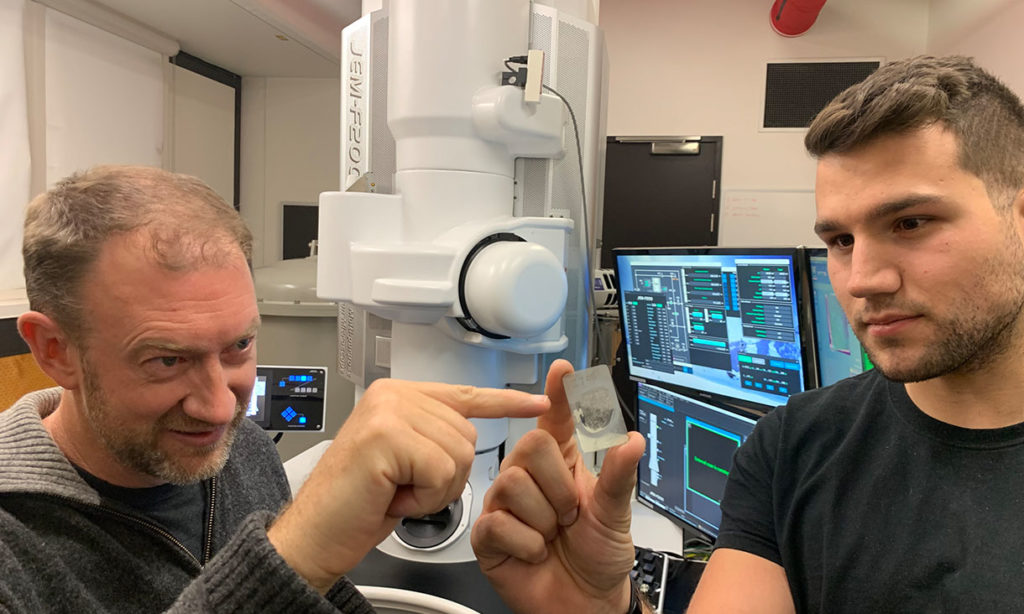 A cut from a meteorite containing lonsdaleites, in the hands of researchers. Photo: RMIT University
Chemical precipitation is used forproduction of diamonds in the laboratory. Under the extreme conditions of high temperature and moderate pressure following a catastrophic collision, the researchers believe graphene diamonds form near-perfect hexagonal structures. They resemble the shape and texture of the two-dimensional modification of carbon - graphene - that existed on the surface before.
As the material cools, part of the lonsdaleitehas been replaced with classic diamonds. The researchers note that the hexagonal modification has increased strength even compared to the hardest mineral on earth. They plan to transfer the conditions for the formation of lonsdaleite to laboratory conditions in order to create a technology for the production of ultra-strong diamond components from graphene for various machines.
Read more:
The space plane will deliver cargo to the ISS and land at a regular "airport"
The star approached the black hole and it was torn apart: scientists observed this from three telescopes
Scientists have found traces of genetic mutations in the blood of every person who has been in space