Scanning the Great Pyramid of Giza (the Pyramid of Cheops) with cosmic rays has shown that over the ancient
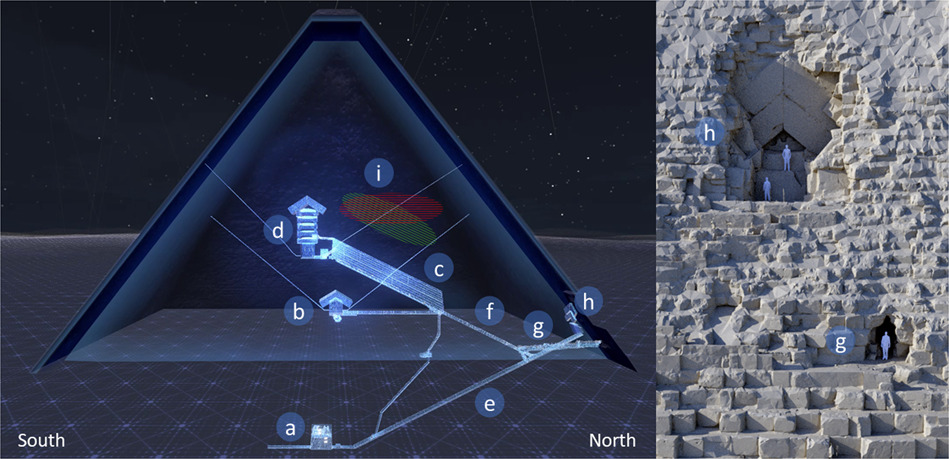 An internal model of the pyramid built from a scan. A previously unknown corridor was opened at point h. Image: Sebastien Procureur et al., Nature Comunications
The researchers opened this room while analyzingmuon scans of the Great Pyramid. Muons are negatively charged elementary particles that are formed when cosmic rays collide with atoms in the Earth's atmosphere. A stream of such particles constantly "spills" onto the Earth. Muons interact with the stone of buildings and air in different ways, as a result, by placing sensitive muon detectors inside the pyramid, archaeologists can find voids hidden inside the walls.
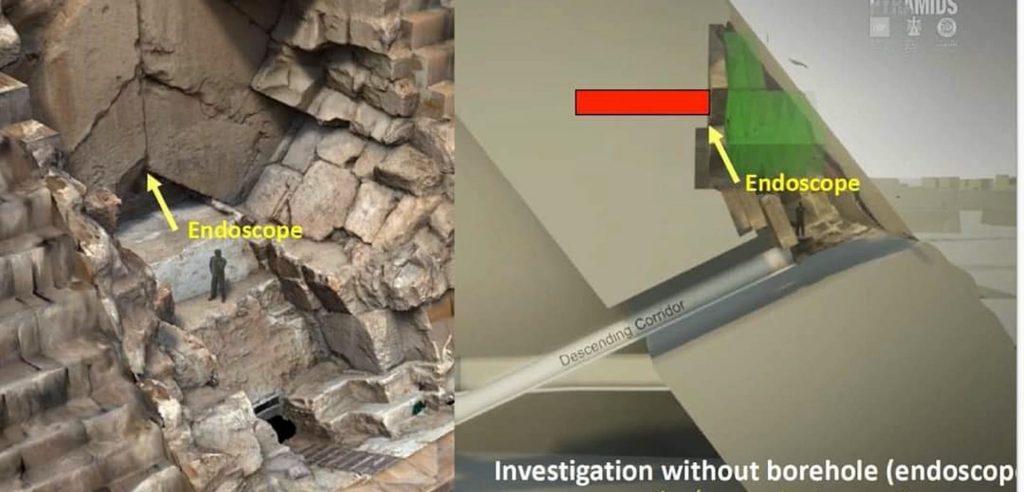 Scanning the room with an endoscope. Image: ArchaeologicalPaths
For more information about this space,the researchers inserted an endoscope into the corridor and peered inside. A preliminary survey showed that the room was empty and no artifacts were visible in it. According to a preliminary hypothesis, this room was an outbuilding that could, for example, serve to deliver goods inside the pyramid.
Press conference and presentation of the discovery of the hidden tunnel. Video: ArchaeologicalPaths
Archaeologists will continue research that will help to better understand the structure and purpose of the ancient building.
Read more:
Asteroid Redirect Mission Exceeds Expectations
It turned out that the monster from medieval manuscripts actually exists
It turned out which men are the most fertile: their sperm is 50% better than the rest