Astronomers from the University of Pennsylvania and colleagues from other countries noted that a map had previously been created
Dark matter in astronomy and cosmology, andin theoretical physics, a form of matter that does not participate in electromagnetic interaction and therefore is inaccessible to direct observation. It is about a quarter of the mass-energy of the Universe and manifests itself only in gravitational interaction.
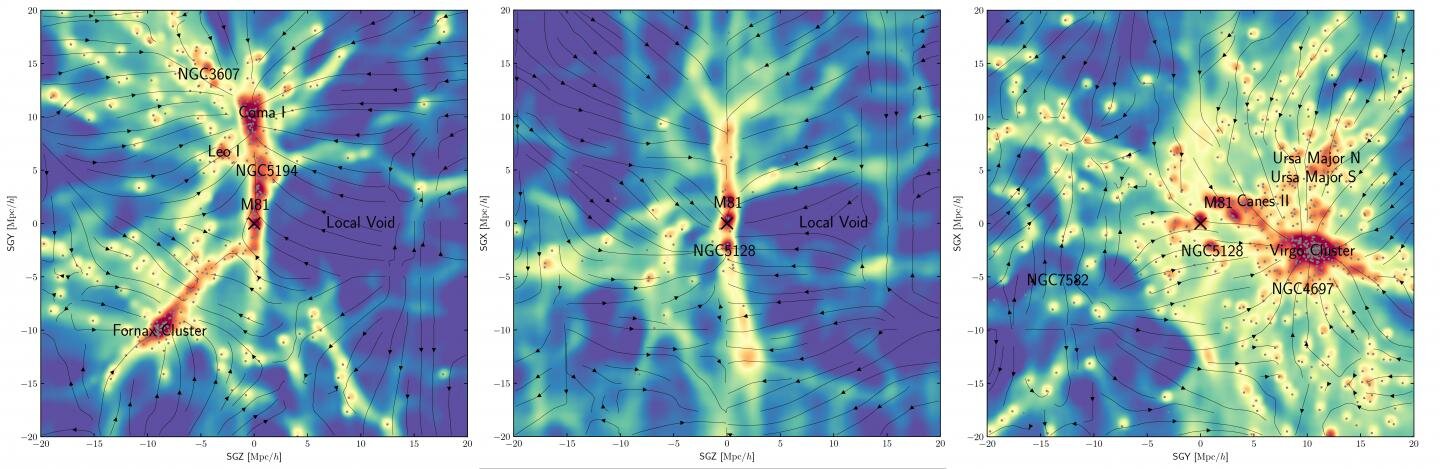
In their new work, the researchers used a set of Illustris-TNG galaxy models, which includes data on dark matter, on the basis of which they trained AI.The result is a model that can predict the distribution of clumps of dark matter in the universe.By applying the model to data from the Cosmicflow-3 galactic catalog, the researchers obtained a map of the distribution of dark matter.
The map from our models doesn't fit the simulation data perfectly, but we can still reconstruct very detailed structures.We found that including the motion of the galaxies – their radial velocities – in addition to their distribution greatly improved the quality of the map and allowed us to see these details.
Research text
As a result, the authors found that such matter connects neighboring galaxies with invisible filament-like structures — a kind of bridges made of dark matter. Studying how the distribution of dark matter compares to other data will helpwe need to understand the nature of dark matter.
Read more:
New batteries made of aluminum and graphene charge 60 times faster
A huge moth was found in Australia. Her wingspan is 25 cm
Look at the design of the future iPhone 13 Pro