When King Charles III is crowned in London on May 6, the ceremony will include the Stone of Destiny, a Scottish carving
Stone of Destiny, Coronation Stone or SkunkThe stone is a sacred relic of Scotland, which is a piece of ancient red sandstone weighing 152 kg and measuring 66 x 42.5 x 26.7 cm. A cross is engraved on one side of the stone, and two rings are attached to the other side, designed to move the relic. Despite its long history, scientists have only recently noticed previously undocumented symbols and other anomalies on the stone.
These anomalies are a copper alloy stain and the remains ofgypsum plaster suggests that the stone has some aspects of history that are not recorded in documents. Now scientists from Historic Environment Scotland, the government organization that deals with the stone, have carried out laser scans of the artefact and carried out scientific tests, revealing new information about it.
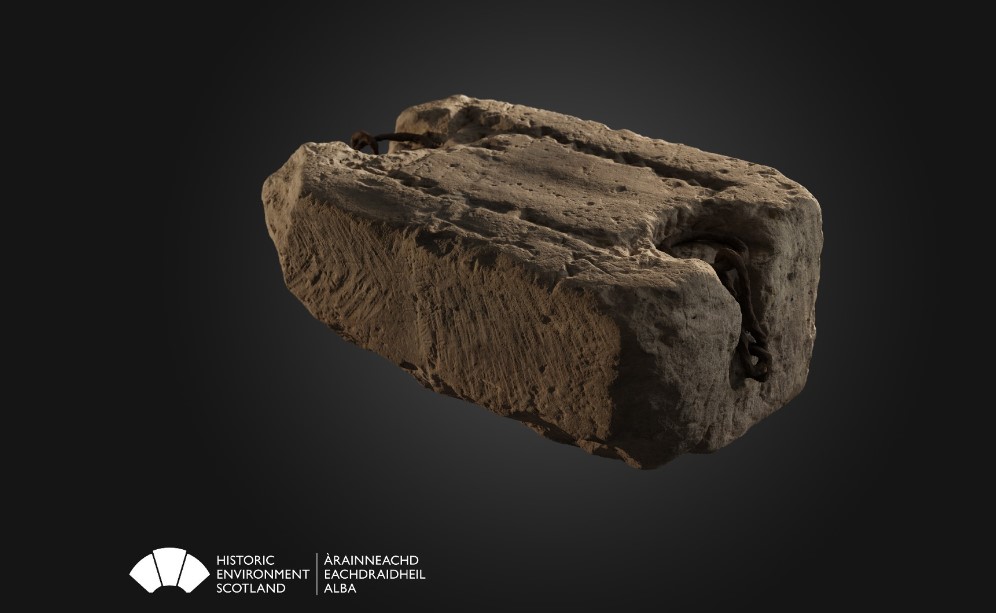 The Stone of Destiny was scanned and a digital model created. Image courtesy of Historic Environment Scotland
Among the finds were markings similarto Roman numerals. They include three X-shaped marks followed by markings that look like the letter "v". However, carved symbols may not be Roman numerals.
The expert team also analyzed the staincopper alloy on stone using x-ray fluorescence analysis - it works by measuring the chemical composition of the materials. The study found that a copper or brass object was placed on the stone for a period of time at some point in its history. It is possible that an object, such as a relic such as a saint's bell, has been on it for a long time.
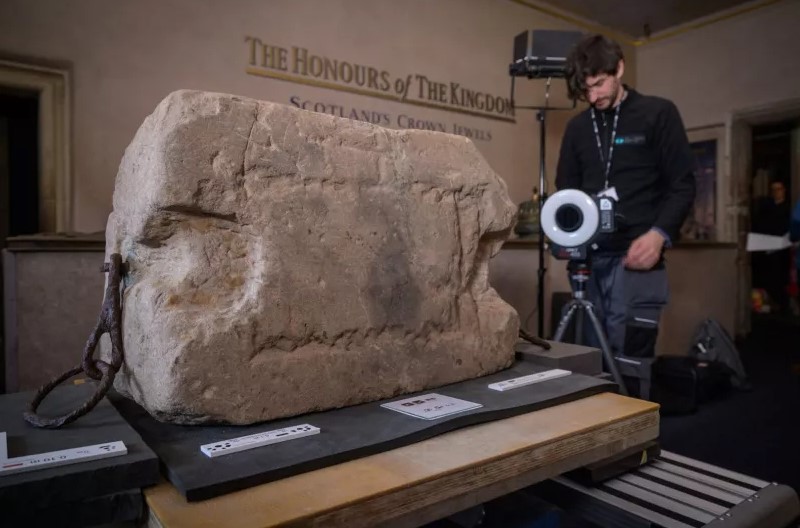 The Stone of Destiny was used at the coronation of the kings of Scotland in the 13th century.
Today it is used at the coronation of the monarch of the United Kingdom. Image courtesy of Historic Environment Scotland
The analysis also revealed the presence ofgypsum plaster. This suggests that a plaster cast of the artifact may have been made at some point. This surprised scientists, since he is not mentioned in any records.
The stone was used at the coronation of monarchsScotland in the 13th century, and today—at the coronation of the monarch of the United Kingdom. In the modern ceremony, the stone is placed in the coronation chair on which the monarch sits. The stone was captured and transported from Scotland to England in 1296 and was only returned in the 20th century. Its history before the 13th century is unclear.
Read more:
New solar cell breaks world efficiency record
It turned out what is happening with the documents of Leonardo da Vinci: they began to change
Listen to the sound of solar plasma as it hits the Earth
Cover photo: when scanned, markings similar to Roman numerals were found on the stone. Image courtesy of Historic Environment Scotland
</ p>