The Galaxy S20 Ultra has a dedicated screen that can refresh twice as fast as a traditional one
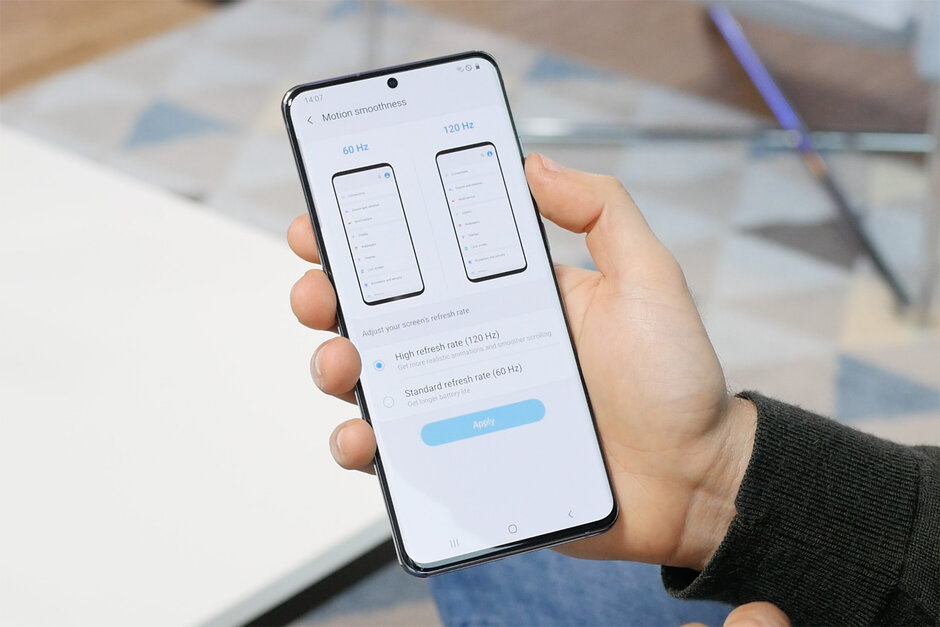
In the new Galaxy S20 Ultra test, bloggers compared the effect of a screen refresh rate of 120 Hz and 60 Hz on the discharge of a smartphone’s battery, whose capacity is 5,000 mAh.
After several tests, one thing became clear: setting the parameter to 120 hertz matters even if you just surf the phone and browse the web. A higher refresh rate will be a huge advantage for gamers, allowing them to respond faster, but after a real test it turned out that none of the popular games supported the new version with a frequency of 120 Hz (however, support promises to be in the near future).
The only area where you won't notice any difference with this new technology is in browsingvideo. YouTube and most other platforms support video recorded at up to 60 frames per second (most of it is recorded at 30 frames per second or 24 frames per second), which will belook perfectly smooth on a traditional 60Hz screen, and the new 120Hz option won'tmatter.
Now turn to the battery test. Before we tell you about the results, we note that bloggers had a S20 Ultra version with an Exynos 990 chip, and they used the phone in battery mode “Optimized” and a screen resolution of 1080p (120 Hz is not yet supported at a maximum resolution of 1440p).
Galaxy S20 Ultra 120 Hz vs. 60 Hz benchmark comparison
- Galaxy S20 Ultra 60Hz – Runtime 12 hours 23 minutes
- Galaxy S20 Ultra 120Hz – Runtime 10 hours 2 minutes
- Samsung Galaxy Note 10 Plus – Runtime 11 hours 37 minutes
- Samsung Galaxy S10 Plus – Runtime 10 Hours 33 Minutes
- Apple iPhone 11 Pro Max – Runtime 12 hours 53 minutes
These results answer the question quite clearly: yes, between 120 Hz and 60 Hz there is a BIG difference not only in how smoothly the phone works, but also in the battery life.
At 60 Hz, the S20 Ultra is one of the bestphones if we talk about battery life. But if you switch to 120 Hz, you will get a battery charge indicator that is 2 hours lower and almost 20 minutes. This means that when switching to 120 Hz, the battery life is reduced by almost 20%.
This is a significant difference. At 60 Hz, the S20 Ultra is among the longest runtimes, but when switched to 120 Hz, the battery life drops significantly. It's up to you to decide if it's worth it.
This test also shows that during installation60 Hz Samsung managed to create a phone with a longer battery life than the Note 10+ and S10 +, but it is slightly inferior to the iPhone 11 Pro Max.