What types of dentures are there?
- Cosmetic - perform only a decorative function.
- Functional -
active prostheses that allow you to performgrip Managed through various mechanisms. They can be in a cosmetic shell, imitating the appearance of a hand, or have a modern technological design. Cosmetic - perform only a decorative function.
Functional prostheses are divided into three more types: traction, working and bionic. They differ in the principle of work, the materials from which they are made, the price and the time it takes for the body to adapt to them.
- Traction (active, mechanical). In these, movement is carried out by springs and cables. These are less functional, but cheaper compared to bionic prostheses.
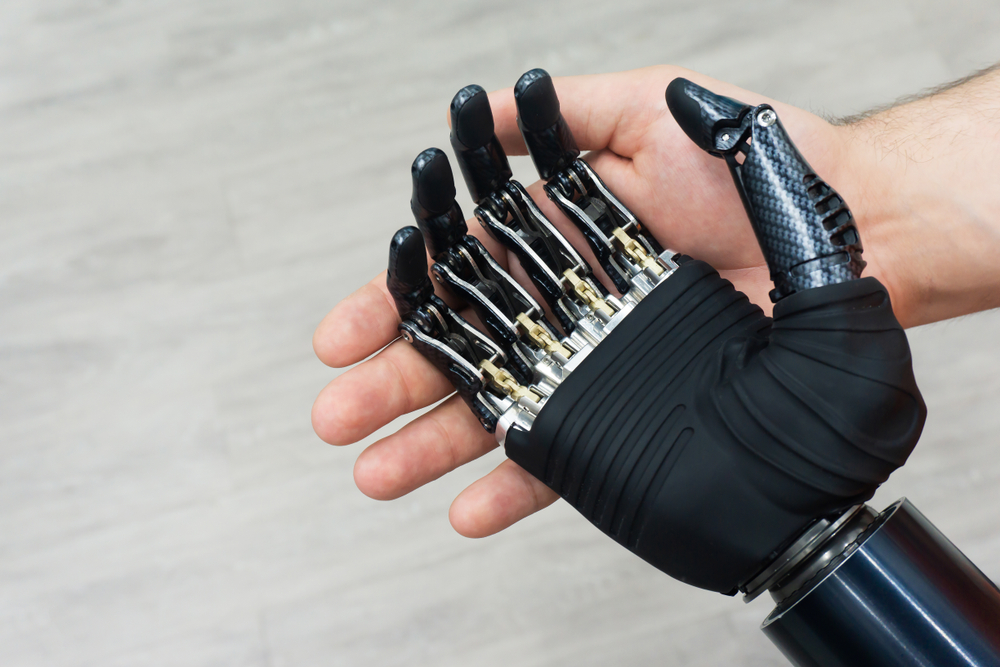
- Myoelectric (bionic). They are equipped with touch sensors, electric motors and rechargeable batteries.
- Workers. They are designed specifically to perform certain functions, such as moving objects or playing sports.
What are dentures made of?
Prosthetic limb production is fastis improving. In particular, the changes concern the choice of materials. The prosthetic device should be lighter, therefore, most of it is made of plastic.
The prosthetic device should be lighter;hence, most of it is made of plastic. The socket is usually made of polypropylene. Light metals such as titanium and aluminum have replaced most of the steel in the pylon. The most commonly used alloys of these materials. The newest development in the production of prostheses is the use of carbon fiber to form a lightweight pylon.
Another new material for prostheses —carbon fiber. Prostheses made from it are lightweight and can be made in various variations, for example, with carbon fiber springs, with long composite arches.

Modern technologies in prosthetics:
In Russia, only two Russian companies - Motorica and MaxBionic - produce such products on a permanent basis.
There are many more such companies in the world: well-known manufacturers of bionic prostheses in the world are now Ossur (Iceland), Ottobock (Germany), Vincent Systems (Germany), Taska (New Zealand), Steeper (Great Britain).
The essence of the work of bionic prostheses isthe fact that the electrodes installed in the cultivation sleeve read the electric potential from the muscles of the stump. The sensors transmit information to the microprocessor, which converts it into motor commands. Usually, when the muscles are straining, the prosthesis makes grasping movements; when the muscles are relaxed, unclenching occurs.
For example, Russian bionicThe Stradivarius prosthesis looks like a cosmetic prosthesis, but it can grab objects, and you can also build additional functions into it: pay for purchases via PayPass. A black and white display can also be built into the bionic arm to track the charge level, date, time and control mode of the prosthesis. Such a prosthesis costs 390 thousand rubles.
MaxBionic prosthesis - MeHandS - costs 14 thousanddollars. The company produces exactly the brushes - the sleeve is assembled by third-party prosthetists. This is a multi-grip prosthesis - fingers can move individually and take objects in several ways:
There are also foreign prostheses on the Russian marketcompanies i-Limb, Touch Bionics, Ottobock (the most famous models - Michelangelo, Bebionic) and Vincent System (Vincent de). There is more choice among foreign models, but their price is several times higher, or even tens. For comparison, the German Bebionic bionic forearm prosthesis costs from 2 million rubles, and the i-Limb bionic brush is sold on Ebay for 40 thousand dollars.
Last year, University staffVanderbilt was shown how a prototype of a high-tech artificial ankle works. Thanks to the presence of sensors, motors, servos and a microcomputer, the prosthesis can analyze the surface on which a person moves without human intervention.
A big role in reducing the cost of productionbionic prosthesis plays 3D printing. It allows you to make dentures as suitable as possible for each specific situation, as well as an individual design for the prosthesis. For example, Open Bionics has partnered with Disney on the lightweight and functional Hero Arm, which has changed the way many children feel about their condition.
The future of prosthetics:
Grand View Research predicts that in sevenyears, the market for bionic prostheses will amount to $ 2.1 billion. But someday mankind will not need prosthetics technologies: we will learn how to restore lost organs by growing them. However, it is too early to talk about it seriously.
Another promising direction isosseointegration. It will allow us to abandon the sleeve and teach humanity how to fuse bone and an artificial module directly. Work on this technology has been going on for the last few years.
Finally, Elon Musk and Neuralink recently announced that prostheses could be controlled by a chip in the brain.
Read also:
The annual mission in the Arctic has ended and the data are disappointing. What awaits humanity?
On day 3 of illness, most COVID-19 patients lose their sense of smell and often suffer from a runny nose
Scientists have found out why children are the most dangerous carriers of COVID-19