What is the real (and not in myths and propaganda traditions) role of UAVs in the conflict?What were the main mistakes
Table of contents
- The role of drones
- Adhesions
- Operational and tactical superiority
After the heavy defeat of the Armenian side fromAzerbaijani troops in the Karabakh war a year has passed. The conflict, at least for some time, is frozen, but, obviously, it will unfreeze in the foreseeable future, such is the region. People live there hot and principled.
We will try to see with a cold headwhy Azerbaijan fought back for a humiliating defeat in the previous war, and in a month and a half of the blitzkrieg managed to completely recapture the territory that the Armenians liberated during two years of the hardest massacre in 1992-1994. And, as you might guess, such a difference in the results of these wars lies in the weapons.
The role of drones
UAVs of Turkish and Israeli production tookall the laurels of the winners, whether deservedly ... in many respects, yes. First of all, you need to understand that the Azerbaijanis did not have purely shock drones, such as the powerful Turkish-made Akinci, but lighter Bayraktars TB-2. Perhaps today this device can be taken as a model in the class, but by itself it does not make the weather and is effective only with the support of other weapons, the payload mass is only up to 150 kg (although of course, if we are talking about high-precision ATGMs, this is not so little ).

Loitering ammunition, or kamikaze drone IAI Harop of Israeli production, along with Bayraktar, terrified the Armenian ground forces
iai.co.il
The rest of the UAV fleet is reconnaissance andreconnaissance and shock Turkish, as well as Israeli vehicles. Their main task is to monitor the movement of the enemy and correct artillery and air strikes. And these strikes are already being carried out by artillery systems / MLRS of Soviet models and their Russian modernization. Well, the MiG-29 and Su-25 are pretty commonplace today.
Therefore, in general, it was not some kind ofsuper-technological war, drones have been doing this job for twenty years in different parts of the world. Unless Azerbaijan has purchased many advanced models capable of both withstanding the rare Armenian electronic warfare means and seeping through the thin air defense of Karabakh. But not more.
There are two key problems:
1) No one today has effective and advanced countermeasures against drones. Especially if you have outdated anti-aircraft missile systems of the 70-80s ready to develop.
2) The Armenian side, one might say, ignored the re-equipment of the Azerbaijani army, and did not take any measures, or at least attempts to revise its doctrine of war in the new conditions.
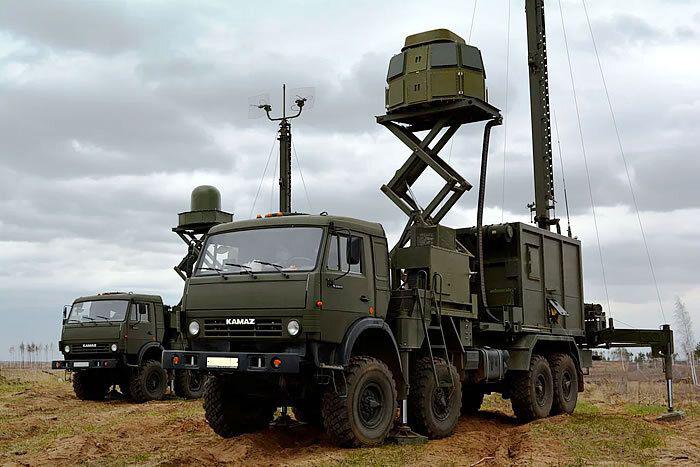
Electronic warfare complex Repellent of Russian design.Armenia had these vehicles to counter drones, but in the end they were not only useless, but even at least one vehicle was destroyed by the UAV. It is not yet possible to create a miracle panacea for drones - this is a set of solutions and measures.
The drone is quite cheap, even in comparison withfighter of generation 4 ++, costing 130 - 150 million dollars, UAV Bayraktar TV-2 costs about 69 million dollars for 6 pieces + control station and ammunition for them. At the same time, the 4 ++ fighter does not have guaranteed protection even against the Wasp-level air defense systems or, even more so, Thor, while drones seep through them almost unnoticed until the fateful second, when the installation that allowed itself to be detected does not fire a rocket.
If your country has a deplorable economicthe situation and throwing money even for a holy war will not work, then in any case, you need to analyze the current hostilities in the world and understand that the enemy with whom you have disputed territories and monthly skirmishes in the frozen conflict zone buys modern drones. Even if the Armenian intelligence did not possess such information, it was impossible not to guess - Aliyev pumped billions into the new army, the UAV of advanced developments could not be there.
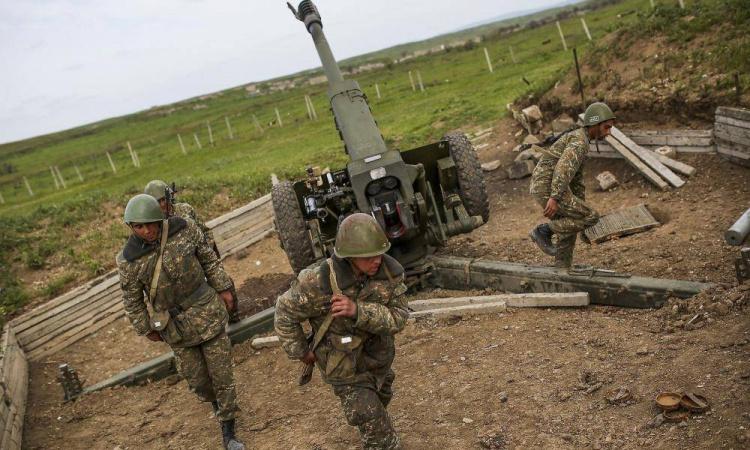
Open and unmasked artillery positions became a convenient target for the Bayraktar
voicenews.gr
The enemy buys drones, which meansdevelop new tactical combat schemes, take care of camouflage means, purchase electronic warfare systems. Instead, the Artsakh army massively uses tanks, artillery fires from the same positions, practically without moving, infantry in dense columns are led along the roads as part of large tactical formations, not to mention the shooting of helpless and defenseless supply columns by Azerbaijanis. In general, the actions are the same as in the teachings of twenty years ago.
Against the background of absolutely predictable "old-fashioned" military tactics, Azerbaijani drones were amused as in a shooting range, or as in Call of Duty, where the enemy behaves like a bot at the minimum level of difficulty.
Drone and drone attacks, strictly 18+
Adhesions
No drones would lead to thisthe defeat of the Artsakh army, if not for the Israeli Spike ATGM systems, which we wrote about earlier. Azerbaijan understood that tanks and motorized infantry are the backbone of the Armenian military formations, and even if they are outdated, this is a serious force and a significant threat. Without these means, the enemies will not be capable of any effective action. Accordingly, the strikes on armored vehicles were planned thoroughly - they purchased the advanced multifunctional Israeli anti-tank systems Spike.
Adhesions are a third generation system in whichthe missiles are equipped with homing heads, and their performance characteristics surpass even the famous American Javelins: both in range and countermeasures, and the ability to be combined with technology. It was Spikes who were responsible for the main losses of the armored vehicles of Artsakh.
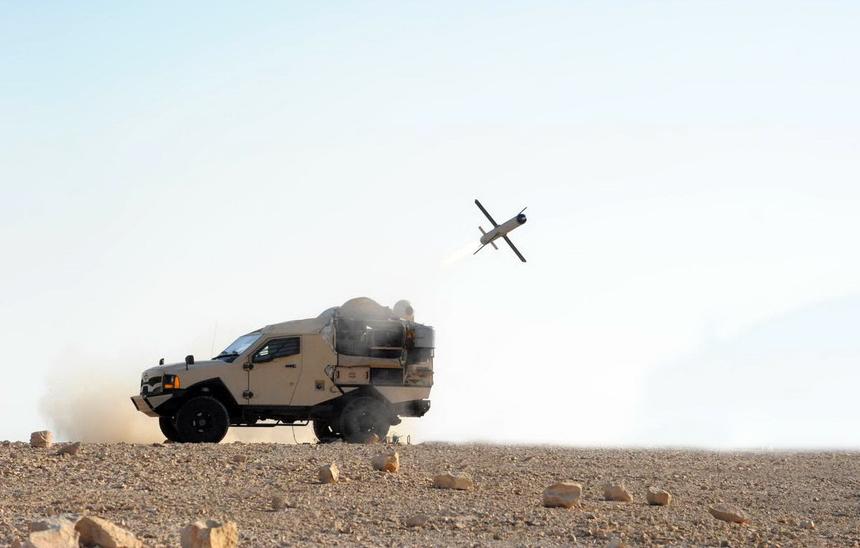
Start Spike NLOS
According to various estimates, only Armenians have a fleet of tankswas 300 units, and the same amount of lightly armored vehicles. But all this did not play any significant role. Without active protection complexes, without the support of modern air defense, they could only fill up the slopes of the mountains with burnt skeletons.
The adhesions of the NLOS modifications, which Azerbaijan used against the tanks of Artsakh, could hit targets even out of sight, because the ceiling of their range is an impressive 25 kilometers.
Supplemented by Spikes ATGM UMTAS Turkishproduction, they are included in the basic set of shock versions of Bayraktar TV-2. Their performance characteristics are much more modest (range of only 4 km), although they already belong to the third generation and similarly combine a homing head with semi-active laser guidance by the operator. But it was these missiles that made the main fame of the Bayraktar in Karabakh, turning the name of these drones into a household name and, sorry, a cult brand, like the iPhone among mobile phones.
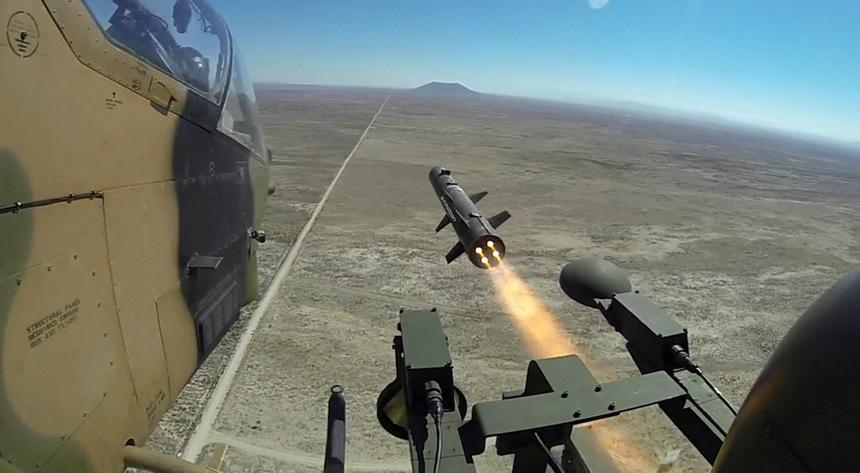
UMTAS launch from an attack helicopter
Operational and tactical superiority
High-tech high-tech, and the main means of destructionremained the classic weapons, this was expressed over the last year by most experts. It was also said that light Bayraktars with 150 kg of weapons are no match for the Su-25, which made 600 sorties to Armenian positions against 200 from Turkish flying robots. The Soviet attack aircraft carries over 4 tons of harmful load in one sortie.
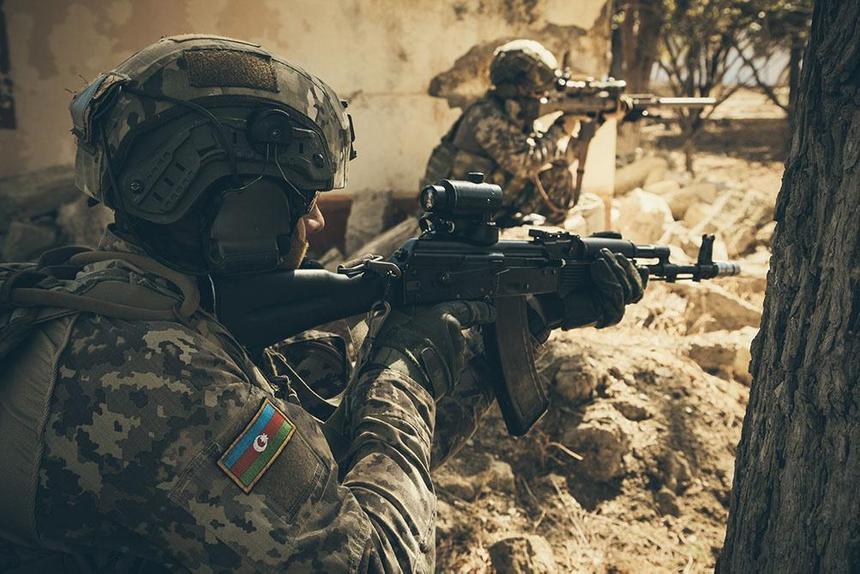
Azerbaijani special forces in training
azernews.az
But, in addition to the fact that the UAV had more advanced weapons, their role is more significant than the Su-25, and here's why:
1)Drones made it possible to control almost the entire theater of war... The Azerbaijani command knew about the deploymentArmenian forces are better than their own command of the latter, even in the deep rear. Conventional aviation could not operate there, the attacking Su-25 is easy prey even for MANPADS.
2) While the Su-25 and artillery were ironing the most combat-ready formations of the Armenians on the front line,drones attacked warehouses and supply columnsleaving the enemy without fuel, provisions,ammunition and logistics as such. Their strikes were more accurate and destructive, so in the long run it played no less role than the classic means.
3)The UAV, even having worked out all the targets, could continue to patrol over the enemy's positions, providing information about his actions, and also aim kamikaze drones (mostlyOrbiter 1K and Harop) for the remaining targets. The Azerbaijani side did not lose control of the situation for a minute, while the management of the Armenian side became more and more chaotic.

Czech heavy 152-mm SPG DANA howitzers, far from a new development, proved to be excellent in the Azerbaijani troops, about 30 units were purchased by Ukraine
And another very important new aspect of that war.Youtube was filled with videos where Bayraktars (in fact, not necessarily, there are about a dozen different UAVs among Azerbaijanis) were shooting at the equipment and positions of the Armenians. No chance to be warned, no chance to escape or survive - all this formed a picture of the hopelessness of resistance, because of which the reservists of Armenia began to evade mobilization, and the country was flooded with harsh criticism of the current government. Another front where Azerbaijan did not forget to strike is the information front.
In the end, the unrecognized Republic of Artsakh (aessentially Armenia) suffered defeat several years before the start of the war. Victory in 1994, and then an unsuccessful attempt to unleash a war in 2016 from the Azerbaijani side, led to a dead end - even a larger and better equipped enemy army cannot advance in a region that has been preparing for defense and strengthening for decades, which means there is nothing to be afraid of.
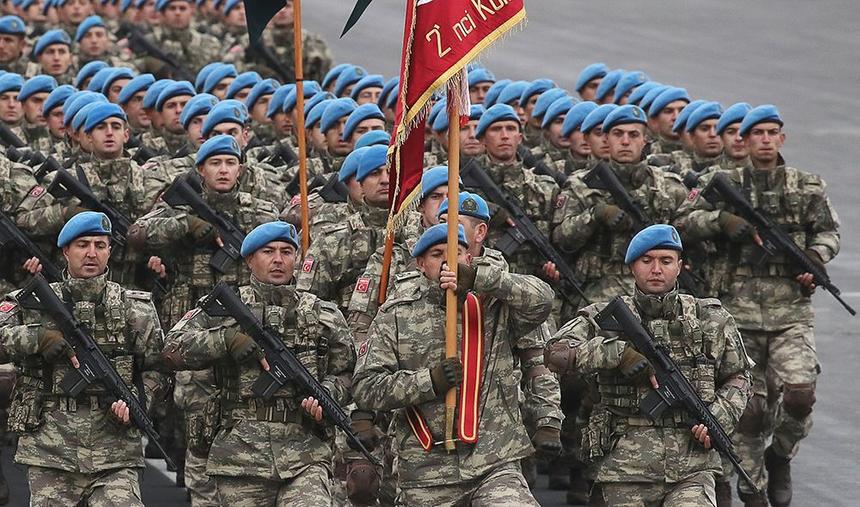
Turkish servicemen at the victory parade in Baku, December 2020
Sharifulin — TASS
As a result, when the enemy switched to the means of a new generation, and all the advantages accumulated over two decades were multiplied by zero, the Armenians had no choice but to blame the failures of the new government.
Despite the fact that talk of revenge withsides of Armenia and preparations for the Third Karabakh War, began immediately, when the current war ended, Armenia has nothing to fight with. Updating weapons systems for new models will cost tens of billions of dollars, and in fact, Armenia is hardly able to simply recover the losses already incurred. A financially unstable and, for the most part, an agrarian country cannot pump petrodollars, like Azerbaijan. Most likely, it will take decades to come to terms with defeat.
Track interesting topics through our Cart - it's more convenient
Subscribe to