In the mid-2000s, robotics already existed.
Back then, this area was promoted by enthusiasts. Probably, the heads of the robotics circles were the same people who led the amateur radio circles in the USSR.
The structures were assembled literally from the fact thatwas, and the firmware for the controller was written on the knee. However, it was enough to compete in the first robotics competitions. There, children and teachers exchanged ideas and experiences, forming a kind of "trends" in robotics.
But teachers quickly realized that roboticsThis is not just a great hobby and entertainment for children, but also a great way to introduce them to modern technology in a playful way. Working with robots, children acquire practical knowledge in three competencies at once: design, electrical engineering and programming.
- Constructiongives an understanding of how the "skeleton" of the robot is arranged, what mechanisms are and how they are arranged, teaches children to design and model robots.
- Electrical engineeringabout how electronic components work.By analogy with the human body, for example, the motors work like the "muscles" of the robot, and the controller, like the brain, gives a signal to the motor. The older children get, the more they are immersed in electrical engineering.
- Programming- everything is more or less clear here, children are taughtcreate an action algorithm for the robot. Relatively speaking, they learn in what language to “communicate” with the robot, with the help of what actions to give the robot certain commands.
In general, a lot of useful for moderntechnological world of knowledge. Today, robotics has turned from a circle into a full-fledged discipline with a program and textbooks - and from September 1 of this year it has become a mandatory module as part of school labor lessons.
What robots teach schoolchildren today, what kitsdo they do it for them? This all evolves along with technology. In 2014, copters were popular, a couple of years later - 3D printers, today the focus is on computer vision and neural networks. How are sets created today?
The birth of an idea
The team is looking for new ideas for setsengineers, programmers and market analysts: they communicate with teachers, collect their own feedback from them, and the wishes of children, and also monitor global development trends.
Many of the engineers are educators themselves.
The collected information is compared with the latesttrends in IT and with requests and requirements for kits from winners of competitions in robotics and programming. And only then proceed to the creation of technical specifications for new sets.
The main principle of success is simple:the robotics kit should be fun for kids. If it is too simple, it will quickly get boring. Too complicated - the desire to understand it will disappear. It is necessary to seek a balance, focusing on the age and abilities of the students.
Check the idea and draw up a TOR
Once an idea has emerged, focus groups are held. It is important to check on teachers and children of a particular age whether the new set will be interesting and useful to them. And, of course, to understand what can be changed and improved.
Let’s say the purpose of the set is to introduce preschoolerswith the basics of programming. Then you need to understand: how interesting is it for children to create a program from bright “cubes” on the screen? What size should the parts be? For a set that introduces high school students to industrial manipulators, it is necessary to decide: how many degrees of freedom need to be provided, what kind of actuators there will be, how many motors are needed, and so on.
After the focus group, if it went well, the preparation of detailed technical specifications begins. There we indicate:
- what components are needed;
- What size and color should they be?
- how they should look in general;
- what software is needed;
- what motors and sensors are needed, etc.
After the TOR is ready and agreed upon, the actual development begins.
Bringing an idea to life
A large team works on the creation of each new set:
- engineers - they design controllers, sensors and various actuators;
- constructors and 3D-modelers;
- software developers;
- methodologists - develop an educational and methodological complex;
- testers and many others.
How does this whole team work?
From description to real components
When the technical specifications are ready, the engineers get into action. They work through the composition of the kit, design each part, model use cases and figure out what devices will be needed.
Let's say for one set you have to developnew board. For another - to find or develop more powerful motors. Or maybe we need to invent new ways to connect sensors to the controller - such that even a child can understand it.
At this stage, not only do they come up with everythingelectronic modules. They need to be developed, produced, and then tested for practicality and durability. And the most interesting thing is a battle test: how difficult is the module to connect and interact with them? Will be able Can children of a certain age work with it?
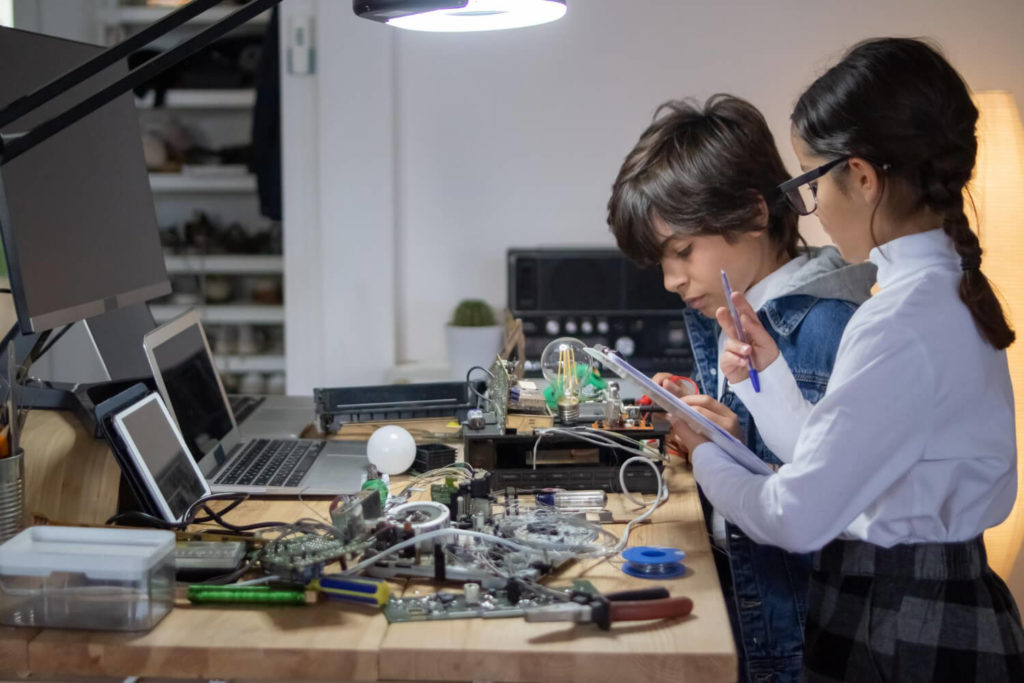 It is necessary to create a “language” in which children can “communicate” with the robot
We develop software
Even the most thoughtful set without commandsmanagement - a dead "brick". It is necessary to create a "language" in which children can "communicate" with the robot - that is, to develop a programming environment where children will write algorithms for their robots. And here, following the engineers, programmers enter the business.
What should the software look like?with which a child can write a robot control program himself? Of course, it must be appropriate for the age of the students. There are kits for children as young as four years old - no one is going to teach them Python, of course.
There is visual software for the youngest roboticists.It’s very simple: every action of the robot, for example, “turn on the motor” or “light up the LED,” corresponds to a bright block in the interface. Children arrange these blocks in a certain order - and assemble the code like a puzzle.
For those who are older, the classic version is suitable. Children learn to program for real - they write commands to the robot in text.
To help the mentor: educational and methodological complex
Creating a set and software for it is one part of the task.But you still need to teach children how to use it. And in order for educators to teach children, we first need to educate the educators themselves - or at least provide them with methodological materials.
The textbook should be, firstly, the basicsrobotics. Secondly, instructions for a specific set: how to work with this sensor, what commands are needed for programming, what each color block or text command means. Finally, there is a block specifically for teachers: it tells how to teach a lesson, how to build the entire course and better present the material.
New set almost ready
How long does it take to create a new set?Depends on all previous stages, especially on the work of engineers. And recently, it also depends on the availability of components. So this process could take months, or it could take years.
Let's say in the process of producing a new setIt turned out that some kind of capacitor had run out, and neither it nor its analogue could be ordered anywhere in the world. Then you have to develop part of the set again.
After all the ingredients are ready,tested and provided with methodological aids, the focus group is reconvened. Teachers, robotics specialists and university students get acquainted with the kit, work with it, and give their comments. And now, after all the errors have been eliminated, the set finally goes into production.
But the work with him does not stop there.Constantly collect feedback - from robotics teachers, from the students themselves - and find out what can be improved. At some point, there is an understanding that there is a need for a new set. Then the cycle repeats: focus groups, technical specifications, development team - and the production of a new version of the set.
Robotics allows children to learn howthe world of modern things, and touch the technologies of the future. For young engineers, programmers, designers and inventors, robotics lessons are perhaps the first introduction to their life’s work. And the robot kits they get today will determine what fantastic technologies they'll invent in the future.
The school cannot afford to purchaseequipment that is in factories and costs millions. Yes, this is not necessary. By writing a program for a simple robot that avoids obstacles, the child will understand how the robot vacuum cleaner works. And the manipulators from the set are a great opportunity to understand what computer-controlled machines and automated assembly lines are.
In general, create new kits for roboticsis an important work that directly affects the technical progress and the level of knowledge of children. This is a complex and sometimes lengthy process. Dozens of people are doing this - mostly young enthusiasts who just yesterday went to the robotics circle themselves.
</ p>Read more:
A huge satellite can outshine all the stars and planets in the night sky
China says they will have fusion power in 6 years
Developed generator for wind farms without expensive magnets