An international team of astrophysicists has announced the discovery of an unusual object in images from the Hubble Telescope.
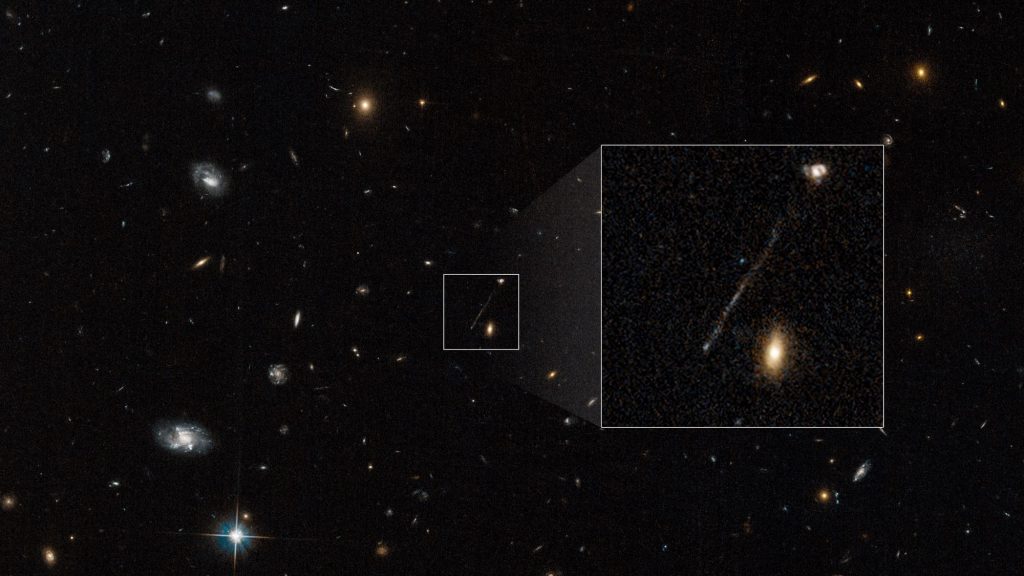 A trail of young stars that trails behind a black hole. Image: NASA, ESA, Pieter van Dokkum (Yale); Image Processing: Joseph DePasquale (STScI)
Astrophysicists accidentally discovered unusualformation on one of the archival images of the Hubble telescope. Initially, they took it for an artifact (unintentional distortion) that accidentally fell into the photo. But additional spectroscopic observations at the Keck Observatory in Hawaii showed that the bright band in the image is a string of young blue stars 200,000 light-years long.
The black hole is at one end of the column,which extends to the parent galaxy. At the farthest end of the stream, a surprisingly bright bunch of ionized oxygen is visible. The researchers believe that the gas is likely to heat up as the black hole crashes into it.
A trail of young stars trailing behind a black hole. Video: NASA's Goddard Space Flight Center, Paul Morris
Researchers believe that this intergalacticthe explosion is the result of multiple collisions of supermassive black holes. About 50 million years ago, the merger of the first two galaxies took place, as a result of which the supermassive black holes at their centers began to rotate as a binary system.
Then another galaxy appeared with itsown supermassive black hole. This merger upset the equilibrium of the system. As a result, one of the black holes, under the influence of the other two, was ejected from the galaxy, and the binary black holes scattered in the opposite direction.
This hypothesis is confirmed by the fact thatvisible at the opposite end of the galaxy from the star trail. It could be a runaway binary black hole. Indirect evidence of this is also the fact that there are no signs of an active black hole left in the core of the galaxy. The researchers will make additional observations of the system using the James Webb Telescope and the Chandra X-ray Observatory.
Read more:
A red halo flared up over Italy. Now its nature has been explained
Named a way to reduce appetite without surgery
Chia seed experiment confirms Alan Turing's famous mathematical model
On the cover: an artistic illustration of the "contrail" of a black hole. Image: NASA, ESA, Leah Hustak (STScI)