The Hubble Space Telescope has revealed a detailed image of the spiral galaxy Z 229-15. She
The image shows two almost straight sleeves,coming from the left and right of the core, which meet with the ring of stars at the edge of the galaxy. The outer region of the galaxy glows bluish, while the core is golden and shiny.
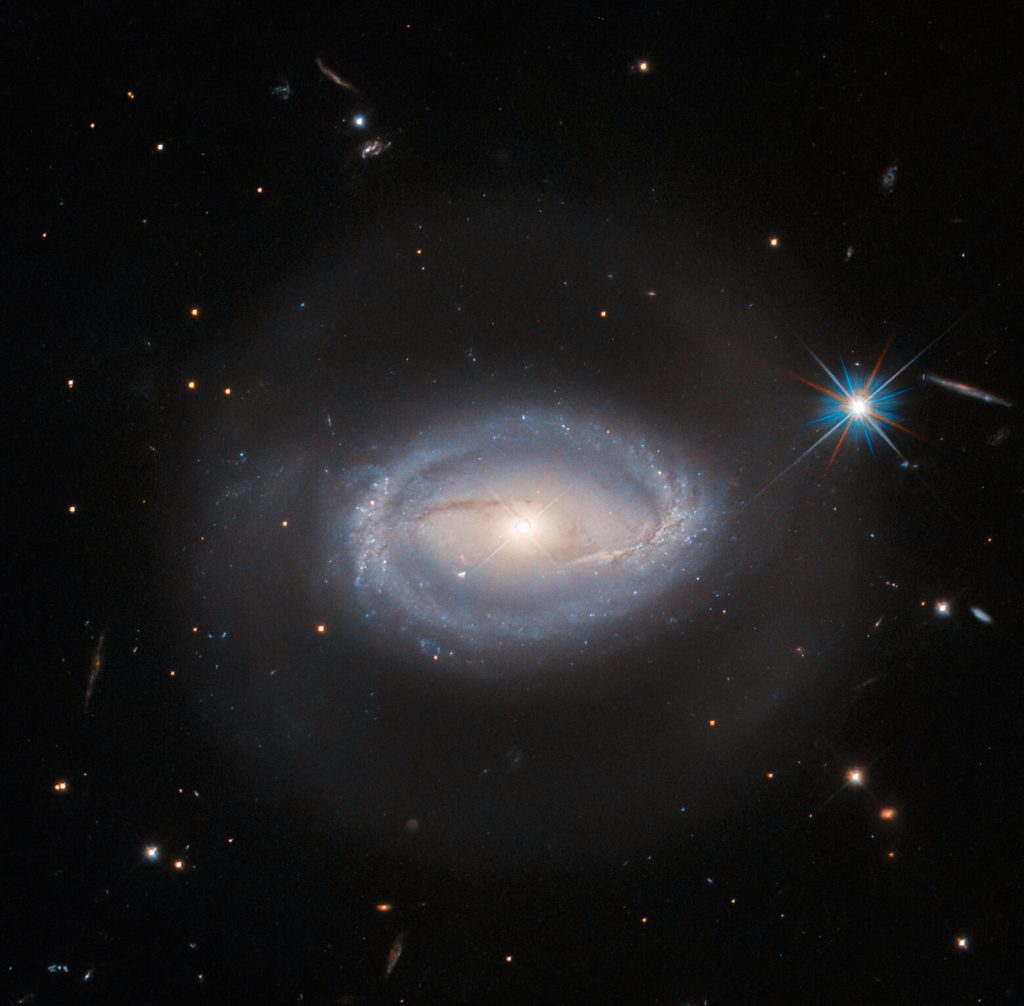 Galaxy Z 229-15. Image: ESA/Hubble & NASA, A. Barth, R. Mushotzky
There is a bright region in the center of the galaxy,which shines brighter than individual stars could shine. This region is called the active nucleus of the galaxy. The extra brightness is due to the presence of a supermassive black hole. Material that moves toward the black hole does not fall directly into it, but is instead pulled into the rotating accretion disk. This disk gets so hot that it releases large amounts of energy in the electromagnetic spectrum, which is why active nuclei appear so bright.
Z 229-15 belongs to a rare type of Seyfertgalaxies that have an extremely bright active nucleus. Most often, such structures are found only in distant quasars located billions of light years from Earth. Seyfert galaxies are distinguished by the fact that, due to their proximity to the observer, despite the brightness of the core, the rest of the structure can still be seen in them. Astrophysicists are studying such galaxies to better understand the nature of quasars.
Read more:
The key theory of quantum physics has finally been proven. Main
NASA helicopter showed sunset on Mars. It doesn't look like earth.
'Legendary' cat-fox that lives on an island in Europe may become a new subspecies