The Hubble Space Telescope captured an image of the dense molecular cloud CB 130-3, a compact cluster
Dense molecular clouds or star cradles- these are regions in interstellar space in which the concentration of dust and gas significantly exceeds the average density of the interstellar medium. Enough mass can accumulate in such structures to cause a gravitational collapse and trigger the nuclear fusion that marks the birth of a new star.
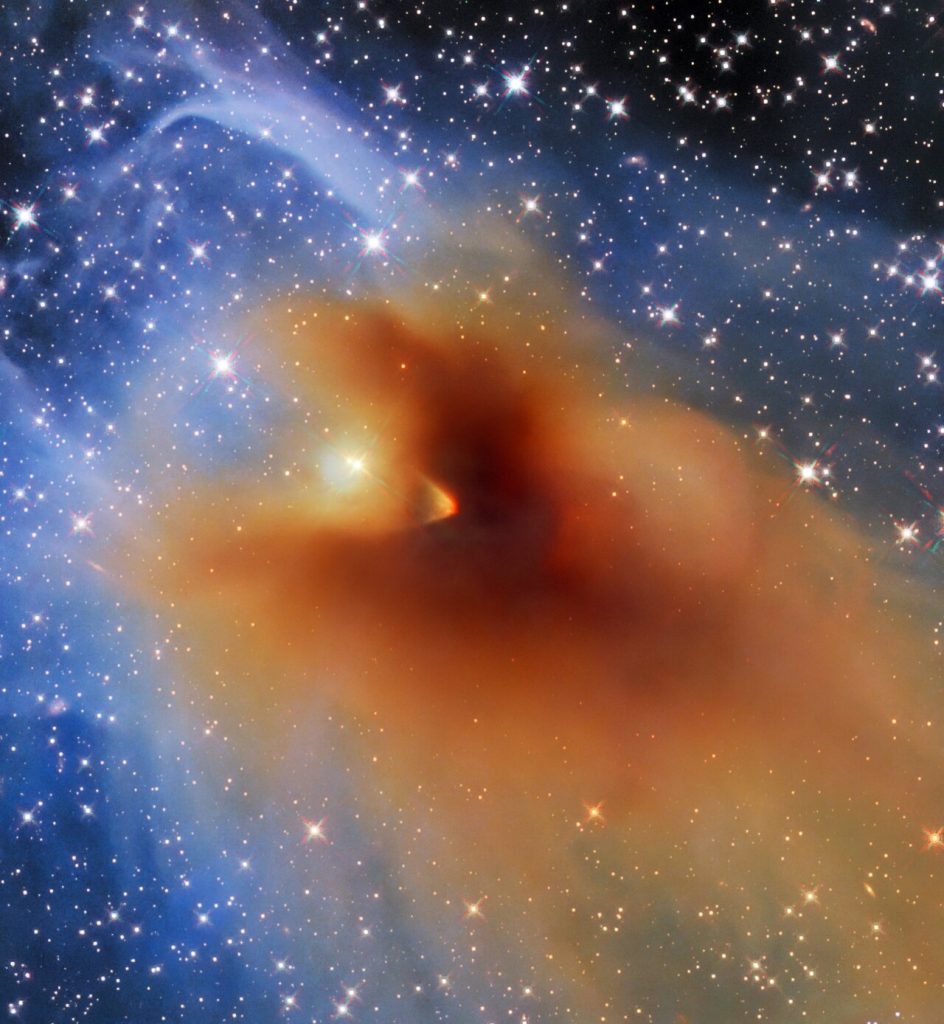 Molecular cloud CB 130-3. Image: ESA/Hubble, NASA & STScI, C. Britt, T. Huard, A. Pagan
The image shows a bright orange objectirregularly shaped, composed of dense gas and dust, which appears darker and more compact in the center. This dense cloud, named CB 130-3, is outlined by thinner gas and dust in lighter shades of blue. In the background you can see many bright stars on a black background.
Although the CB 130-3 is more like a sparsea dusty "ghost" that soared into the sky and covered the distant stars. Despite this, deep inside the dense part of the cloud is a compact object, teetering on the verge of becoming a star.
Molecular cloud CB 130-3. Video: ESA/Hubble, NASA & STScI, C. Britt, T. Huard
The researchers used a wide-angle cameraHubble to better understand the environment surrounding the young star. The researchers note that the density of the molecular cloud around it is not constant. In the central part, it reaches extremely high values: dust and gas completely block the background light. At the same time, only sparse threads are visible along the edges.
The gas and dust that make up CB 130-3 do not affectonly on the brightness, but also on the apparent color of the background stars, with the stars closer to the center of the cloud appearing redder than their counterparts on the outskirts of this image. By studying the change in the emission spectrum of distant stars, astrophysicists investigate the internal structure and density of the star-forming region.
Read more:
A magnetic storm is about to hit Earth
Created a navigation system that is more accurate than GPS
An ancient amulet rewrote the history of Europe's most mysterious language