New image reveals the structure of the brilliant spiral galaxy NGC 1961, located 180 million away
Galaxies with an active nucleus have a very bright center,formed by a supermassive black hole. It attracts material from its surroundings and emits massive amounts of radiation in the form of bright jets and winds that feed the active core of the galaxy. Due to the active galactic nucleus, such galaxies are quite difficult to see: it overshadows most of the image.
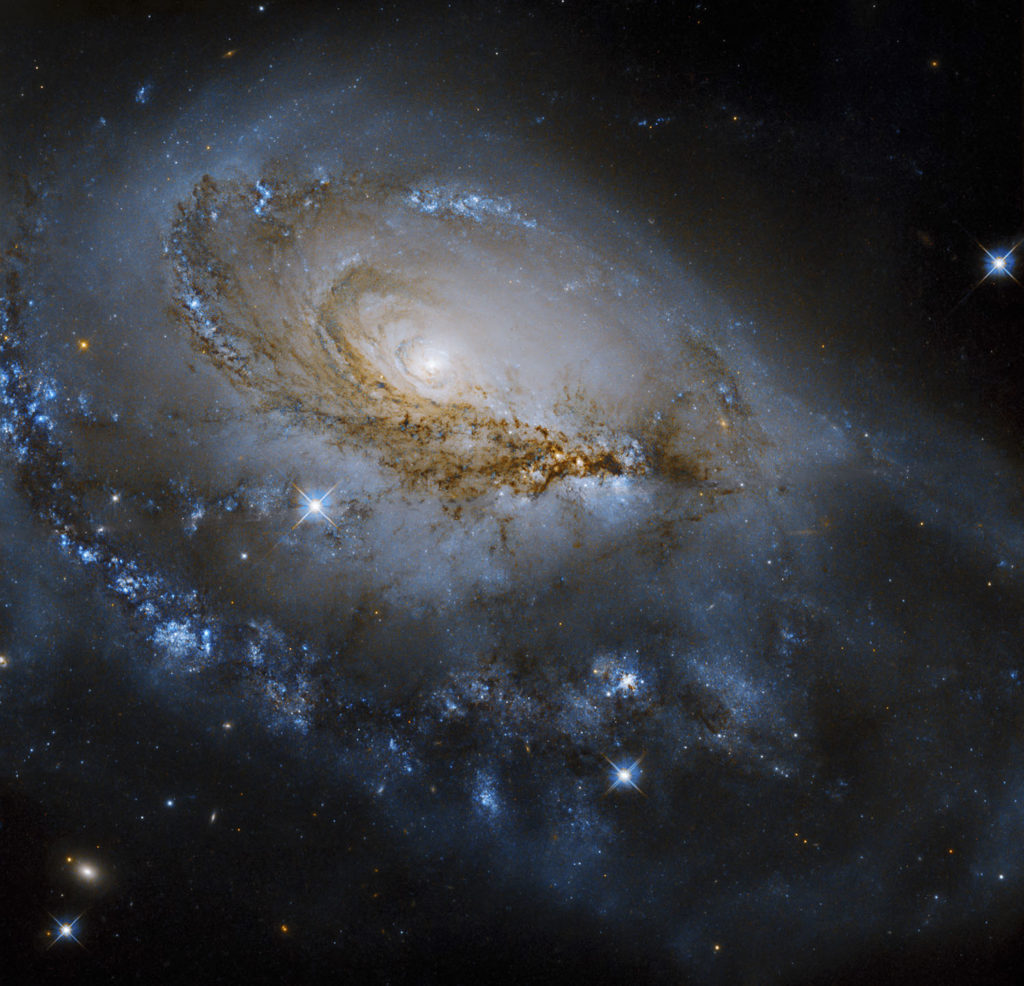 Spiral galaxy NGC 1961.Image: NASA, ESA, J. Dalcanton (University of Washington), R. Foley (University of California — Santa Cruz), G. Kober (NASA Goddard/Catholic University of America)
Technical capabilities of the Hubble telescopeovercome this limitation and allow you to look inside. In the image, you can see a scattering of young stars shining with blue light. NASA notes that the active galactic nucleus NGC 1961 belongs to a fairly common type. It emits low-energy charged particles.
NGC 1961 does not have a clearly defined centrala rod-like structure that acts like a funnel to draw matter into the nucleus from the surrounding accretion disk. Scientists have classified this galaxy as an intermediate galaxy, occupying a place between barred and unbarred spiral galaxies.
Read more:
Scientists have come close to unraveling the secrets of the pyramids: how ancient people were able to build them
The mechanism of maintaining liver health in old age is revealed
Physicists explain Hawking's 'cosmic mismatch': how it will change science