The Hubble Space Telescope has captured a new photograph of the Carina Nebula, officially known as NGC 3372. This
NGC 3372 - emission nebula; intensivethe radiation from its stars ionizes the gas and causes it to glow. Starbursts are observed here, which occur simultaneously with the death of stars. As stars form and produce ultraviolet radiation, their winds scatter gas and dust around them.
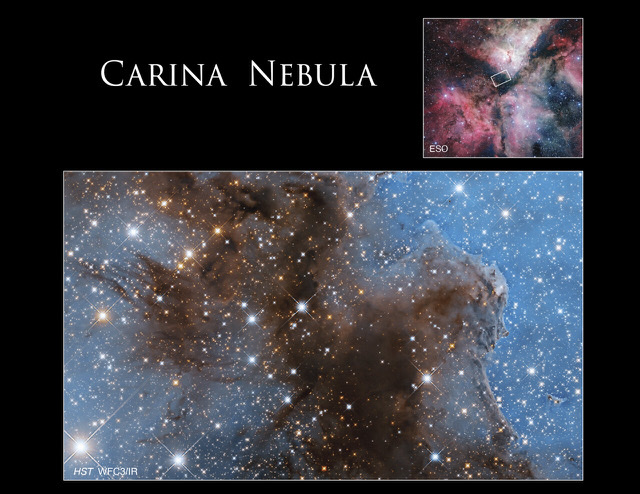 The Carina Nebula is a huge stellar nurseryabout 7500 light years from Earth. The inset in the upper left represents the region of the Carina Nebula observed by Hubble in the new image. Image Credit & Copyright: NASA, ESA, A. Kraus (University of Texas at Austin) and ESO
Processing: Gladys Kober (NASA/Catholic University of America)
To make this image of the nebula, scientistsused the capabilities of Hubble's infrared radiation, which detects longer wavelengths of light that are not scattered by heavy dust and gas. The new photo shows only a small patch of the nebula, which is located near the center in an area with more rarefied gas.
Read more:
Does science exist in extreme conditions? We answer in numbers
Scientists have found out who benefited from the death of dinosaurs
Look at the photo of the Earth from space: it was made by the first private module
Cover: Hubble Image Credit & Copyright: NASA, ESA, and A. Kraus (University of Texas at Austin)
Processing: Gladys Kober (NASA/Catholic University of America)