Hubble has revealed a new image of a pair of galaxies, IC 4271, that appear to be “crashing” into each other. This object
Seyfert galaxies are named after the astronomerCarl K. Seifert, who in 1943 published a paper on spiral galaxies with very bright emission lines. Today it is known that about 10% of all galaxies may be Seyfert objects. They belong to the class of "active galaxies" - that is, those whose centers have supermassive black holes accreting material that emits huge amounts of radiation.
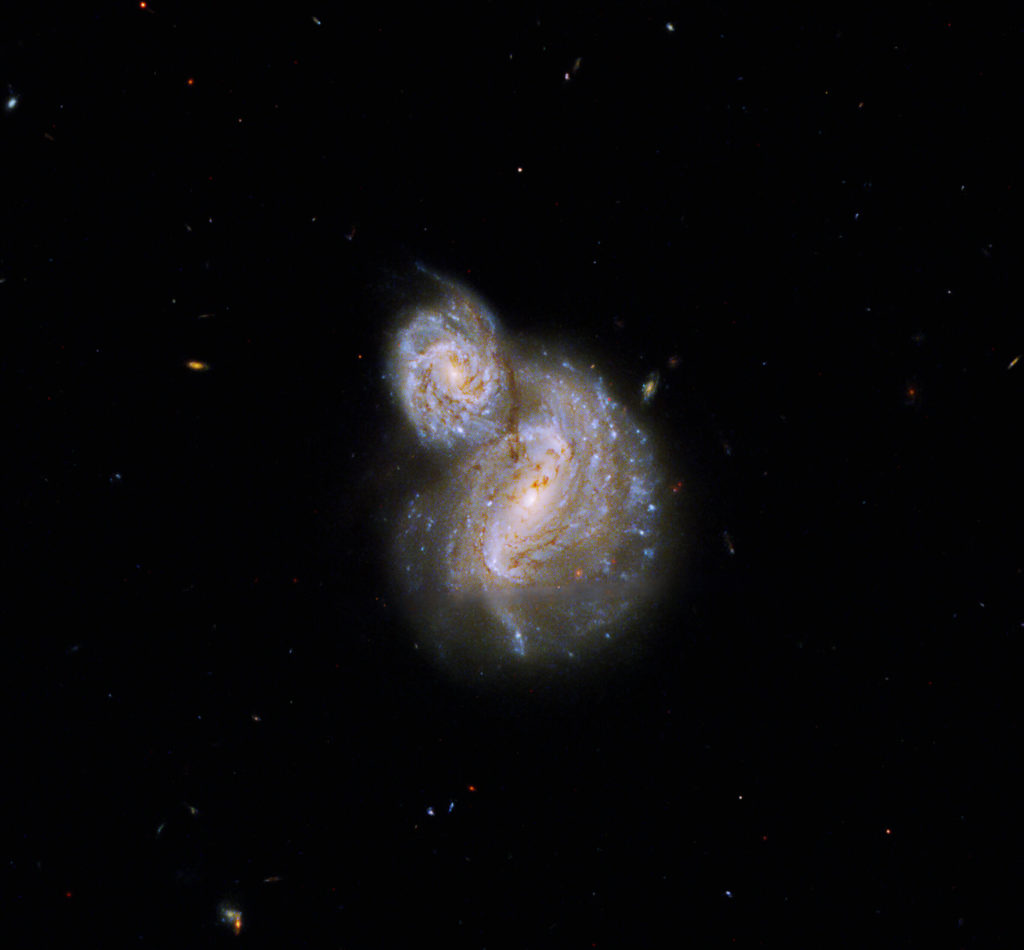 Credit: NASA, ESA and B. Holwerda (University of Louisville Research Foundation, Inc.);
Image Processing: G. Kober (NASA Goddard/Catholic University of America)
The active nuclei of Seyfert galaxies are the mostbright when observed in light beyond the visible spectrum. The larger galaxy in this pair is a type II Seyfert galaxy. This means that it is a very bright source of infrared and visible light.
The image uses data collected duringHubble observations. They were conducted to study the role of dust in shaping the energy distribution of low-mass disk galaxies. The wide range of light to which Hubble's Wide Field Camera 3 is sensitive, along with its resolution, allowed researchers to map the galaxy's dust disk in the foreground in exquisite detail in ultraviolet, visible and infrared light.
The photograph is dominated by visible and infraredwaves of light. The violet color in the image is responsible for ultraviolet light, and the red color is for near-infrared light. The remaining colors are mostly visible light.
Read more
The “fifth force” creates invisible “walls” in the universe. The main thing about the new theory of physicists
You have never seen the Sun so close. Solar Orbiter video published
Compare how the lunar eclipse was filmed by NASA and Roscosmos