Scientists looked at the Hubble data and found that a space telecop had captured the supernova for a period of time.
In general, scientists expected to detect transients,missed in past searches. They were very surprised to find several images of the supernova. “The images of a rapidly developing supernova were completely unexpected,” Wenlei Chen, a researcher at the University of Minnesota and leader of the study, told IE.
A rapidly developing supernova was incluster of galaxies Abell 370 at a distance of almost 5 million light years. Hubble photographed it back in December 2010. Scientists were going to observe faint optical transients in the archived telescope data, but found three images of a supernova obtained using gravitational lensing.
Gravitational lensing - deflectionelectromagnetic radiation of a distant object under the influence of the gravity of another massive object. For example, this is the distortion of the light of a distant galaxy by a black hole or a cluster of galaxies, like an ordinary lens.
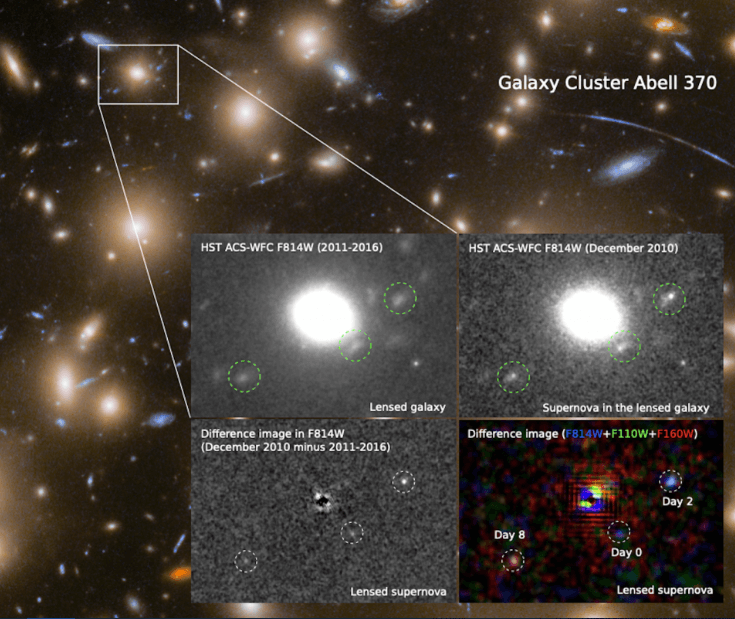 Photo: NASA, ESA, STScI, Wenlei Chen (UMN), Patrick Kelly (UMN), Hubble Frontier Fields
Three images taken with"cosmic lens", showing the early phases of a supernova at different stages. The first photo shows the supernova just six hours after the explosion. Based on their redshift calculations, the scientists hypothesized that the star is about 11.5 billion years old.
Redshift is a phenomenon in which the lengththe wavelength of electromagnetic radiation for the observer increases relative to the wavelength of the radiation emitted by the source. In simple terms, it is a measure of the expansion rate of the universe.
Read more:
Named the consequences of the last solar storm that hit the Earth
A massive impact from a space object triggered the Earth's magnetic field
A huge tunnel under the Egyptian temple “hidden” mysterious artifacts
Cover: supernova illustration by Robert Sullivan