The European Space Agency has publishedImage of the galaxy SGAS J143845+145407 taken by the Hubble Space Telescope. Gravitational lensing has resulted in a mirror image of the galaxy at the center of the image, creating a spectacular centerpiece in the image.
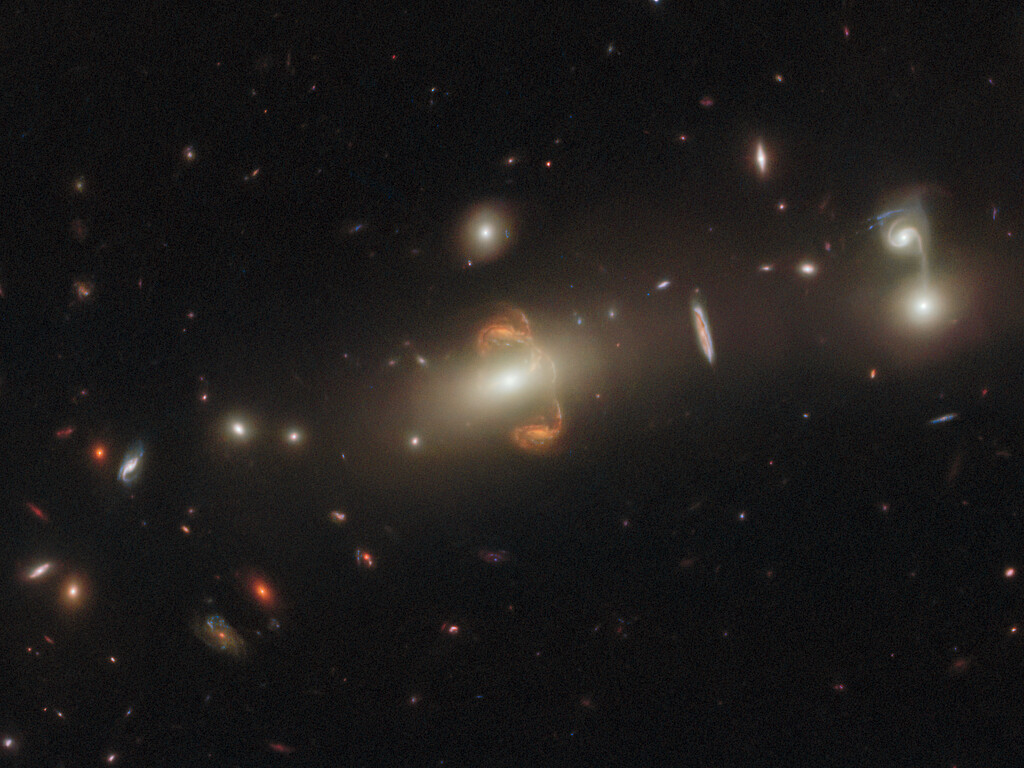 Image of the galaxy SGAS J143845+145407. Photo: ESA/Hubble & NASA, J. Rigby
There's a bright light at the center of the new Hubble image,emanating from SGAS J143845+145407, appears as an arc or ring around an object located between a distant galaxy and a space telescope. The image also shows several other galaxies and celestial objects scattered throughout space.
Gravitational lensing is a direct consequenceAlbert Einstein's general theory of relativity. Massive bodies bend space-time by changing the movement of light that passes near them. This effect is especially noticeable on massive objects, such as, for example, clusters of galaxies. Such objects act as a lens, and the distorted background object is called a "lensed" object.
Video: NASA & ESA
Researchers from the European Spaceagencies note that the Hubble telescope is very well suited to search for gravitational lenses. The space telescope's ultra-sensitive instruments and crystal-clear mirrors allow it to see faint and distant gravitational lenses that ground-based telescopes cannot detect due to the blurry effect of the earth's atmosphere.
Researchers are using this featuretelescope for studying the galaxies of the early Universe. The gravitational lens not only distorts the image, as in the published image. Like a real optical device, it allows you to see the details of distant objects, the light from which has been bent by the lens.
Previously, Hi-Tech talked about how astrophysicists used the effect of gravitational lensing to explore the dark matter of the early Universe.
Read more:
Scientists filmed a strange creature with tentacles, which they mistook for a flower
On the moon, they found a place where the temperature is always comfortable for humans
AI has appeared that monitors processes and proposes new laws of physics