Scientists have noted small annual changes in Saturn's color bands. As the planet moves towards
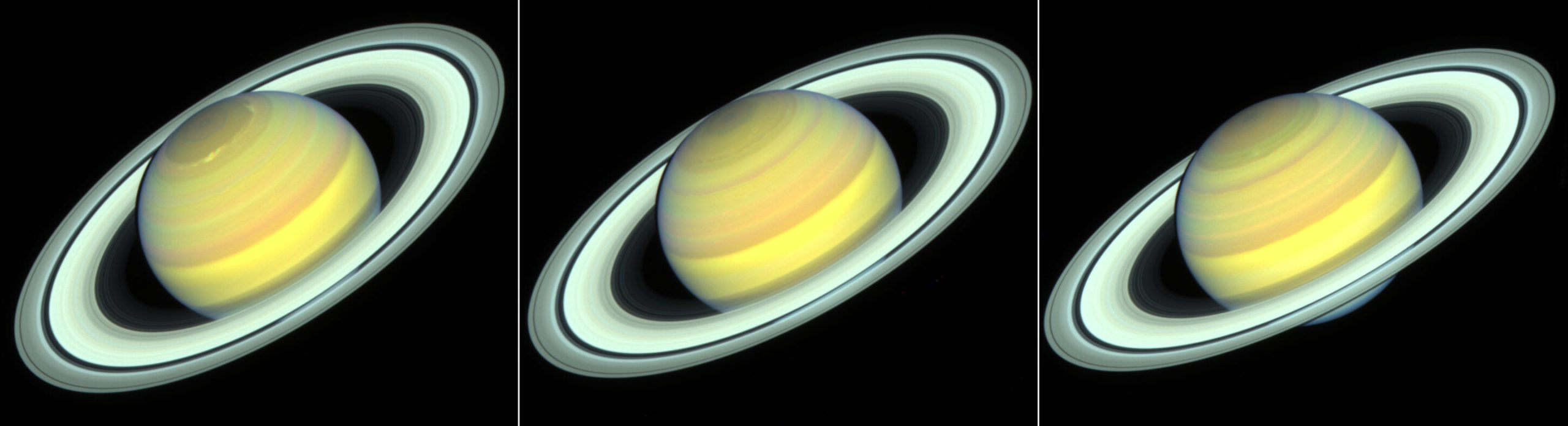 Space telescope images of SaturnHubble in 2018, 2019 and 2020, when summer in the northern hemisphere of the planet turns into autumn. Credit: NASA Goddard Space Flight Center.
Slight color change from year to year,possibly related to the height of clouds and winds. Unsurprisingly, the changes are not huge, since only a small fraction of the year of Saturn is available for observation, the study authors note.
Hubble telescope data show that from 2018 toIn 2020, the equator has become 5-10% brighter, and the winds have changed slightly. In 2018, the wind speed measured near the equator was around 1,600 kilometers per hour. These wind figures are higher than those measured by NASA's Cassini spacecraft in 2004-2009. Then the wind speed was about 1300 kilometers per hour. In 2019 and 2020, they returned to their previous indicators. Saturn's winds also change with altitude. The change in their velocities could mean that the clouds in 2018 were about 60 kilometers deeper than those measured during the Cassini mission. Further observations are needed to understand what is happening, NASA said.
Saturn is the sixth planet in the solar systemand orbits at a distance of about 1.4 billion km from the star. It takes about 29 Earth years for the planet to orbit around it. As a result, each season on Saturn lasts more than seven Earth years. The Earth is tilted in relation to the Sun, which changes the amount of sunlight each hemisphere receives as the planet moves through its orbit. These fluctuations in solar energy are the driving force behind our seasonal changes. Saturn is also tilted, so as the seasons change on this distant world, changing sunlight causes some of the observed atmospheric changes.
Like Jupiter, the largest planet in the solarsystem, Saturn is a gas giant composed primarily of hydrogen and helium, although it may have a rocky core deep inside. Enormous storms, some as large as the Earth, occasionally erupt from deep within the atmosphere. Because many planets discovered around other stars are also gas giants, astronomers are eager to learn more about how gas giant atmospheres work.
Read more
Oxygen will definitely disappear: what will happen to the Earth without the main source of life
Solar energy made liquid fuel in China
Physicists have created an analogue of a black hole and confirmed Hawking's theory. Where it leads?