The Hubble Telescope photographed the spiral galaxy NGC 5486, located 110 million light years from Earth. IN
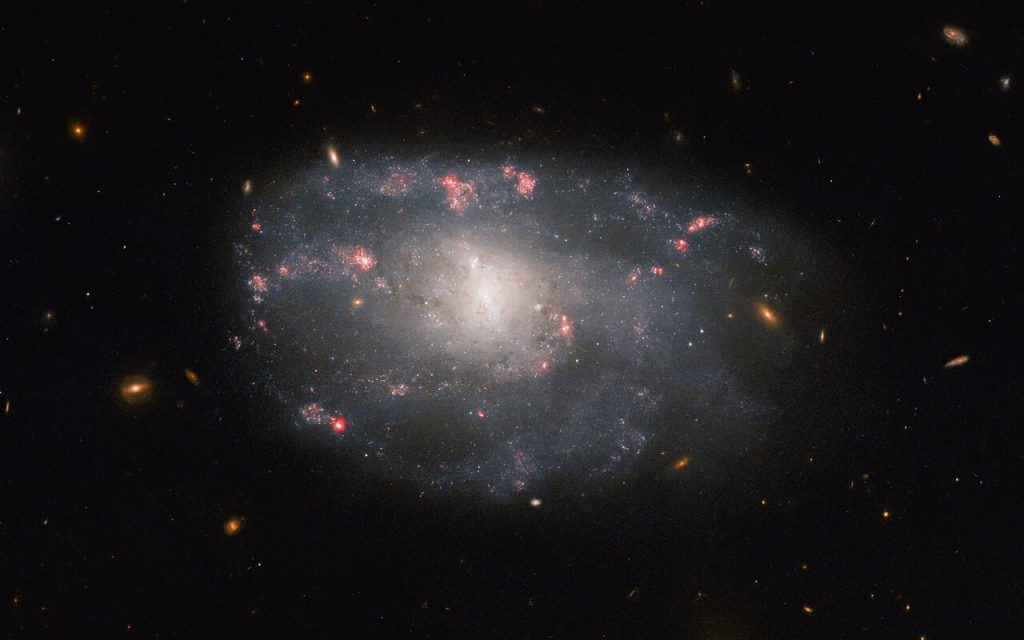 Galaxy NGC 5486. Image: ESA/Hubble & NASA, C. Kilpatrick
The galaxy NGC 5486 is located in the constellationUrsa Major and was discovered back in the 18th century by the English astronomer William Herschel. The new Hubble observation is part of a large-scale study of the aftermath of Type II supernova explosions.
A supernova explosion occurred in NGC 5486 in 2004. The researchers intend to study how a powerful explosion that threw a large amount of energy into space influenced the evolution of the galaxy.
Type II supernovae occur when a largea star with several times the mass of the sun is running out of nuclear fuel. As a result of the rapid compression (gravitational collapse) and subsequent powerful explosion of a massive star, its luminosity increases sharply. Such events are essential for the production of most of the heavy chemical elements in the Universe. Observations of the consequences of explosions allow us to better study the evolution of stars and galaxies.
Read more:
Named a vitamin that protects the brain from dementia
See how the Earth has changed over 100 million years on the most detailed map
It turned out which men are the most fertile: their sperm is 50% better than the rest