What are the hurricanes?
Hurricanes are tropical cyclones. When the wind speed in them reaches speeds from 63
The Saffir-Simpson Hurricane Scale (SSHWS), or the Saffir-Simpson Hurricane Scale (SSHS), classifies hurricanes into five categories that differ in the intensity of their sustained winds.
Saffir - Simpson Hurricane Wind Scalebased on maximum wind speed averaged over a 1-minute interval of 10 m above the surface. Although the scale shows wind speeds over a continuous range of speeds, the National Hurricane Center Central Pacific Hurricane Center indicates the intensity of tropical cyclones in 5-knot increments, such as 100, 105, 100, 115 knots, and so on. Due to the inherent uncertainty in assessing the strength of tropical cyclones. The wind speed in knots is then converted to other units and rounded to the nearest 5 km / h.
- Category 1: from 119 to 153 km / h
Category 1 hurricanes usually do not causesignificant structural damage to most well-constructed permanent structures; however, they can topple loose mobile homes and uproot or break weak trees. Poorly attached shingles can break off. Coastal flooding and pier damage are often associated with Category 1 storms.
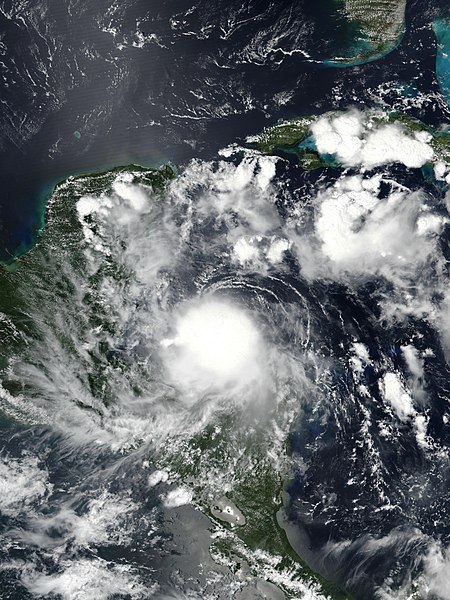 Nana in 2020 is approaching Belize
- Category 2: 154 to 177 km / h
Category 2 storms often damage roofingmaterial (sometimes exposing the roof) and wreaking havoc on poorly constructed doors and windows. Poorly anchored signs and supports can suffer significant damage, and many trees are uprooted or broken.
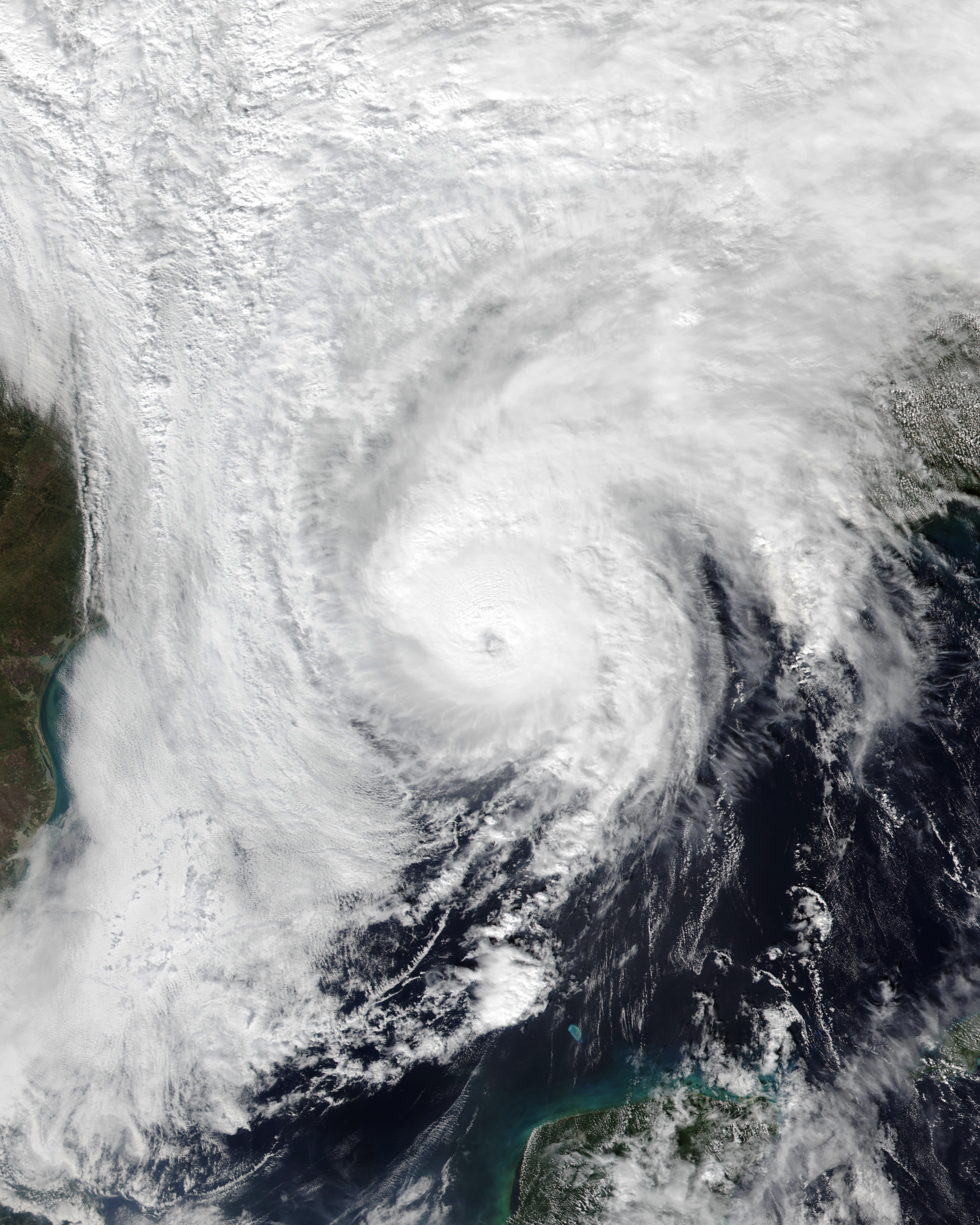 Zeta in 2020 approaches Louisiana
- Category 3: from 178 to 208 km / h
Tropical cyclones of category 3 and above,described as major hurricanes in the Atlantic or East Pacific Basin. These hurricanes can cause some structural damage to small homes and outbuildings, especially timber frames or industrial materials with minor damage to curtain walls.
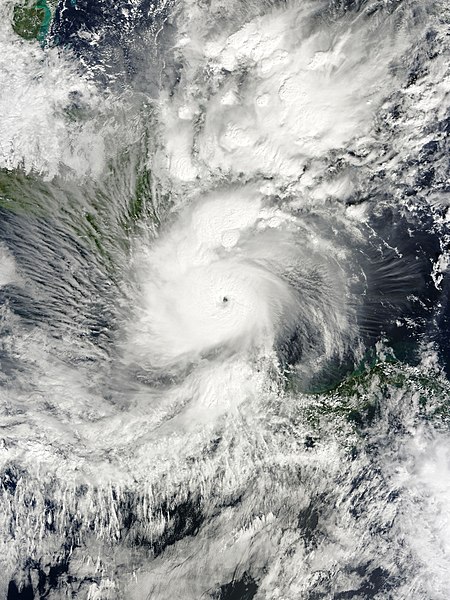 Otto in 2016 at the landfall in Nicaragua.
- Category 4: 209 to 251 km / h
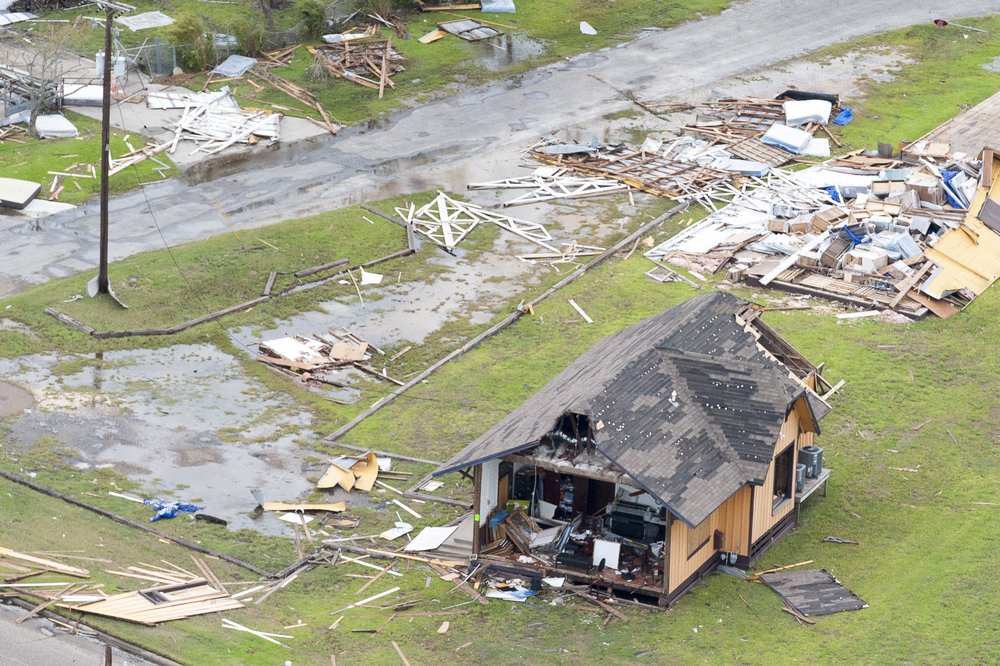
Category 4 hurricanes typically result inmore extensive deterioration of curtain walls with some total collapse of structures in smaller homes. Severe, irreparable damage and almost complete destruction of petrol station canopies and other structures with a wide span are common.
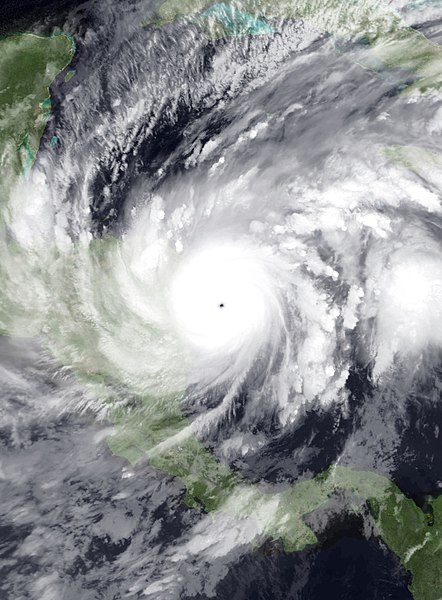 Eta in 2020 is approaching the coast in Nicaragua.
- Category 5: from 252 km / h or higher
Category 5 - the highest category of the hurricane scalewinds of Saffir - Simpson. These hurricanes lead to the complete destruction of the roofs of many residential and industrial buildings, as well as to the complete destruction of some buildings when small outbuildings are blown away by the wind or carried away by the wind. The collapse of many wide-span roofs and walls, especially those without internal supports, is common.
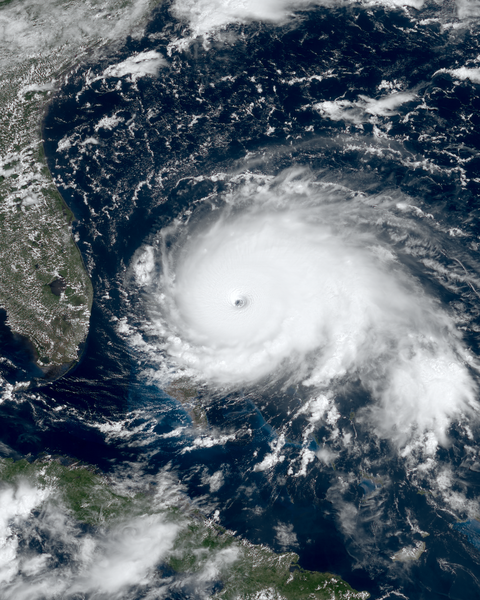 Dorian is approaching the coast of the Bahamas in 2019.
Named hurricanes
If the wind speed of a tropical storm exceeds60 kilometers per hour, then it is assigned a personal name. This is done in order not to confuse hurricanes, especially when several tropical storms operate simultaneously in the same region. Also, the assigned names are easier to remember, which prevents confusion in news, weather forecasts and storm warnings. Especially strong and destructive hurricanes (such as Katrina and Irma) go down in history.
Several named hurricanes have already occurred in 2021:
- Tropical Storm Ana: observed on May 22, northeast of Bermuda.
- Tropical Storm Bill: observed June 14, southeast of Halifax, Nova Scotia.
- Tropical Storm Claudette: observed on June 17, along the Gulf Coast.
- Tropical Storm Danny: Made landfall north of Hilton Head on Prichards Island, South Carolina, on June 28.
- Hurricane Elsa: observed on July 2nd in the Eastern Caribbean as a Category 1 hurricane.
How do hurricanes appear?
In the Far East and Southeast Asiatropical cyclones are called typhoons, and in the Americas, hurricanes, after the Mayan god of the wind, Huracan. It is generally accepted, according to the Beaufort scale, that a storm turns into a hurricane when the wind speed is over 117 km / h (or 30 m / s).
The tropical cyclone itself occurs overwarm sea surface and is accompanied by powerful thunderstorms, showers and stormy winds. Tropical cyclones receive energy from the rise of moist air upward, the condensation of water vapor in the form of rain and the descent of drier air, which is obtained in this process, downward. This mechanism is fundamentally different from the mechanism of extratropical and polar cyclones, in contrast to which tropical cyclones are classified as “cyclones with a warm core.”
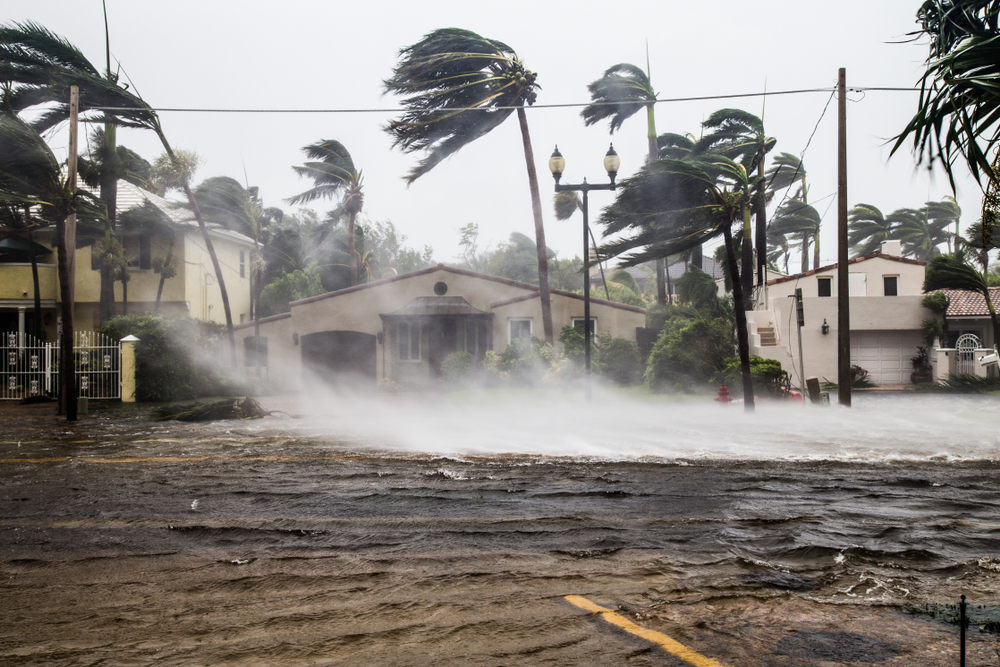
The term "tropical" means both geographicalthe area where in the overwhelming majority of cases such cyclones occur, that is, tropical latitudes, and the formation of these cyclones in tropical air masses.
Tropical cyclones carry large amounts ofenergy from tropical latitudes towards temperate latitudes, which makes them an important component of global atmospheric circulation processes. Thanks to them, the difference in temperature on different parts of the Earth's surface is reduced, which allows the existence of a more moderate climate on the entire surface of the planet.
Many tropical cyclones form whenfavorable conditions from weak atmospheric disturbances, the occurrence of which is influenced by such effects as the Madden-Julian oscillation, El Niño and the North Atlantic oscillation. Other cyclones, in particular subtropical ones, are capable of acquiring the characteristics of tropical cyclones as they develop. Once formed, tropical cyclones move under the influence of prevailing winds; If conditions remain favorable, the cyclone gains strength and forms a characteristic vortex structure with an eye in the center. If conditions are unfavorable or if the cyclone moves inland, it will dissipate quite quickly.
Hurricane season 2021
Atlantic hurricane season officially beginsJune 1 and lasts until November 30. In the East Pacific, hurricane season starts on May 15 and ends on November 30, according to the National Weather Service. However, according to the National Weather Service's Climate Prediction Center, most of these storms occur during the peak hurricane season from August to October on both coasts.
It is expected that this year, following in the footstepsrecord-breaking 2020 hurricane season will be impressive as the US National Oceanic and Atmospheric Administration (NOAA) predicts above-average storm activity. In late May, the department said there was a 70 percent chance there would be a total of 13 to 20 named storms this season. Six to 10 of them are expected to reach hurricane status, with up to five of them strengthening into major hurricanes, meaning they will have winds of at least 179 km/h. As experts note, this could lead to disasters.
When making forecasts, scientists analyzemany factors, from wind speed to sea surface temperature. Because the El Niño cycle typically materializes in the summer or early fall, forecasts that are too early are of limited value.
Climate Prediction Center classifiesover-normal hurricane seasons (12 to 28 tropical storms and 7 to 15 hurricanes); nearly normal (10 to 15 tropical storms and four to nine hurricanes) and below normal (four to nine tropical storms and two to four hurricanes).
Are hurricanes getting stronger?
Yes.On average, the world is experiencing stronger tropical cyclones more frequently than in past decades. According to an analysis of 4,000 tropical cyclones from 1979 to 2017, researchers concluded that due to global warming, storms are not only getting stronger, but also happening much more often. In another study, scientists found that compared to six decades ago, hurricanes hitting Bermuda are twice as strong, reports the journal Environmental Research Letters.
Where do hurricanes hit most often?
According to HurricaneCity, a hurricane tracking website, here are the 10 cities most frequently hit or hit by hurricanes since accounting began in 1871:
- Cape Hatteras, North Carolina: every 1.34 years (110 hurricanes since 1871)
- Morehead City, North Carolina: every 1.52 years.
- Grand Bahamas Island, Bahamas: every 1.63 years.
- Wilmington, North Carolina: every 1.69 years.
- Cayman Islands (worst-affected area in the Caribbean): every 1.73 years.
- Great Abaco Island, Bahamas: every 1.81 years.
- Andros Island, Bahamas: every 1.84 years.
- Bermuda: every 1.86 years.
- Savannah, Georgia: every 1.91 years.
- Miami, Florida: every 1.96 years (75 times since 1871)
Read more
Explained how the universe is reflected near black holes
Mass poisoning and new versions of the death of civilization: how our knowledge about the Maya changed
UAE tests artificial precipitation technology in 50-degree heat