Geneticists from the Delft University of Technology “transplanted” sections of human DNA into yeast DNA
The Function Scientists Have Added to Yeastcells, vital for the functioning of the human body. It controls the metabolic pathway, the process during which sugar is broken down and the energy released is used to create cellular building blocks within muscle cells.
In their work, scientists replaced the genes thatcontrol metabolism in baker's yeast cells, to similar parts of the human chromosome. Experiments showed that the modified fungi retained their viability. In addition, the altered sections of DNA continued to work, express proteins and control cell metabolism. The properties of the human enzymes produced by yeast and their human cells were strikingly similar.
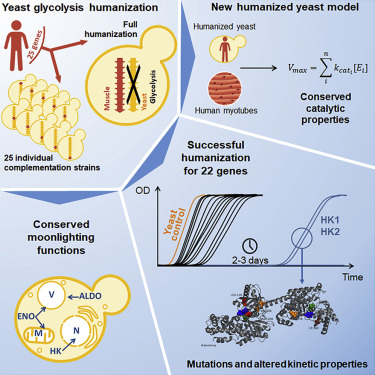 Scheme of the experiment.25 human genes responsible for the functioning of metabolism in muscle cells were transplanted into yeast. 22 of them successfully adapted and retained their functions. Image: Francine J. Boonekamp et al., Cell Reports
The authors note that, despitesignificant differences, there are many similarities between yeast and humans. Because of this, scientists often transplant individual genes into yeast to study their functions. But this work is the first example of a “transplantation” of a complex function that has retained its performance.
In a pure environment of yeast cells, one can observehow individual functions of human cells work in isolation from other processes. Since cell metabolism influences the development of many diseases, including cancer, studying it under "ideal" conditions will help doctors better understand the development and spread of the disease.
Now that we understand the whole process, medical scientists can use this "humanized" yeast model as a tool for drug screening and cancer research.
Pascal Daran-Lapuhade, head of research
Cover image: Ella Maru Studio, Pascale Daran-Lapujade
Read more:
“This is science fiction”: scientists create a fundamentally new type of quantum computers
The length of the earth day is increasing. Scientists don't know why
What are supergenes and how do they make animals so weird