An international team of archaeologists reported an unusual find. Researchers who carried out excavations in
Researchers worked on excavations in the areaMelka Kunture, site of Stone Age Paleolithic sites in Ethiopia, when a hand ax was found buried in a layer of sediment. As a result of further excavations, another 578 similar tools were found, and, with the exception of three, all the rest were made of obsidian.
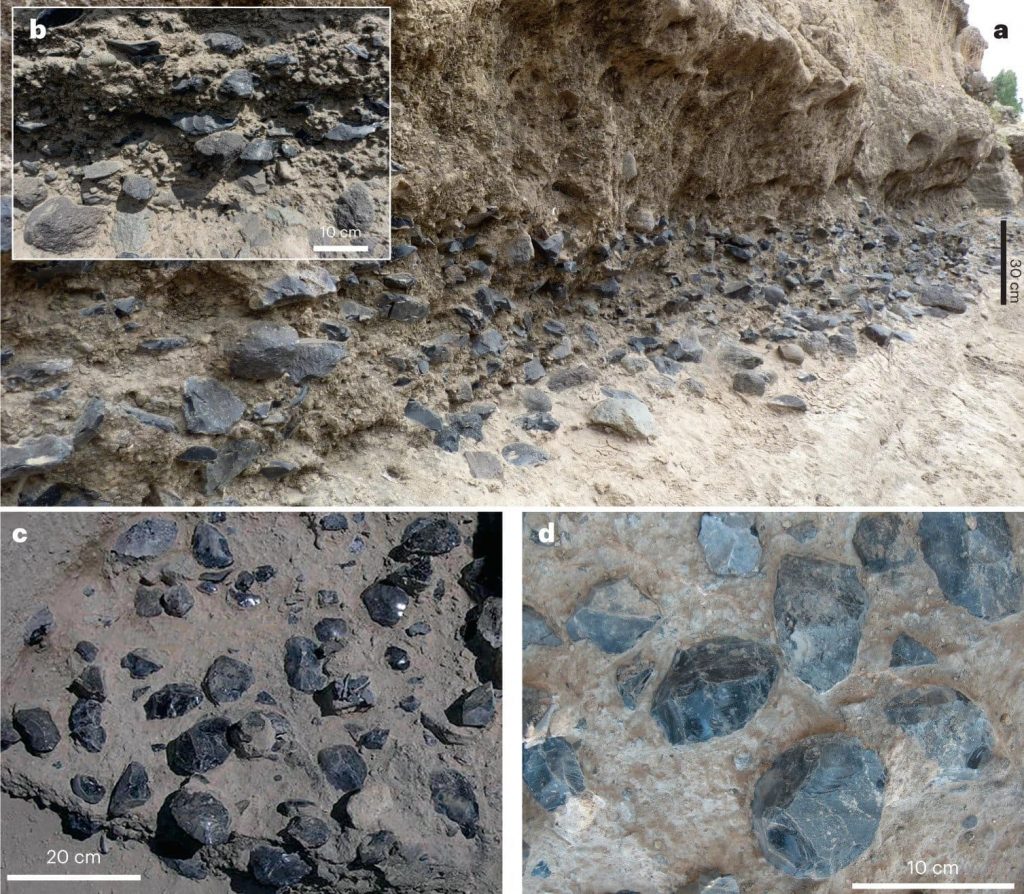 A cluster of obsidian artifacts found during excavations. Image: Margherita Mussi et al., Nature Ecology & Evolution
Analysis of the finds showed that all the axes weremade identically, while the creators achieved maximum accuracy in the “beauty” of the finished product. The study authors note that “the morphological standardization is striking.” Achieving such uniformity requires refined skills and standardized technology.
Obsidian is a brittle stone that needs to be cut withmuch greater dexterity than flint or basalt, scientists add. They believe that the collected data indicates that all the finds, dating back to 1.2 million years ago, were made in one workshop, which was engaged in mass production.
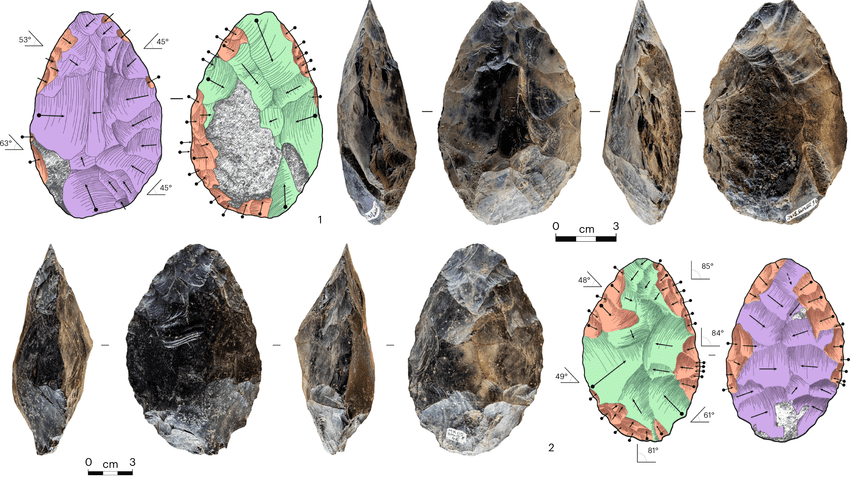 Hand axes made of obsidian. Image: Margherita Mussi et al., Nature Ecology & Evolution
Hand ax or hand ax - one of the first ancientweapons. They were made of stone, which was chipped from the mass in such a way as to form a sharp edge. For the production of such tools, stones were used, and later - obsidian (an igneous rock that forms as a result of the rapid cooling of lava.
Although stone hand axes were common andlogging workshops were previously thought to have appeared during the Middle Pleistocene in Europe, approximately 774,000 to 129,000 years ago. The functioning of a full-fledged in-line production requires more complex cognitive skills. The discovery suggests that ancient members of the Homo species developed the necessary skills much earlier than previously thought.
Read more:
Found a fragment of a mysterious artifact that was used in magical rituals
Real "Terminator-2" turns into a liquid and flows through obstacles
Sword thought to be fake turns out to be a 3,000-year-old Bronze Age artifact
On the cover: obsidian axe. Image: Margherita Mussi