What are gravitational waves?
Gravitational waves are changes in the gravitational field propagating
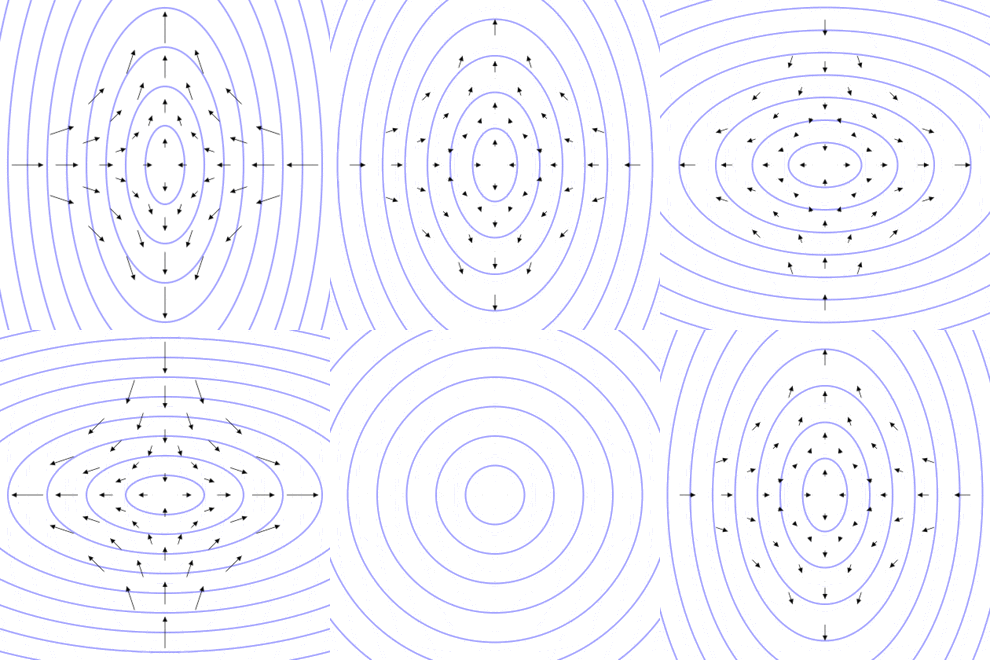 Polarized gravitational wave
In the general theory of relativity, as well as in most other modern ones, it is indicated that gravitational waves arise from Gravitational waves propagate freely through space at the speed of light.They are very small and difficult to register.
Gravitational waves were first detected in September 2015 by two twin detectors at the LIGO observatory, which recorded gravitational waves likely resulting from the merger of two black holesand the formation of one more massive spinning black hole.
Any binary star, as its components rotate around a common center of mass, losesenergy (presumably due to the emission of gravitational waves) and eventually merges into one.But for ordinary, non-compact, binary stars, this process takes a very long time, much longer than the actual age of the universe.
If the double compact system consists ofpairs of neutron stars, black holes, or a combination of both, the merger can occur in a few million years. At first, the objects approach each other, and their orbital period decreases. Then, at the final stage, a collision and asymmetric gravitational collapse occurs. This process lasts a fraction of a second, and during this time energy is released into gravitational radiation, which, according to some estimates, is more than 50% of the system's mass.
How are gravitational waves found?
It is quite difficult to detect gravitational waves due to their weakness. The devices for registering them are gravitational wave detectors. Detection attempts have been made since the late 1960s.
Gravitational waves of detectable amplitudeare born during the collapse of a double pulsar. Similar events occur in the vicinity of our galaxy approximately once a decade. The strongest and most frequent sources of gravitational waves for gravitational telescopes and antennas are catastrophes associated with the collapse of binary systems in nearby galaxies. It is expected that in the near future several similar events per year will be recorded on improved gravitational detectors, distorting the metric in the vicinity of the Earth by 10−21—10−23.
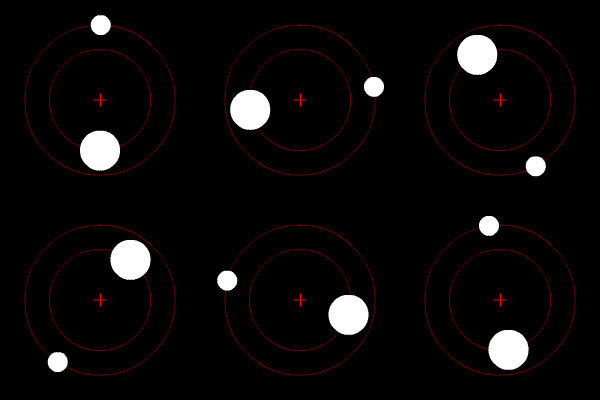 Two bodies moving in circular orbits around a common center of mass
New ways to detect gravitational waves
In 2017, scientists who conducted an experiment underThe Laser Interferometric Gravitational Wave Observatory (LIGO), won the Nobel Prize in Physics for the first-ever direct detection of gravitational waves produced by the merger of two black holes about 1.3 billion light-years from Earth. The waves generated by this collision violated the gravitational-wave background of the Universe and reached the Earth.
In addition to such one-time strong disturbances,which astrophysicists have already learned to fix, there is a so-called background of gravitational waves - a constant flow of gravitational radiation, which, according to the theory, is constantly washing the Earth.
Another opportunity to detect the backgroundof gravitational waves filling the Universe is a high-precision timing of distant pulsars - an analysis of the time of arrival of their pulses, which change in a characteristic way under the action of gravitational waves passing through the space between the Earth and the pulsar.
As of 2013, timing accuracy is estimated to beneeds to be raised by about one order of magnitude to be able to detect background waves from many sources in our Universe, and this task can be solved before the end of the decade. But the passage of a gravitational wave should slightly, by a few nanoseconds, change the time at which these flares are recorded. Thus, by accurately tracking the timing of distant pulsars, it is theoretically possible to detect the gravitational wave background of the galaxy. This is confirmed by preliminary results from the NANOGrav project.
What new gravitational waves have scientists found?
Scientists said they were able to detect signs of constant gravitational radiation that passes through the Universe and distorts the fabric of space-time.
We found a strong signal in our dataset. We can't yet say that these are background gravitational waves, but our target is getting closer.
Joseph Simon, astrophysicist and lead author of the paper
According to the authors, no other observatoryable to detect background gravitational waves, because they are focused on searching for one-time events lasting several seconds. As part of the experiment, scientists have been tracking 45 pulsars over several years - and have already found signs of slight changes in their frequency. Pulsars can be compared to galactic lighthouses that are constantly in the same place.
We are looking for waves that last for years or decades.According to the theory, galactic mergers and other cosmological events cause a constant burst of huge gravitational waves. It takes years or even longer for one such wave to pass by the Earth. For this reason, no other existing experiments can detect them directly.
Joseph Simon, astrophysicist and lead author of the paper
The passing gravity waves changea stable pattern of light emanating from pulsars, increasing or contracting the relative distances that these rays travel through space. In other words, scientists can theoretically detect the background of gravitational waves by tracking correlated changes in the time of arrival of pulsar radiation on Earth.
What are these gravitational waves doing?
Passing gravitational waves changea stable pattern of light emanating from pulsars, increasing or compressing the relative distances these rays travel through space. In other words, scientists could theoretically detect the background of gravitational waves by tracking correlated changes in the arrival times of pulsar radiation on Earth. However, this is not enough for definitive conclusions. Therefore, astronomers have announced plans to create IPTA, a network of instruments that will make it possible to detect such deviations for a large number of pulsars.
Detection of the gravitational wave background will bea big step forward, but only a first step. The next stage will be the discovery of their sources, and then - everything new that they can tell us about the Universe.
Joseph Simon, astrophysicist and lead author of the paper
Read more
Research: humans will not be able to control superintelligent AI machines
Abortion and science: what will happen to the children who will give birth
Check out the most beautiful pictures of Hubble. What has the telescope seen in 30 years?